



 Chat with AI
Exam 18: Extending the Analysis of Aggregate Supply

Exam 1: Limits, Alternatives, and Choices212 Questions
Exam 2: The Market System and the Circular Flow141 Questions
Exam 3: Demand, Supply, and Market Equilibrium202 Questions
Exam 4: Market Failures: Public Goods and Externalities155 Questions
Exam 5: Governments Role and Government Failure148 Questions
Exam 6: An Introduction to Macroeconomics123 Questions
Exam 7: Measuring Domestic Output and National Income157 Questions
Exam 8: Economic Growth114 Questions
Exam 9: Business Cycles, Unemployment, and Inflation143 Questions
Exam 10: Basic Macroeconomic Relationships142 Questions
Exam 11: The Aggregate Expenditures Model143 Questions
Exam 12: Aggregate Demand and Aggregate Supply152 Questions
Exam 13: Fiscal Policy, Deficits, and Debt164 Questions
Exam 14: Money, Banking, and Financial Institutions130 Questions
Exam 15: Money Creation127 Questions
Exam 16: Interest Rates and Monetary Policy174 Questions
Exam 17: Financial Economics136 Questions
Exam 18: Extending the Analysis of Aggregate Supply135 Questions
Exam 19: Current Issues in Macro Theory and Policy134 Questions
Exam 20: International Trade151 Questions
Exam 21: The Balance of Payments, Exchange Rates, and Trade Deficits152 Questions
Exam 22: The Economics of Developing Countries135 Questions
Select questions type


One central idea in supply-side economics concerning budget deficits is illustrated by the:
(Multiple Choice)
4.8/5  (84)
(84) In the context of the Phillips curve, stagflation can only be understood as a rightward shift of the curve.
(True/False)
4.7/5 (89)
(89) Supply-side economists contend that aggregate supply is the relevant policy factor in influencing the price level and real output in an economy.
(True/False)
5.0/5 (81)
(81) One significant criticism of the major proposition of supply-side economics during the period 1980-1988 was that:
(Multiple Choice)
4.9/5 (76)
(76) The Romer and Romer 2010 paper in the American Economic Review found that tax changes that are made to promote long-run growth or to reduce an inherited budget deficit tend to result in:
(Multiple Choice)
4.8/5 (76)
(76) What will occur in the short run if there is cost-push inflation and the government adopts a hands-off approach to it?
(Multiple Choice)
4.9/5 (88)
(88) A senator states: "We need to cut taxes in order to increase incentives to work and produce, so that we can pull the nation out of this economic slump." A mainstream economist who is a critic of this policy would likely reply that:
(Multiple Choice)
4.9/5 (74)
(74) The Laffer Curve indicates that lower tax rates will increase output.
(True/False)
4.7/5 (78)
(78) Based on the Phillips Curve, when the actual rate of inflation is greater than the expected rate, the unemployment rate will:
(Multiple Choice)
4.9/5 (73)
(73) 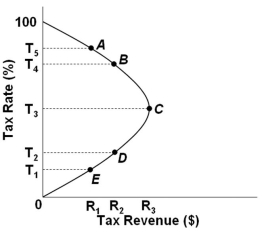 Refer to the Laffer Curve above. An increase in the tax rate from T2 to T3 would:
 (Multiple Choice)
4.8/5 (72)
(72) If the economy is operating in the intermediate range of the aggregate supply curve, then the greater the rate of growth of aggregate demand the:
(Multiple Choice)
4.9/5 (80)
(80) According to the simple extended AD-AS model, if the economy is in a recession, prices and nominal wages will eventually fall, and the short-run aggregate supply curve increases, so that real output returns to its full-employment level in the long run.
(True/False)
5.0/5 (71)
(71) Supply-side economists contend that the system of taxation in the United States:
(Multiple Choice)
4.9/5 (75)
(75) The automatic adjustment mechanism that makes the economy move towards the long-run Phillips Curve is:
(Multiple Choice)
4.9/5 (71)
(71) 
Filters
- Essay(0)
- Multiple Choice(0)
- Short Answer(0)
- True False(0)
- Matching(0)