



 Chat with AI
Exam 14: Aromatic Compounds

Exam 1: Carbon Compounds and Chemical Bonds134 Questions
Exam 2: Representative Carbon Compounds: Functional Groups, Intermolecular Forces, and Infrared Ir Spectroscopy114 Questions
Exam 3: An Introduction to Organic Reactions: Acids and Bases47 Questions
Exam 4: Alkanes: Nomenclature, Conformational Analysis, and an Introduction to Synthesis125 Questions
Exam 5: Stereochemistry: Chiral Molecules150 Questions
Exam 6: Ionic Reactions - Nucleophilic Substitution and Elimination Reactions of Alkyl Halides146 Questions
Exam 7: Alkenes and Alkynes I: Properties and Synthesis, Elimination Reactions of Alkyl Halides99 Questions
Exam 8: Alkenes and Alkynes Ii: Addition Reactions140 Questions
Exam 9: Nuclear Magnetic Resonance and Mass Spectrometry: Tools for Structure Determination94 Questions
Exam 10: Radical Reactions114 Questions
Exam 11: Alcohols and Ethers172 Questions
Exam 12: Alcohols From Carbonyl Compounds Oxidation-Reduction and Organometallic Compounds147 Questions
Exam 13: Conjugated Unsaturated Systems166 Questions
Exam 14: Aromatic Compounds151 Questions
Exam 15: Reactions of Aromatic Compounds173 Questions
Exam 16: Aldehydes and Ketones I Nucleophilic Addition to the Carbonyl Group165 Questions
Exam 17: Aldehydes and Ketones Ii Aldol Reactions131 Questions
Exam 18: Carboxylic Acids and Their Derivatives Nucleophilic Addition - Elimination at the Acyl Carbon124 Questions
Exam 19: Synthesis and Reactions of Beta-Dicarbonyl Compounds: More Chemistry of Enolate Ions131 Questions
Exam 20: Amines148 Questions
Exam 21: Phenols and Aryl Halides: Nucleophilic Aromatic Substitution87 Questions
Exam 22: Carbohydrates104 Questions
Exam 23: Lipids99 Questions
Exam 24: Amino Acids and Proteins94 Questions
Exam 25: Nucleic Acids and Protein Synthesis89 Questions
Select questions type


Consider the molecular orbital model of benzene.In the ground state how many molecular orbitals are filled with electrons?
(Multiple Choice)
4.7/5  (67)
(67) The heats of hydrogenation for cyclohexene and benzene are given below.Calculate the resonance stabilization energy of benzene.
C6H10 + H2 C6H12 Ho = -120 kJ/mol
C6H6 + 3H2 C6H12 Ho = -208 kJ/mol
(Essay)
4.9/5 (85)
(85) In the molecular orbital model of cyclobutadiene,how many pairs of degenerate -antibonding molecular orbitals are there?
(Multiple Choice)
5.0/5 (70)
(70) Which reagent(s)would serve as the basis for a simple chemical test that would distinguish between benzene and cyclohexene?
(Multiple Choice)
4.9/5 (68)
(68) If thiophene is an aromatic molecule and reacts similarly to benzene,how many (neutral)monobromothiophenes could be obtained in the following reaction? 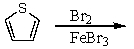
(Multiple Choice)
4.7/5 (74)
(74) How many resonances would be expected in the broad-band decoupled C-13 spectra of: 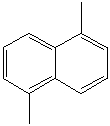
(Multiple Choice)
4.8/5 (83)
(83) A compound has the formula C8H9Br.Its 1H NMR spectrum consists of: doublet, 2.0
Quartet, 5.15
Multiplet, 7.35
The IR spectrum shows two peaks in the 680-840 cm-1 region;one is between 690 and 710 cm-1 and the other is between 730 and 770 cm-1.Which is a possible structure for the compound? 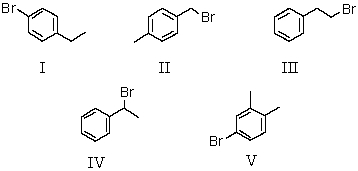
(Multiple Choice)
5.0/5 (64)
(64) We now know that the two Kekule structures for benzene are related in the following way:
(Multiple Choice)
4.9/5 (72)
(72) In the molecular orbital model of cyclobutadiene,how many -bonding molecular orbitals are there?
(Multiple Choice)
4.8/5 (74)
(74) In the molecular orbital model of the cyclobutadiene,how many pairs of degenerate -bonding molecular orbitals are there?
(Multiple Choice)
4.8/5 (77)
(77) How many resonances would be expected in the broad-band decoupled C-13 spectra of: 
(Multiple Choice)
4.7/5 (73)
(73) In which of the following compounds would the shortest carbon-carbon bond(s)be found?
(Multiple Choice)
4.9/5 (73)
(73) How many resonances would be expected in the broad-band decoupled C-13 spectra of: 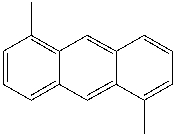
(Multiple Choice)
4.9/5 (77)
(77) Use the "polygon-in-circle" method to draw an MO diagram showing the pi-electron distribution pattern in the cyclopentadienyl anion.How is this diagram useful in explaining the aromatic properties of this anion?
(Essay)
4.7/5 (71)
(71) On the basis of molecular orbital theory and Hückel's rule,which molecules and/or ions should be aromatic? 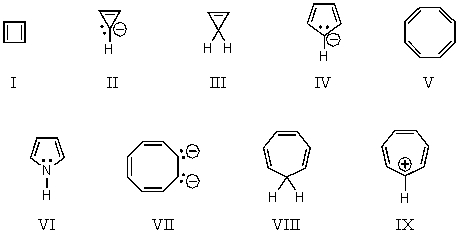
(Multiple Choice)
4.8/5 (77)
(77) Which dibromobenzene can,in theory,yield three mononitro derivatives?
(Multiple Choice)
4.9/5 (78)
(78) Which of the following statements regarding the cyclopentadienyl radical is correct?
(Multiple Choice)
4.9/5 (78)
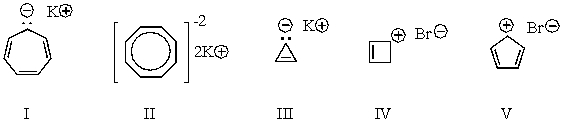
(78) 

Filters
- Essay(0)
- Multiple Choice(0)
- Short Answer(0)
- True False(0)
- Matching(0)