



 Chat with AI
Exam 14: Aromatic Compounds

Exam 1: Carbon Compounds and Chemical Bonds134 Questions
Exam 2: Representative Carbon Compounds: Functional Groups, Intermolecular Forces, and Infrared Ir Spectroscopy114 Questions
Exam 3: An Introduction to Organic Reactions: Acids and Bases47 Questions
Exam 4: Alkanes: Nomenclature, Conformational Analysis, and an Introduction to Synthesis125 Questions
Exam 5: Stereochemistry: Chiral Molecules150 Questions
Exam 6: Ionic Reactions - Nucleophilic Substitution and Elimination Reactions of Alkyl Halides146 Questions
Exam 7: Alkenes and Alkynes I: Properties and Synthesis, Elimination Reactions of Alkyl Halides99 Questions
Exam 8: Alkenes and Alkynes Ii: Addition Reactions140 Questions
Exam 9: Nuclear Magnetic Resonance and Mass Spectrometry: Tools for Structure Determination94 Questions
Exam 10: Radical Reactions114 Questions
Exam 11: Alcohols and Ethers172 Questions
Exam 12: Alcohols From Carbonyl Compounds Oxidation-Reduction and Organometallic Compounds147 Questions
Exam 13: Conjugated Unsaturated Systems166 Questions
Exam 14: Aromatic Compounds151 Questions
Exam 15: Reactions of Aromatic Compounds173 Questions
Exam 16: Aldehydes and Ketones I Nucleophilic Addition to the Carbonyl Group165 Questions
Exam 17: Aldehydes and Ketones Ii Aldol Reactions131 Questions
Exam 18: Carboxylic Acids and Their Derivatives Nucleophilic Addition - Elimination at the Acyl Carbon124 Questions
Exam 19: Synthesis and Reactions of Beta-Dicarbonyl Compounds: More Chemistry of Enolate Ions131 Questions
Exam 20: Amines148 Questions
Exam 21: Phenols and Aryl Halides: Nucleophilic Aromatic Substitution87 Questions
Exam 22: Carbohydrates104 Questions
Exam 23: Lipids99 Questions
Exam 24: Amino Acids and Proteins94 Questions
Exam 25: Nucleic Acids and Protein Synthesis89 Questions
Select questions type


On the basis of molecular orbital theory and Hückel's rule,which of these compounds should be aromatic? 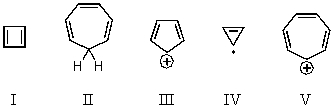
(Multiple Choice)
4.9/5  (79)
(79) In the molecular orbital model of benzene,how many pi-electrons are delocalized about the ring?
(Multiple Choice)
4.7/5 (75)
(75) In the molecular orbital model of the cyclopentadienyl cation,how many -bonding molecular orbitals are there?
(Multiple Choice)
4.9/5 (78)
(78) 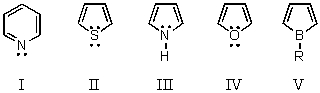
How many equivalent resonance structures can be written for the cyclopentadienyl anion?
(Multiple Choice)
4.8/5 (71)
(71) Which dichlorobenzene might theoretically yield three mononitro products?
(Multiple Choice)
4.9/5 (94)
(94) The difference between the amount of heat actually released upon hydrogenation of benzene and that calculated on the basis of the Kekule structure is called the ____________________ of benzene.
(Short Answer)
4.9/5 (92)
(92) In the molecular orbital model of benzene,how many pi-electrons are in bonding molecular orbitals?
(Multiple Choice)
4.7/5 (84)
(84) Why would 1,3-cyclohexadiene undergo dehydrogenation readily?
(Multiple Choice)
4.8/5 (66)
(66) Which reagent(s)would serve as the basis for a simple chemical test that would distinguish between ethylbenzene and vinylcyclohexane?
(Multiple Choice)
4.8/5 (79)
(79) Which of the following statements regarding the cyclopentadienyl cation is correct?
(Multiple Choice)
5.0/5 (76)
(76) Consider the oxygen atom in the molecules of furan and tetrahydrofuran.Bearing in mind that furan exhibits aromatic properties,compare the hybridization of oxygen in both species,explaining why it must be different,although at first glance,it may appear identical. 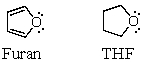
(Essay)
4.7/5 (75)
(75) In the molecular orbital model of cyclobutadiene,how many -antibonding molecular orbitals are there?
(Multiple Choice)
4.8/5 (76)
(76) Which of the following statements regarding the cyclopropenyl anion is correct?
(Multiple Choice)
4.8/5 (79)
(79) 
Filters
- Essay(0)
- Multiple Choice(0)
- Short Answer(0)
- True False(0)
- Matching(0)