



 Chat with AI
Exam 11: Alcohols and Ethers

Exam 1: Carbon Compounds and Chemical Bonds134 Questions
Exam 2: Representative Carbon Compounds: Functional Groups, Intermolecular Forces, and Infrared Ir Spectroscopy114 Questions
Exam 3: An Introduction to Organic Reactions: Acids and Bases47 Questions
Exam 4: Alkanes: Nomenclature, Conformational Analysis, and an Introduction to Synthesis125 Questions
Exam 5: Stereochemistry: Chiral Molecules150 Questions
Exam 6: Ionic Reactions - Nucleophilic Substitution and Elimination Reactions of Alkyl Halides146 Questions
Exam 7: Alkenes and Alkynes I: Properties and Synthesis, Elimination Reactions of Alkyl Halides99 Questions
Exam 8: Alkenes and Alkynes Ii: Addition Reactions140 Questions
Exam 9: Nuclear Magnetic Resonance and Mass Spectrometry: Tools for Structure Determination94 Questions
Exam 10: Radical Reactions114 Questions
Exam 11: Alcohols and Ethers172 Questions
Exam 12: Alcohols From Carbonyl Compounds Oxidation-Reduction and Organometallic Compounds147 Questions
Exam 13: Conjugated Unsaturated Systems166 Questions
Exam 14: Aromatic Compounds151 Questions
Exam 15: Reactions of Aromatic Compounds173 Questions
Exam 16: Aldehydes and Ketones I Nucleophilic Addition to the Carbonyl Group165 Questions
Exam 17: Aldehydes and Ketones Ii Aldol Reactions131 Questions
Exam 18: Carboxylic Acids and Their Derivatives Nucleophilic Addition - Elimination at the Acyl Carbon124 Questions
Exam 19: Synthesis and Reactions of Beta-Dicarbonyl Compounds: More Chemistry of Enolate Ions131 Questions
Exam 20: Amines148 Questions
Exam 21: Phenols and Aryl Halides: Nucleophilic Aromatic Substitution87 Questions
Exam 22: Carbohydrates104 Questions
Exam 23: Lipids99 Questions
Exam 24: Amino Acids and Proteins94 Questions
Exam 25: Nucleic Acids and Protein Synthesis89 Questions
Select questions type


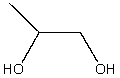

Which is the best method to prepare ethoxycyclopentane via the Williamson method?
(Essay)
4.8/5  (88)
(88) 
Assuming an overall exothermic process,select the potential energy diagram that best represents the following reaction: 
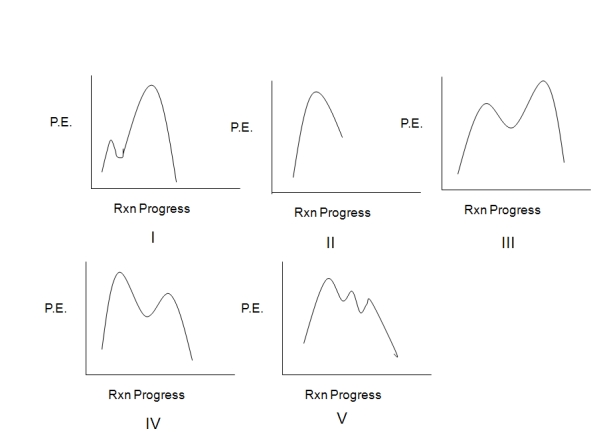
(Multiple Choice)
4.9/5 (86)
(86) Which of the reagents listed below would serve as the basis for a simple chemical test to distinguish between 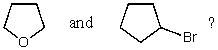
(Multiple Choice)
4.8/5 (76)
(76) The conversion of 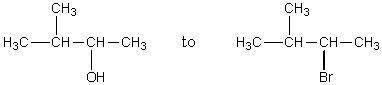 is best achieved through use of which of these reagents in a low temperature reaction?
 (Multiple Choice)
4.8/5 (75)
(75) What is the relationship between alcohols I and II? 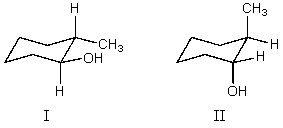 They are:
 (Multiple Choice)
4.7/5 (66)
(66) Propose a structure for the compound with the following formula that is consistent with the IR and 1H NMR data shown:
C6H14O
IR - 1120cm−1,strong,broad
3H triplet at 1.1
9H singlet at 1.15
2H quartet at 3.45
(Essay)
4.8/5 (87)
(87) Provide a reasonable synthetic strategy for the synthesis of a racemic mixture of (1R,2R)and (1S,2S)-2-bromo-1-methylcyclopentanol from methylcyclopentane:
(Essay)
4.9/5 (80)
(80) When 3-methyl-2-pentene is treated with mercuric acetate,Hg(O2CCH3)2,in a THF-t-butyl alcohol mixture and the resulting product reacted with NaBH4 in basic solution,the principal product formed is which of these?
(Multiple Choice)
4.8/5 (87)
(87) 
If cis-2-butene is treated with meta-chloroperbenzoic acid what is the final product? 
(Multiple Choice)
5.0/5 (78)
(78) What is the nucleophilic species involved in the initial step of the reaction below? 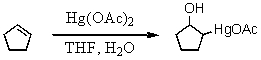
(Multiple Choice)
4.9/5 (76)
(76) Finish the following acid-base reaction and predict if it will proceed in the forward direction: 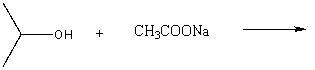
(Essay)
4.7/5 (80)
(80) Select the structure of the major product formed from the following reaction. 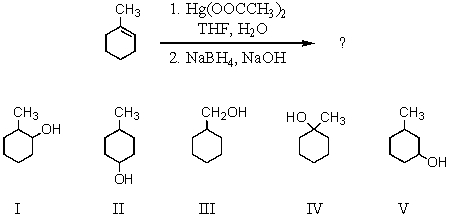
(Multiple Choice)
4.8/5 (79)
(79) Select the structure of the major product formed from the following reaction. 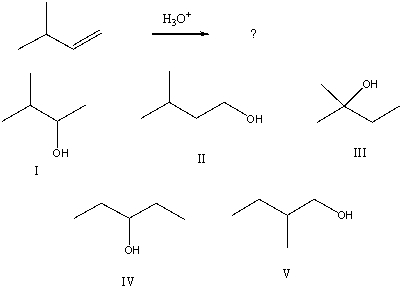
(Multiple Choice)
4.9/5 (86)
(86) 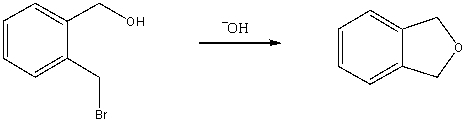
A reaction which leads to a product of particular stereoisomeric outcome,depending on the stereochemistry of the reactant,is termed_________________.
(Short Answer)
4.8/5 (71)
(71) 
Filters
- Essay(0)
- Multiple Choice(0)
- Short Answer(0)
- True False(0)
- Matching(0)