



 Chat with AI
Exam 11: Alcohols and Ethers

Exam 1: Carbon Compounds and Chemical Bonds134 Questions
Exam 2: Representative Carbon Compounds: Functional Groups, Intermolecular Forces, and Infrared Ir Spectroscopy114 Questions
Exam 3: An Introduction to Organic Reactions: Acids and Bases47 Questions
Exam 4: Alkanes: Nomenclature, Conformational Analysis, and an Introduction to Synthesis125 Questions
Exam 5: Stereochemistry: Chiral Molecules150 Questions
Exam 6: Ionic Reactions - Nucleophilic Substitution and Elimination Reactions of Alkyl Halides146 Questions
Exam 7: Alkenes and Alkynes I: Properties and Synthesis, Elimination Reactions of Alkyl Halides99 Questions
Exam 8: Alkenes and Alkynes Ii: Addition Reactions140 Questions
Exam 9: Nuclear Magnetic Resonance and Mass Spectrometry: Tools for Structure Determination94 Questions
Exam 10: Radical Reactions114 Questions
Exam 11: Alcohols and Ethers172 Questions
Exam 12: Alcohols From Carbonyl Compounds Oxidation-Reduction and Organometallic Compounds147 Questions
Exam 13: Conjugated Unsaturated Systems166 Questions
Exam 14: Aromatic Compounds151 Questions
Exam 15: Reactions of Aromatic Compounds173 Questions
Exam 16: Aldehydes and Ketones I Nucleophilic Addition to the Carbonyl Group165 Questions
Exam 17: Aldehydes and Ketones Ii Aldol Reactions131 Questions
Exam 18: Carboxylic Acids and Their Derivatives Nucleophilic Addition - Elimination at the Acyl Carbon124 Questions
Exam 19: Synthesis and Reactions of Beta-Dicarbonyl Compounds: More Chemistry of Enolate Ions131 Questions
Exam 20: Amines148 Questions
Exam 21: Phenols and Aryl Halides: Nucleophilic Aromatic Substitution87 Questions
Exam 22: Carbohydrates104 Questions
Exam 23: Lipids99 Questions
Exam 24: Amino Acids and Proteins94 Questions
Exam 25: Nucleic Acids and Protein Synthesis89 Questions
Select questions type


Methanesulfonic acid, 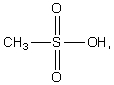 is treated,in turn,with PCl5 and (R)-2-butanol.Which of the following Fischer formulas is a stereochemically correct representation of the final product?
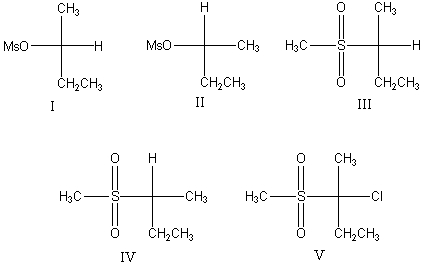
is treated,in turn,with PCl5 and (R)-2-butanol.Which of the following Fischer formulas is a stereochemically correct representation of the final product? (Multiple Choice)
4.9/5  (74)
(74) A compound has the formula C5H10,with the 13C and 1H NMR spectral data shown.Propose structure that fits this data.
13C NMR
Broadband decoupled 13C NMR: 23.5,26.7,68.9 δ
DEPT-90: no peaks
DEPT-135: no positive peaks;negative peaks at 23.5,26.7,68.9 δ
1H NMR
1.7 δ,multiplet (6H)
3.72 δ,triplet (4H)J = 7Hz
(Essay)
4.8/5 (92)
(92) What is the relationship between alcohols I and II? 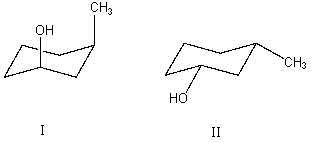 They are:
 (Multiple Choice)
4.9/5 (74)
(74) Which is the best way to prepare 3-methoxypentane via the Williamson method?
(Multiple Choice)
4.9/5 (79)
(79) Which of the alcohols listed below would you expect to react most rapidly with PBr3?
(Multiple Choice)
4.9/5 (78)
(78) Which of the following would be a reasonable synthesis of CH3CH2CH2CH2OH?
(Multiple Choice)
4.8/5 (65)
(65) 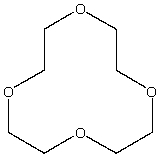
What would be the major product(s)of the following reaction 
(Multiple Choice)
4.8/5 (84)
(84) What is the relationship between alcohols I and II? 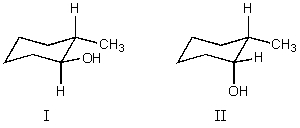 They are:
 (Multiple Choice)
4.9/5 (88)
(88) Select the structure of the major product formed from the following reaction. 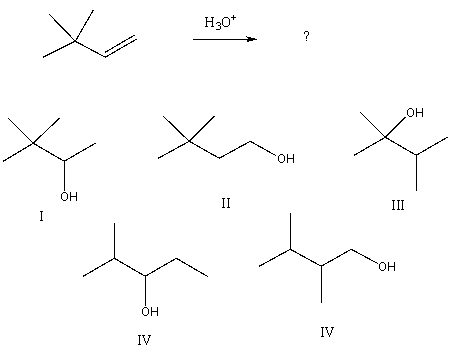
(Multiple Choice)
4.8/5 (88)
(88) Which is the most efficient way to prepare isopropyl methyl ether via the Williamson method?
(Essay)
4.9/5 (101)
(101) Provide a reasonable synthetic strategy for the synthesis of trans-1,2-cyclohexanediol from bromocyclohexane
(Essay)
5.0/5 (85)
(85) Propose a structure for the compound with the following formula that is consistent with the IR and 1H NMR data shown:
C3H8O
IR - 3350cm−1,strong,broad
6H doublet at 1.3 ,J = 7 Hz
1H singlet at 2.2 , (exchangeable)
1H septet at 4.0 ,J = 7 Hz
(Essay)
4.8/5 (85)
(85) A compound has the formula C6H14O.The 13C and 1H NMR spectral data for this compound are:
13C NMR
Broadband decoupled 13C NMR: 29.7,29.8,46.4,60.0 δ
DEPT-90: no peaks
DEPT-135: positive peak at 29.8 δ;negative peaks at 29.7,60.0 δ
1H NMR
0.91 δ,singlet (9H)
1.53 δ,triplet (2H)J = 7.3Hz
2.13 δ,broad singlet (exchangeable,1H)
3.70 δ,triplet (2H)J = 7.3Hz
(Essay)
4.9/5 (74)
(74) The major industrial process in use today for the production of methanol is the:
(Multiple Choice)
5.0/5 (77)
(77) Heating 2-ethoxyhexane with one equivalent of concentrated HBr would produce:
(Multiple Choice)
4.7/5 (88)
(88) The hydroboration-oxidation procedure can be successfully employed for synthesis of deuterated derivatives,by using BD3 instead of BH3.What product would you expect from the following reaction? 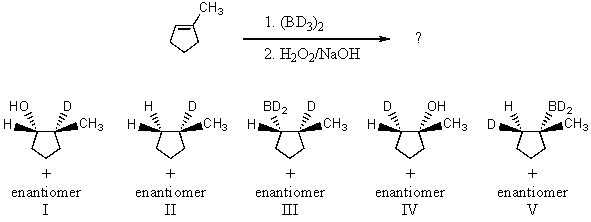
(Multiple Choice)
4.9/5 (86)
(86) Which of these ethers is least likely to undergo significant cleavage by hot aqueous H2SO4 ? 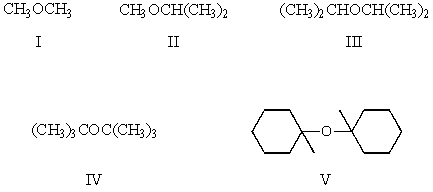
(Multiple Choice)
5.0/5 (76)
(76) What reaction is needed to accomplish the following transformation: 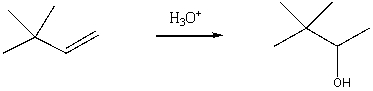
(Short Answer)
4.7/5 (78)
(78) 
Filters
- Essay(0)
- Multiple Choice(0)
- Short Answer(0)
- True False(0)
- Matching(0)