



 Chat with AI
Exam 11: Alcohols and Ethers

Exam 1: Carbon Compounds and Chemical Bonds134 Questions
Exam 2: Representative Carbon Compounds: Functional Groups, Intermolecular Forces, and Infrared Ir Spectroscopy114 Questions
Exam 3: An Introduction to Organic Reactions: Acids and Bases47 Questions
Exam 4: Alkanes: Nomenclature, Conformational Analysis, and an Introduction to Synthesis125 Questions
Exam 5: Stereochemistry: Chiral Molecules150 Questions
Exam 6: Ionic Reactions - Nucleophilic Substitution and Elimination Reactions of Alkyl Halides146 Questions
Exam 7: Alkenes and Alkynes I: Properties and Synthesis, Elimination Reactions of Alkyl Halides99 Questions
Exam 8: Alkenes and Alkynes Ii: Addition Reactions140 Questions
Exam 9: Nuclear Magnetic Resonance and Mass Spectrometry: Tools for Structure Determination94 Questions
Exam 10: Radical Reactions114 Questions
Exam 11: Alcohols and Ethers172 Questions
Exam 12: Alcohols From Carbonyl Compounds Oxidation-Reduction and Organometallic Compounds147 Questions
Exam 13: Conjugated Unsaturated Systems166 Questions
Exam 14: Aromatic Compounds151 Questions
Exam 15: Reactions of Aromatic Compounds173 Questions
Exam 16: Aldehydes and Ketones I Nucleophilic Addition to the Carbonyl Group165 Questions
Exam 17: Aldehydes and Ketones Ii Aldol Reactions131 Questions
Exam 18: Carboxylic Acids and Their Derivatives Nucleophilic Addition - Elimination at the Acyl Carbon124 Questions
Exam 19: Synthesis and Reactions of Beta-Dicarbonyl Compounds: More Chemistry of Enolate Ions131 Questions
Exam 20: Amines148 Questions
Exam 21: Phenols and Aryl Halides: Nucleophilic Aromatic Substitution87 Questions
Exam 22: Carbohydrates104 Questions
Exam 23: Lipids99 Questions
Exam 24: Amino Acids and Proteins94 Questions
Exam 25: Nucleic Acids and Protein Synthesis89 Questions
Select questions type


Assuming an overall exothermic process,select the potential energy diagram that best represents the following reaction: 
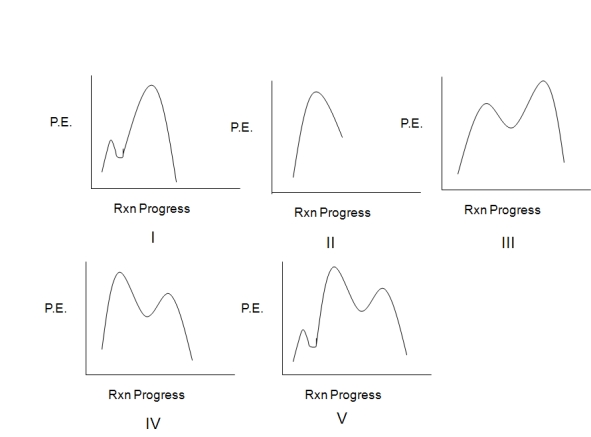
(Multiple Choice)
4.8/5  (81)
(81) Select the structure of the major product formed in the following reaction. 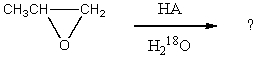
(Multiple Choice)
4.9/5 (88)
(88) Complete the following reaction sequence,giving structures for compounds C and D: 
(Essay)
4.9/5 (76)
(76) Provide a reasonable synthetic strategy for the synthesis of trans-2-methoxycyclopentanol from bromocyclopentane
(Essay)
4.7/5 (87)
(87) Which of these alkyl halide syntheses is predicted to occur at the greatest rate?
(Multiple Choice)
4.7/5 (83)
(83) Propose a structure for the compound with the following formula that is consistent with the IR and 1H NMR data shown:
C7H8O
IR - 3325cm−1,strong,broad
1H broad singlet at 2.3 (exchangeable)
2H singlet at 4.6
5H multiplet at 7.3
(Essay)
4.9/5 (80)
(80) Draw all of the ethers corresponding to the formula C5H12O,including stereoisomers.
(Essay)
4.8/5 (91)
(91) Which is the best method to prepare 2-ethoxy-5-methylhexane?
(Multiple Choice)
4.8/5 (88)
(88) Three-membered rings containing oxygen are called _______________ or ______________.
(Short Answer)
4.8/5 (72)
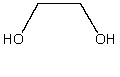
(72) 
What would be the major product of the following reaction sequence? 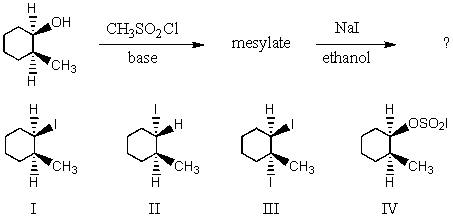
(Multiple Choice)
4.8/5 (82)
(82) Which compound would have the greatest solubility in water?
(Multiple Choice)
4.8/5 (91)
(91) Complete the following reaction sequence,giving structural details of all key intermediates: 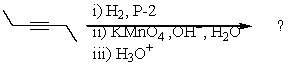
(Essay)
4.7/5 (82)
(82) Which of the following can be described as "optically active,primary alcohol"?
(Multiple Choice)
4.9/5 (92)
(92) Propose a structure for the compound with the following formula that is consistent with the IR and 1H NMR data shown:
C6H14O
IR - 1120cm−1,strong,broad
6H triplet at 0.9
4H sextet at 1.5
4H triplet at 3.4
(Essay)
4.9/5 (84)
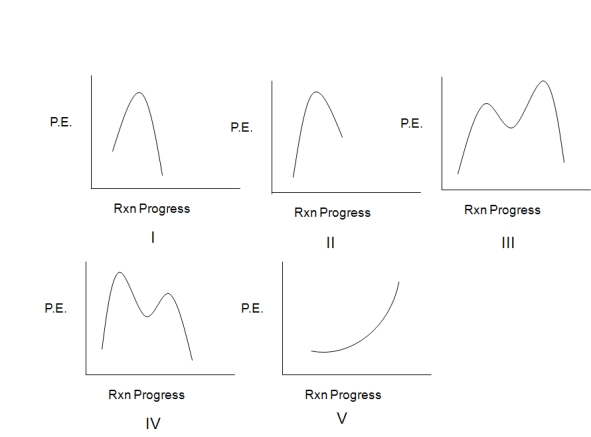
(84) Select the potential energy diagram that best represents the following reaction: 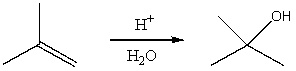
(Multiple Choice)
4.9/5 (84)
(84) If (Z)-2-pentene is treated with meta-chloroperbenzoic acid what is the final product? 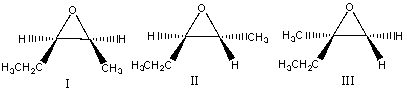
(Multiple Choice)
4.9/5 (85)
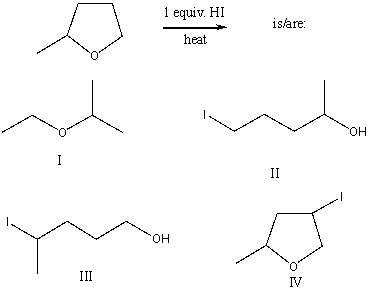
(85) 

Filters
- Essay(0)
- Multiple Choice(0)
- Short Answer(0)
- True False(0)
- Matching(0)