



 Chat with AI
Exam 13: Social Psychology-Part B

Exam 1: Evolution of Psychological Science-Part A323 Questions
Exam 1: Evolution of Psychological Science-Part B14 Questions
Exam 1: Evolution of Psychological Science-Part C98 Questions
Exam 1: Evolution of Psychological Science-Part D15 Questions
Exam 1: Evolution of Psychological Science-Part E15 Questions
Exam 2: Methods in Psychology-Part A295 Questions
Exam 2: Methods in Psychology-Part B13 Questions
Exam 2: Methods in Psychology-Part C73 Questions
Exam 2: Methods in Psychology-Part D15 Questions
Exam 2: Methods in Psychology-Part E14 Questions
Exam 3: Neuroscience and Behavior-Part A424 Questions
Exam 3: Neuroscience and Behavior-Part B12 Questions
Exam 3: Neuroscience and Behavior-Part C122 Questions
Exam 3: Neuroscience and Behavior-Part D15 Questions
Exam 3: Neuroscience and Behavior-Part E15 Questions
Exam 4: Sensation and Perception-Part A365 Questions
Exam 4: Sensation and Perception-Part B12 Questions
Exam 4: Sensation and Perception-Part C147 Questions
Exam 4: Sensation and Perception-Part D15 Questions
Exam 4: Sensation and Perception-Part E15 Questions
Exam 5: Consciousness-Part A264 Questions
Exam 5: Consciousness-Part B13 Questions
Exam 5: Consciousness-Part C102 Questions
Exam 5: Consciousness-Part D15 Questions
Exam 5: Consciousness-Part E15 Questions
Exam 6: Memory-Part A346 Questions
Exam 6: Memory-Part B11 Questions
Exam 6: Memory-Part C99 Questions
Exam 6: Memory-Part D15 Questions
Exam 6: Memory-Part E15 Questions
Exam 7: Learning-Part A291 Questions
Exam 7: Learning-Part B13 Questions
Exam 7: Learning-Part C134 Questions
Exam 7: Learning-Part D16 Questions
Exam 7: Learning-Part E15 Questions
Exam 8: Emotion and Motivation-Part A231 Questions
Exam 8: Emotion and Motivation-Part B12 Questions
Exam 8: Emotion and Motivation-Part C91 Questions
Exam 8: Emotion and Motivation-Part D15 Questions
Exam 8: Emotion and Motivation-Part E15 Questions
Exam 9: Language and Thought-Part A242 Questions
Exam 9: Language and Thought-Part B12 Questions
Exam 9: Language and Thought-Part C107 Questions
Exam 9: Language and Thought-Part D15 Questions
Exam 9: Language and Thought-Part E15 Questions
Exam 10: Intelligence-Part A187 Questions
Exam 10: Intelligence-Part B12 Questions
Exam 10: Intelligence-Part C84 Questions
Exam 10: Intelligence-Part D15 Questions
Exam 10: Intelligence-Part E12 Questions
Exam 11: Development-Part A261 Questions
Exam 11: Development-Part B14 Questions
Exam 11: Development-Part C83 Questions
Exam 11: Development-Part D15 Questions
Exam 11: Development-Part E15 Questions
Exam 12: Personality-Part A252 Questions
Exam 12: Personality-Part B12 Questions
Exam 12: Personality-Part C75 Questions
Exam 12: Personality-Part D15 Questions
Exam 12: Personality-Part E15 Questions
Exam 13: Social Psychology-Part A238 Questions
Exam 13: Social Psychology-Part B16 Questions
Exam 13: Social Psychology-Part C81 Questions
Exam 13: Social Psychology-Part D15 Questions
Exam 13: Social Psychology-Part E15 Questions
Exam 14: Stress and Health-Part A186 Questions
Exam 14: Stress and Health-Part B12 Questions
Exam 14: Stress and Health-Part C84 Questions
Exam 14: Stress and Health-Part D15 Questions
Exam 14: Stress and Health-Part E15 Questions
Exam 15: Psychological Disorders-Part A282 Questions
Exam 15: Psychological Disorders-Part B12 Questions
Exam 15: Psychological Disorders-Part C57 Questions
Exam 15: Psychological Disorders-Part D15 Questions
Exam 15: Psychological Disorders-Part E15 Questions
Exam 16: Treatment of Psychological Disorders-Part A212 Questions
Exam 16: Treatment of Psychological Disorders-Part B12 Questions
Exam 16: Treatment of Psychological Disorders-Part C95 Questions
Exam 16: Treatment of Psychological Disorders-Part D14 Questions
Exam 16: Treatment of Psychological Disorders-Part E15 Questions
Exam 17: Psychology Appendix214 Questions
Select questions type


Use the following to answer questions
Scenario II
The following scenario contains fabricated results consistent with the following study:
Petty,R.E. ,Cacioppo,J.T. ,& Goldman,R.(1981).Personal involvement as a determinant of argument-based persuasion.Journal of Personality and Social Psychology,41,847-855.
Every day,consumers are exposed to scientifically based sales,marketing,and public relations strategies designed to influence purchasing decisions,change opinions,or win votes.One common sales strategy is the foot-in-the-door technique,a method that involves first making a smaller request that consumers are likely to grant and then following it with a larger request.Another common strategy is the door-in-the-face technique,which involves making an unreasonably large request that consumers will reject and then following it with a smaller request.When persuasion is necessary,it usually takes one of two forms: heuristic persuasion,which involves an appeal to habits or emotion,and systematic persuasion,which involves an appeal to facts and reason.Often,people will rely more on heuristics-simple shortcuts or "rules of thumb"-to make decisions instead of systematically weighing the evidence.
Petty and colleagues (1981)investigated some of these techniques in college students listening to arguments in favor of their college requiring an institution-level comprehensive final examination for graduation.Some students were led to believe that,if adopted,this policy would take place right away,and some were led to believe that the change would take place in a decade.In addition,some of the students were led to believe that they were listening to an argument from a Princeton professor,and others were led to believe that they were listening to an argument from a high-school student.Finally,some students heard strong arguments in favor of the policy,and some heard weak arguments.Thus,the experiment arranged six groups of students.For example,one group of students heard strong arguments from a high-school student about a far-removed policy change.Figure 13.1 shows fabricated results illustrating the major findings of this experiment.
Figure 13.1 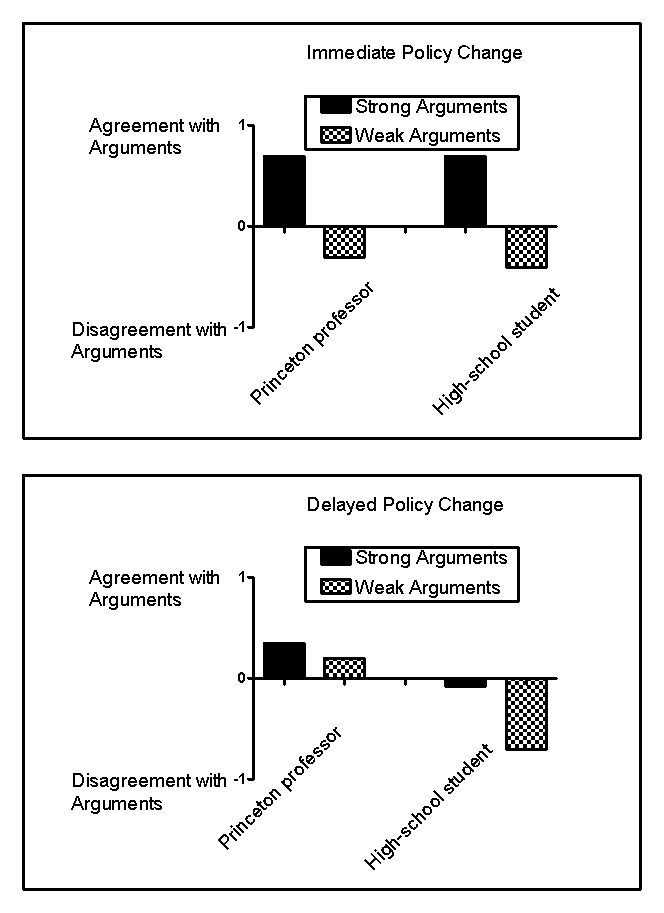 -(Scenario II)The door-in-the-face technique works primarily because consumers:
Free
(Multiple Choice)
4.9/5  (80)
(80) Correct Answer: Verified
A
Use the following to answer questions
Scenario I
The following scenario describes research findings discussed in the following review article:
Cameron,C.C. ,& Thaler,R.H.(1995).Anomalies: Ultimatums,dictators,and manners.Journal of Economic Perspectives,9(19),209-219.
In the ultimatum game,two participants are assigned to be either the "Divider" or the "Decider" by a coin flip.The Divider is given a sum of money,such as $10,and is instructed to offer some nonzero portion of it to the Decider.If the Decider accepts,she gets to keep what was offered and the Divider keeps the rest.If the Decider rejects the deal,both players get nothing.Both players are made aware of all of these rules and then the game begins.Under these conditions,Dividers usually offer a little less than $5 and Deciders usually accept this amount.If Dividers offer less,Deciders often reject and both players get nothing.A similar game is termed the dictator game.Players are randomly assigned to be either the "Allocator" or the "Receiver." The Allocator is given a sum of money and makes a decision about how much money she would like to give the Receiver,who must accept this result.Allocators in this game usually offer some money to the Receiver but typically less than they offer the Dividers in the ultimatum game.
-(Scenario I)Consider the real-world observation that lottery winners tend to give away more of their money to friends and family than self-made millionaires give to theirs.Using the dictator game,which strategy is the BEST way to model this phenomenon in the laboratory?
Free
(Multiple Choice)
4.9/5 (77)
(77) Correct Answer:Verified
VerifiedB
Use the following to answer questions
Scenario II
The following scenario contains fabricated results consistent with the following study:
Petty,R.E. ,Cacioppo,J.T. ,& Goldman,R.(1981).Personal involvement as a determinant of argument-based persuasion.Journal of Personality and Social Psychology,41,847-855.
Every day,consumers are exposed to scientifically based sales,marketing,and public relations strategies designed to influence purchasing decisions,change opinions,or win votes.One common sales strategy is the foot-in-the-door technique,a method that involves first making a smaller request that consumers are likely to grant and then following it with a larger request.Another common strategy is the door-in-the-face technique,which involves making an unreasonably large request that consumers will reject and then following it with a smaller request.When persuasion is necessary,it usually takes one of two forms: heuristic persuasion,which involves an appeal to habits or emotion,and systematic persuasion,which involves an appeal to facts and reason.Often,people will rely more on heuristics-simple shortcuts or "rules of thumb"-to make decisions instead of systematically weighing the evidence.
Petty and colleagues (1981)investigated some of these techniques in college students listening to arguments in favor of their college requiring an institution-level comprehensive final examination for graduation.Some students were led to believe that,if adopted,this policy would take place right away,and some were led to believe that the change would take place in a decade.In addition,some of the students were led to believe that they were listening to an argument from a Princeton professor,and others were led to believe that they were listening to an argument from a high-school student.Finally,some students heard strong arguments in favor of the policy,and some heard weak arguments.Thus,the experiment arranged six groups of students.For example,one group of students heard strong arguments from a high-school student about a far-removed policy change.Figure 13.1 shows fabricated results illustrating the major findings of this experiment.
Figure 13.1
-(Scenario II)In the Petty and colleagues (1981)experiment,which example BEST describes a heuristic?
-(Scenario II)In the Petty and colleagues (1981)experiment,which example BEST describes a heuristic?Free
(Multiple Choice)
4.8/5 (79)
(79) Correct Answer:Verified
VerifiedA
Use the following to answer questions
Scenario II
The following scenario contains fabricated results consistent with the following study:
Petty,R.E. ,Cacioppo,J.T. ,& Goldman,R.(1981).Personal involvement as a determinant of argument-based persuasion.Journal of Personality and Social Psychology,41,847-855.
Every day,consumers are exposed to scientifically based sales,marketing,and public relations strategies designed to influence purchasing decisions,change opinions,or win votes.One common sales strategy is the foot-in-the-door technique,a method that involves first making a smaller request that consumers are likely to grant and then following it with a larger request.Another common strategy is the door-in-the-face technique,which involves making an unreasonably large request that consumers will reject and then following it with a smaller request.When persuasion is necessary,it usually takes one of two forms: heuristic persuasion,which involves an appeal to habits or emotion,and systematic persuasion,which involves an appeal to facts and reason.Often,people will rely more on heuristics-simple shortcuts or "rules of thumb"-to make decisions instead of systematically weighing the evidence.
Petty and colleagues (1981)investigated some of these techniques in college students listening to arguments in favor of their college requiring an institution-level comprehensive final examination for graduation.Some students were led to believe that,if adopted,this policy would take place right away,and some were led to believe that the change would take place in a decade.In addition,some of the students were led to believe that they were listening to an argument from a Princeton professor,and others were led to believe that they were listening to an argument from a high-school student.Finally,some students heard strong arguments in favor of the policy,and some heard weak arguments.Thus,the experiment arranged six groups of students.For example,one group of students heard strong arguments from a high-school student about a far-removed policy change.Figure 13.1 shows fabricated results illustrating the major findings of this experiment.
Figure 13.1
-(Scenario II)Which example describes systematic persuasion?
-(Scenario II)Which example describes systematic persuasion? (Multiple Choice)
4.8/5 (77)
(77) Use the following to answer questions
Scenario I
The following scenario describes research findings discussed in the following review article:
Cameron,C.C. ,& Thaler,R.H.(1995).Anomalies: Ultimatums,dictators,and manners.Journal of Economic Perspectives,9(19),209-219.
In the ultimatum game,two participants are assigned to be either the "Divider" or the "Decider" by a coin flip.The Divider is given a sum of money,such as $10,and is instructed to offer some nonzero portion of it to the Decider.If the Decider accepts,she gets to keep what was offered and the Divider keeps the rest.If the Decider rejects the deal,both players get nothing.Both players are made aware of all of these rules and then the game begins.Under these conditions,Dividers usually offer a little less than $5 and Deciders usually accept this amount.If Dividers offer less,Deciders often reject and both players get nothing.A similar game is termed the dictator game.Players are randomly assigned to be either the "Allocator" or the "Receiver." The Allocator is given a sum of money and makes a decision about how much money she would like to give the Receiver,who must accept this result.Allocators in this game usually offer some money to the Receiver but typically less than they offer the Dividers in the ultimatum game.
-(Scenario I)Skeptics of the results of the original ultimatum game criticized the research for drawing conclusions based on games involving small amounts of money not representative of important real-life economic decisions.This was a criticism associated with the _____ of the research.
(Multiple Choice)
4.8/5 (71)
(71) Use the following to answer questions
Scenario II
The following scenario contains fabricated results consistent with the following study:
Petty,R.E. ,Cacioppo,J.T. ,& Goldman,R.(1981).Personal involvement as a determinant of argument-based persuasion.Journal of Personality and Social Psychology,41,847-855.
Every day,consumers are exposed to scientifically based sales,marketing,and public relations strategies designed to influence purchasing decisions,change opinions,or win votes.One common sales strategy is the foot-in-the-door technique,a method that involves first making a smaller request that consumers are likely to grant and then following it with a larger request.Another common strategy is the door-in-the-face technique,which involves making an unreasonably large request that consumers will reject and then following it with a smaller request.When persuasion is necessary,it usually takes one of two forms: heuristic persuasion,which involves an appeal to habits or emotion,and systematic persuasion,which involves an appeal to facts and reason.Often,people will rely more on heuristics-simple shortcuts or "rules of thumb"-to make decisions instead of systematically weighing the evidence.
Petty and colleagues (1981)investigated some of these techniques in college students listening to arguments in favor of their college requiring an institution-level comprehensive final examination for graduation.Some students were led to believe that,if adopted,this policy would take place right away,and some were led to believe that the change would take place in a decade.In addition,some of the students were led to believe that they were listening to an argument from a Princeton professor,and others were led to believe that they were listening to an argument from a high-school student.Finally,some students heard strong arguments in favor of the policy,and some heard weak arguments.Thus,the experiment arranged six groups of students.For example,one group of students heard strong arguments from a high-school student about a far-removed policy change.Figure 13.1 shows fabricated results illustrating the major findings of this experiment.
Figure 13.1
-(Scenario II)Which factor is NOT an independent variable in the Petty and colleagues (1981)experiment?
-(Scenario II)Which factor is NOT an independent variable in the Petty and colleagues (1981)experiment? (Multiple Choice)
4.9/5 (87)
(87) Use the following to answer questions
Scenario I
The following scenario describes research findings discussed in the following review article:
Cameron,C.C. ,& Thaler,R.H.(1995).Anomalies: Ultimatums,dictators,and manners.Journal of Economic Perspectives,9(19),209-219.
In the ultimatum game,two participants are assigned to be either the "Divider" or the "Decider" by a coin flip.The Divider is given a sum of money,such as $10,and is instructed to offer some nonzero portion of it to the Decider.If the Decider accepts,she gets to keep what was offered and the Divider keeps the rest.If the Decider rejects the deal,both players get nothing.Both players are made aware of all of these rules and then the game begins.Under these conditions,Dividers usually offer a little less than $5 and Deciders usually accept this amount.If Dividers offer less,Deciders often reject and both players get nothing.A similar game is termed the dictator game.Players are randomly assigned to be either the "Allocator" or the "Receiver." The Allocator is given a sum of money and makes a decision about how much money she would like to give the Receiver,who must accept this result.Allocators in this game usually offer some money to the Receiver but typically less than they offer the Dividers in the ultimatum game.
-(Scenario I)In the ultimatum game,the behavior of the _____ is of the most theoretical interest to psychologists and economists because _____.
(Multiple Choice)
4.8/5 (77)
(77) Use the following to answer questions
Scenario II
The following scenario contains fabricated results consistent with the following study:
Petty,R.E. ,Cacioppo,J.T. ,& Goldman,R.(1981).Personal involvement as a determinant of argument-based persuasion.Journal of Personality and Social Psychology,41,847-855.
Every day,consumers are exposed to scientifically based sales,marketing,and public relations strategies designed to influence purchasing decisions,change opinions,or win votes.One common sales strategy is the foot-in-the-door technique,a method that involves first making a smaller request that consumers are likely to grant and then following it with a larger request.Another common strategy is the door-in-the-face technique,which involves making an unreasonably large request that consumers will reject and then following it with a smaller request.When persuasion is necessary,it usually takes one of two forms: heuristic persuasion,which involves an appeal to habits or emotion,and systematic persuasion,which involves an appeal to facts and reason.Often,people will rely more on heuristics-simple shortcuts or "rules of thumb"-to make decisions instead of systematically weighing the evidence.
Petty and colleagues (1981)investigated some of these techniques in college students listening to arguments in favor of their college requiring an institution-level comprehensive final examination for graduation.Some students were led to believe that,if adopted,this policy would take place right away,and some were led to believe that the change would take place in a decade.In addition,some of the students were led to believe that they were listening to an argument from a Princeton professor,and others were led to believe that they were listening to an argument from a high-school student.Finally,some students heard strong arguments in favor of the policy,and some heard weak arguments.Thus,the experiment arranged six groups of students.For example,one group of students heard strong arguments from a high-school student about a far-removed policy change.Figure 13.1 shows fabricated results illustrating the major findings of this experiment.
Figure 13.1
-(Scenario II)The results shown in Figure 13.1 suggest that college students were heuristically persuaded when the:
-(Scenario II)The results shown in Figure 13.1 suggest that college students were heuristically persuaded when the: (Multiple Choice)
4.9/5 (92)
(92) Use the following to answer questions
Scenario I
The following scenario describes research findings discussed in the following review article:
Cameron,C.C. ,& Thaler,R.H.(1995).Anomalies: Ultimatums,dictators,and manners.Journal of Economic Perspectives,9(19),209-219.
In the ultimatum game,two participants are assigned to be either the "Divider" or the "Decider" by a coin flip.The Divider is given a sum of money,such as $10,and is instructed to offer some nonzero portion of it to the Decider.If the Decider accepts,she gets to keep what was offered and the Divider keeps the rest.If the Decider rejects the deal,both players get nothing.Both players are made aware of all of these rules and then the game begins.Under these conditions,Dividers usually offer a little less than $5 and Deciders usually accept this amount.If Dividers offer less,Deciders often reject and both players get nothing.A similar game is termed the dictator game.Players are randomly assigned to be either the "Allocator" or the "Receiver." The Allocator is given a sum of money and makes a decision about how much money she would like to give the Receiver,who must accept this result.Allocators in this game usually offer some money to the Receiver but typically less than they offer the Dividers in the ultimatum game.
-(Scenario I)Which research finding suggests that participants are more concerned with appearing fair than they are with being fair?
(Multiple Choice)
4.9/5 (80)
(80) Use the following to answer questions
Scenario I
The following scenario describes research findings discussed in the following review article:
Cameron,C.C. ,& Thaler,R.H.(1995).Anomalies: Ultimatums,dictators,and manners.Journal of Economic Perspectives,9(19),209-219.
In the ultimatum game,two participants are assigned to be either the "Divider" or the "Decider" by a coin flip.The Divider is given a sum of money,such as $10,and is instructed to offer some nonzero portion of it to the Decider.If the Decider accepts,she gets to keep what was offered and the Divider keeps the rest.If the Decider rejects the deal,both players get nothing.Both players are made aware of all of these rules and then the game begins.Under these conditions,Dividers usually offer a little less than $5 and Deciders usually accept this amount.If Dividers offer less,Deciders often reject and both players get nothing.A similar game is termed the dictator game.Players are randomly assigned to be either the "Allocator" or the "Receiver." The Allocator is given a sum of money and makes a decision about how much money she would like to give the Receiver,who must accept this result.Allocators in this game usually offer some money to the Receiver but typically less than they offer the Dividers in the ultimatum game.
-(Scenario I)Which factor is studied in the ultimatum game but not in the dictator game?
(Multiple Choice)
4.7/5 (79)
(79) Use the following to answer questions
Scenario I
The following scenario describes research findings discussed in the following review article:
Cameron,C.C. ,& Thaler,R.H.(1995).Anomalies: Ultimatums,dictators,and manners.Journal of Economic Perspectives,9(19),209-219.
In the ultimatum game,two participants are assigned to be either the "Divider" or the "Decider" by a coin flip.The Divider is given a sum of money,such as $10,and is instructed to offer some nonzero portion of it to the Decider.If the Decider accepts,she gets to keep what was offered and the Divider keeps the rest.If the Decider rejects the deal,both players get nothing.Both players are made aware of all of these rules and then the game begins.Under these conditions,Dividers usually offer a little less than $5 and Deciders usually accept this amount.If Dividers offer less,Deciders often reject and both players get nothing.A similar game is termed the dictator game.Players are randomly assigned to be either the "Allocator" or the "Receiver." The Allocator is given a sum of money and makes a decision about how much money she would like to give the Receiver,who must accept this result.Allocators in this game usually offer some money to the Receiver but typically less than they offer the Dividers in the ultimatum game.
-(Scenario I)In a single $10 ultimatum game,if both players behaved independently without cooperating or retaliating and sought to maximize their individual earnings:
(Multiple Choice)
4.9/5 (74)
(74) Use the following to answer questions
Scenario II
The following scenario contains fabricated results consistent with the following study:
Petty,R.E. ,Cacioppo,J.T. ,& Goldman,R.(1981).Personal involvement as a determinant of argument-based persuasion.Journal of Personality and Social Psychology,41,847-855.
Every day,consumers are exposed to scientifically based sales,marketing,and public relations strategies designed to influence purchasing decisions,change opinions,or win votes.One common sales strategy is the foot-in-the-door technique,a method that involves first making a smaller request that consumers are likely to grant and then following it with a larger request.Another common strategy is the door-in-the-face technique,which involves making an unreasonably large request that consumers will reject and then following it with a smaller request.When persuasion is necessary,it usually takes one of two forms: heuristic persuasion,which involves an appeal to habits or emotion,and systematic persuasion,which involves an appeal to facts and reason.Often,people will rely more on heuristics-simple shortcuts or "rules of thumb"-to make decisions instead of systematically weighing the evidence.
Petty and colleagues (1981)investigated some of these techniques in college students listening to arguments in favor of their college requiring an institution-level comprehensive final examination for graduation.Some students were led to believe that,if adopted,this policy would take place right away,and some were led to believe that the change would take place in a decade.In addition,some of the students were led to believe that they were listening to an argument from a Princeton professor,and others were led to believe that they were listening to an argument from a high-school student.Finally,some students heard strong arguments in favor of the policy,and some heard weak arguments.Thus,the experiment arranged six groups of students.For example,one group of students heard strong arguments from a high-school student about a far-removed policy change.Figure 13.1 shows fabricated results illustrating the major findings of this experiment.
Figure 13.1
-(Scenario II)The foot-in-the-door technique works primarily because consumers:
-(Scenario II)The foot-in-the-door technique works primarily because consumers: (Multiple Choice)
4.8/5 (78)
(78) Use the following to answer questions
Scenario I
The following scenario describes research findings discussed in the following review article:
Cameron,C.C. ,& Thaler,R.H.(1995).Anomalies: Ultimatums,dictators,and manners.Journal of Economic Perspectives,9(19),209-219.
In the ultimatum game,two participants are assigned to be either the "Divider" or the "Decider" by a coin flip.The Divider is given a sum of money,such as $10,and is instructed to offer some nonzero portion of it to the Decider.If the Decider accepts,she gets to keep what was offered and the Divider keeps the rest.If the Decider rejects the deal,both players get nothing.Both players are made aware of all of these rules and then the game begins.Under these conditions,Dividers usually offer a little less than $5 and Deciders usually accept this amount.If Dividers offer less,Deciders often reject and both players get nothing.A similar game is termed the dictator game.Players are randomly assigned to be either the "Allocator" or the "Receiver." The Allocator is given a sum of money and makes a decision about how much money she would like to give the Receiver,who must accept this result.Allocators in this game usually offer some money to the Receiver but typically less than they offer the Dividers in the ultimatum game.
-(Scenario I)In the ultimatum game,the decision to reject an offer has been interpreted differently.One explanation is that Deciders seek,on principle alone,to exact retribution on Dividers who offer unfair deals.Another explanation is that rejecting unfair offers is part of a strategy to help ensure more fair deals in the future.Which strategy is the BEST way to evaluate these two explanations?
(Multiple Choice)
5.0/5 (87)
(87) Use the following to answer questions
Scenario II
The following scenario contains fabricated results consistent with the following study:
Petty,R.E. ,Cacioppo,J.T. ,& Goldman,R.(1981).Personal involvement as a determinant of argument-based persuasion.Journal of Personality and Social Psychology,41,847-855.
Every day,consumers are exposed to scientifically based sales,marketing,and public relations strategies designed to influence purchasing decisions,change opinions,or win votes.One common sales strategy is the foot-in-the-door technique,a method that involves first making a smaller request that consumers are likely to grant and then following it with a larger request.Another common strategy is the door-in-the-face technique,which involves making an unreasonably large request that consumers will reject and then following it with a smaller request.When persuasion is necessary,it usually takes one of two forms: heuristic persuasion,which involves an appeal to habits or emotion,and systematic persuasion,which involves an appeal to facts and reason.Often,people will rely more on heuristics-simple shortcuts or "rules of thumb"-to make decisions instead of systematically weighing the evidence.
Petty and colleagues (1981)investigated some of these techniques in college students listening to arguments in favor of their college requiring an institution-level comprehensive final examination for graduation.Some students were led to believe that,if adopted,this policy would take place right away,and some were led to believe that the change would take place in a decade.In addition,some of the students were led to believe that they were listening to an argument from a Princeton professor,and others were led to believe that they were listening to an argument from a high-school student.Finally,some students heard strong arguments in favor of the policy,and some heard weak arguments.Thus,the experiment arranged six groups of students.For example,one group of students heard strong arguments from a high-school student about a far-removed policy change.Figure 13.1 shows fabricated results illustrating the major findings of this experiment.
Figure 13.1
-(Scenario II)The results shown in Figure 13.1 suggest that college students were systematically persuaded when the:
-(Scenario II)The results shown in Figure 13.1 suggest that college students were systematically persuaded when the: (Multiple Choice)
4.8/5 (84)
(84) Use the following to answer questions
Scenario I
The following scenario describes research findings discussed in the following review article:
Cameron,C.C. ,& Thaler,R.H.(1995).Anomalies: Ultimatums,dictators,and manners.Journal of Economic Perspectives,9(19),209-219.
In the ultimatum game,two participants are assigned to be either the "Divider" or the "Decider" by a coin flip.The Divider is given a sum of money,such as $10,and is instructed to offer some nonzero portion of it to the Decider.If the Decider accepts,she gets to keep what was offered and the Divider keeps the rest.If the Decider rejects the deal,both players get nothing.Both players are made aware of all of these rules and then the game begins.Under these conditions,Dividers usually offer a little less than $5 and Deciders usually accept this amount.If Dividers offer less,Deciders often reject and both players get nothing.A similar game is termed the dictator game.Players are randomly assigned to be either the "Allocator" or the "Receiver." The Allocator is given a sum of money and makes a decision about how much money she would like to give the Receiver,who must accept this result.Allocators in this game usually offer some money to the Receiver but typically less than they offer the Dividers in the ultimatum game.
-(Scenario I)Replications of the ultimatum game with larger pots of money found similar results to the original studies.Which real-world anecdote is consistent with results from a large-stakes ultimatum game?
(Multiple Choice)
4.8/5 (62)
(62) Use the following to answer questions
Scenario II
The following scenario contains fabricated results consistent with the following study:
Petty,R.E. ,Cacioppo,J.T. ,& Goldman,R.(1981).Personal involvement as a determinant of argument-based persuasion.Journal of Personality and Social Psychology,41,847-855.
Every day,consumers are exposed to scientifically based sales,marketing,and public relations strategies designed to influence purchasing decisions,change opinions,or win votes.One common sales strategy is the foot-in-the-door technique,a method that involves first making a smaller request that consumers are likely to grant and then following it with a larger request.Another common strategy is the door-in-the-face technique,which involves making an unreasonably large request that consumers will reject and then following it with a smaller request.When persuasion is necessary,it usually takes one of two forms: heuristic persuasion,which involves an appeal to habits or emotion,and systematic persuasion,which involves an appeal to facts and reason.Often,people will rely more on heuristics-simple shortcuts or "rules of thumb"-to make decisions instead of systematically weighing the evidence.
Petty and colleagues (1981)investigated some of these techniques in college students listening to arguments in favor of their college requiring an institution-level comprehensive final examination for graduation.Some students were led to believe that,if adopted,this policy would take place right away,and some were led to believe that the change would take place in a decade.In addition,some of the students were led to believe that they were listening to an argument from a Princeton professor,and others were led to believe that they were listening to an argument from a high-school student.Finally,some students heard strong arguments in favor of the policy,and some heard weak arguments.Thus,the experiment arranged six groups of students.For example,one group of students heard strong arguments from a high-school student about a far-removed policy change.Figure 13.1 shows fabricated results illustrating the major findings of this experiment.
Figure 13.1
-(Scenario II)In the Petty and colleagues (1981)experiment,the purpose of manipulating the time that the policy would go into effect was to:
-(Scenario II)In the Petty and colleagues (1981)experiment,the purpose of manipulating the time that the policy would go into effect was to: (Multiple Choice)
4.8/5 (76)
(76) 
Filters
- Essay(0)
- Multiple Choice(0)
- Short Answer(0)
- True False(0)
- Matching(0)