



 Chat with AI
Exam 9: Language and Thought-Part B

Exam 1: Evolution of Psychological Science-Part A323 Questions
Exam 1: Evolution of Psychological Science-Part B14 Questions
Exam 1: Evolution of Psychological Science-Part C98 Questions
Exam 1: Evolution of Psychological Science-Part D15 Questions
Exam 1: Evolution of Psychological Science-Part E15 Questions
Exam 2: Methods in Psychology-Part A295 Questions
Exam 2: Methods in Psychology-Part B13 Questions
Exam 2: Methods in Psychology-Part C73 Questions
Exam 2: Methods in Psychology-Part D15 Questions
Exam 2: Methods in Psychology-Part E14 Questions
Exam 3: Neuroscience and Behavior-Part A424 Questions
Exam 3: Neuroscience and Behavior-Part B12 Questions
Exam 3: Neuroscience and Behavior-Part C122 Questions
Exam 3: Neuroscience and Behavior-Part D15 Questions
Exam 3: Neuroscience and Behavior-Part E15 Questions
Exam 4: Sensation and Perception-Part A365 Questions
Exam 4: Sensation and Perception-Part B12 Questions
Exam 4: Sensation and Perception-Part C147 Questions
Exam 4: Sensation and Perception-Part D15 Questions
Exam 4: Sensation and Perception-Part E15 Questions
Exam 5: Consciousness-Part A264 Questions
Exam 5: Consciousness-Part B13 Questions
Exam 5: Consciousness-Part C102 Questions
Exam 5: Consciousness-Part D15 Questions
Exam 5: Consciousness-Part E15 Questions
Exam 6: Memory-Part A346 Questions
Exam 6: Memory-Part B11 Questions
Exam 6: Memory-Part C99 Questions
Exam 6: Memory-Part D15 Questions
Exam 6: Memory-Part E15 Questions
Exam 7: Learning-Part A291 Questions
Exam 7: Learning-Part B13 Questions
Exam 7: Learning-Part C134 Questions
Exam 7: Learning-Part D16 Questions
Exam 7: Learning-Part E15 Questions
Exam 8: Emotion and Motivation-Part A231 Questions
Exam 8: Emotion and Motivation-Part B12 Questions
Exam 8: Emotion and Motivation-Part C91 Questions
Exam 8: Emotion and Motivation-Part D15 Questions
Exam 8: Emotion and Motivation-Part E15 Questions
Exam 9: Language and Thought-Part A242 Questions
Exam 9: Language and Thought-Part B12 Questions
Exam 9: Language and Thought-Part C107 Questions
Exam 9: Language and Thought-Part D15 Questions
Exam 9: Language and Thought-Part E15 Questions
Exam 10: Intelligence-Part A187 Questions
Exam 10: Intelligence-Part B12 Questions
Exam 10: Intelligence-Part C84 Questions
Exam 10: Intelligence-Part D15 Questions
Exam 10: Intelligence-Part E12 Questions
Exam 11: Development-Part A261 Questions
Exam 11: Development-Part B14 Questions
Exam 11: Development-Part C83 Questions
Exam 11: Development-Part D15 Questions
Exam 11: Development-Part E15 Questions
Exam 12: Personality-Part A252 Questions
Exam 12: Personality-Part B12 Questions
Exam 12: Personality-Part C75 Questions
Exam 12: Personality-Part D15 Questions
Exam 12: Personality-Part E15 Questions
Exam 13: Social Psychology-Part A238 Questions
Exam 13: Social Psychology-Part B16 Questions
Exam 13: Social Psychology-Part C81 Questions
Exam 13: Social Psychology-Part D15 Questions
Exam 13: Social Psychology-Part E15 Questions
Exam 14: Stress and Health-Part A186 Questions
Exam 14: Stress and Health-Part B12 Questions
Exam 14: Stress and Health-Part C84 Questions
Exam 14: Stress and Health-Part D15 Questions
Exam 14: Stress and Health-Part E15 Questions
Exam 15: Psychological Disorders-Part A282 Questions
Exam 15: Psychological Disorders-Part B12 Questions
Exam 15: Psychological Disorders-Part C57 Questions
Exam 15: Psychological Disorders-Part D15 Questions
Exam 15: Psychological Disorders-Part E15 Questions
Exam 16: Treatment of Psychological Disorders-Part A212 Questions
Exam 16: Treatment of Psychological Disorders-Part B12 Questions
Exam 16: Treatment of Psychological Disorders-Part C95 Questions
Exam 16: Treatment of Psychological Disorders-Part D14 Questions
Exam 16: Treatment of Psychological Disorders-Part E15 Questions
Exam 17: Psychology Appendix214 Questions
Select questions type


Use the following to answer questions
Scenario I
Scenario I is based on and presents results consistent with the following studies:
Snedeker,J. ,Geren,J. ,& Shafto,C.L.(2012).Disentangling the effects of cognitive development and linguistic expertise: A longitudinal study of the acquisition of English in internationally-adopted children.Cognitive Psychology,65(1),39-76.doi:10.1016/j.cogpsych.2012.01.004
Snedeker,J. ,Geren,J. ,& Shafto,C.L.(2007).Starting over: International adoption as a natural experiment in language development.Psychological Science,18(1),79-87.doi:10.1111/j.1467-9280.2007.01852.x
Language development occurs in orderly stages,beginning with one-word utterances and progressing to two-word utterances,simple sentences containing function morphemes,and the emergence of grammatical rules.Psycholinguists have attempted to determine if language development is a consequence of cognitive development or if it reflects linguistic processes that occur independently of general cognitive development.Studies on the acquisition of a second language in internationally adopted children have provided insight into this research question.In a series of studies,Snedeker and colleagues (2007,2012)studied the acquisition of the English language in adopted preschoolers from China.These children had no exposure to the English language before being adopted by families in the United States.
Figure 9.1 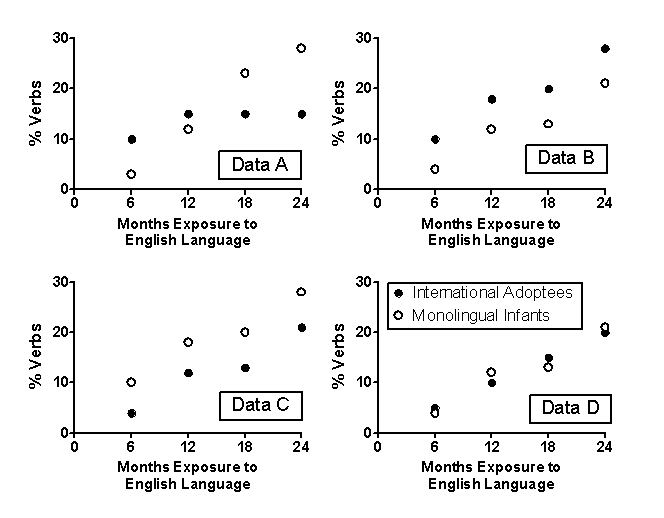 -(Scenario I)Snedeker and colleagues (2007)studied the acquisition of English as a second language in preschool children adopted from China.In trying to disentangle the role of linguistic and cognitive development on language acquisition,which factor would serve as the MOST appropriate control group?
Free
(Multiple Choice)
4.9/5  (76)
(76) Correct Answer: Verified
D
Use the following to answer questions
Scenario II
Scenario II is based on and presents results consistent with the following study:
Bechara,A. ,Damasio,H. ,Tranel,D. ,& Damasio,A.R.(1997).Deciding advantageously before knowing the advantageous strategy.Science,275(5304),1293-1295.doi:10.1126/science.275.5304.1293
Bechara and colleagues (1997)studied risky decision making on a gambling task in patients with brain damage in an area critically involved in executive functions such as planning and decision making.They compared this performance with the performance of control participants without brain damage.All participants were given a starting bankroll of $2,000 in facsimile dollars.In the baseline condition,participants chose cards from among four decks.Selecting cards from decks A and B sometimes resulted in a win of $100.Selecting cards from decks C and D sometimes resulted in a win of $50.No losses were incurred in this condition.In the subsequent experimental condition,however,some cards in all decks produced losses.The losses in decks A and B were large and occurred frequently enough to possibly result in bankruptcy.The losses in decks C and D were considerably smaller.Bechara and colleagues measured deck selection and the galvanic skin response (GSR)both prior to (anticipatory)and after (post-outcome)turning over each card.
In the baseline condition,all participants in both groups showed a clear preference for decks A and B.Both groups showed small but reliable anticipatory and post-outcome GSRs.In the experimental condition,with continued play the controls exhibited a clear preference for decks C and D,while the patients continued to play more from decks A and B.Relative to the baseline condition,controls exhibited a much larger anticipatory GSR prior to each decision,whereas the patients' anticipatory GSR was small and similar to that obtained under the baseline condition.The post-outcome GSRs were similar in the two groups and occurred to both wins and losses.
Interestingly,the investigator systematically interrupted play during the experimental condition and asked all participants if they had developed a game strategy.With continued play,most of the control participants labeled decks A and B as "the bad decks." Among the patients with brain damage,only half eventually labeled decks A and B as "the bad decks." Remarkably,in both groups,this realization did not affect game play.The minority of the control group who did not express a negative opinion about decks A and B nevertheless tended to avoid those decks.Similarly,the patients who acknowledged that decks C and D were risky nevertheless preferred those decks.
-(Scenario II)The results of this experiment illustrate the role of emotional experience on decision making.Choice situations involving probabilistic outcomes often elicit feelings of anxiety,operationally defined in this study as:
Free
(Multiple Choice)
4.8/5 (83)
(83) Correct Answer:Verified
VerifiedA
Use the following to answer questions
Scenario II
Scenario II is based on and presents results consistent with the following study:
Bechara,A. ,Damasio,H. ,Tranel,D. ,& Damasio,A.R.(1997).Deciding advantageously before knowing the advantageous strategy.Science,275(5304),1293-1295.doi:10.1126/science.275.5304.1293
Bechara and colleagues (1997)studied risky decision making on a gambling task in patients with brain damage in an area critically involved in executive functions such as planning and decision making.They compared this performance with the performance of control participants without brain damage.All participants were given a starting bankroll of $2,000 in facsimile dollars.In the baseline condition,participants chose cards from among four decks.Selecting cards from decks A and B sometimes resulted in a win of $100.Selecting cards from decks C and D sometimes resulted in a win of $50.No losses were incurred in this condition.In the subsequent experimental condition,however,some cards in all decks produced losses.The losses in decks A and B were large and occurred frequently enough to possibly result in bankruptcy.The losses in decks C and D were considerably smaller.Bechara and colleagues measured deck selection and the galvanic skin response (GSR)both prior to (anticipatory)and after (post-outcome)turning over each card.
In the baseline condition,all participants in both groups showed a clear preference for decks A and B.Both groups showed small but reliable anticipatory and post-outcome GSRs.In the experimental condition,with continued play the controls exhibited a clear preference for decks C and D,while the patients continued to play more from decks A and B.Relative to the baseline condition,controls exhibited a much larger anticipatory GSR prior to each decision,whereas the patients' anticipatory GSR was small and similar to that obtained under the baseline condition.The post-outcome GSRs were similar in the two groups and occurred to both wins and losses.
Interestingly,the investigator systematically interrupted play during the experimental condition and asked all participants if they had developed a game strategy.With continued play,most of the control participants labeled decks A and B as "the bad decks." Among the patients with brain damage,only half eventually labeled decks A and B as "the bad decks." Remarkably,in both groups,this realization did not affect game play.The minority of the control group who did not express a negative opinion about decks A and B nevertheless tended to avoid those decks.Similarly,the patients who acknowledged that decks C and D were risky nevertheless preferred those decks.
-(Scenario II)Which factor was NOT a dependent variable?
Free
(Multiple Choice)
4.7/5 (90)
(90) Correct Answer:Verified
VerifiedC
Use the following to answer questions
Scenario II
Scenario II is based on and presents results consistent with the following study:
Bechara,A. ,Damasio,H. ,Tranel,D. ,& Damasio,A.R.(1997).Deciding advantageously before knowing the advantageous strategy.Science,275(5304),1293-1295.doi:10.1126/science.275.5304.1293
Bechara and colleagues (1997)studied risky decision making on a gambling task in patients with brain damage in an area critically involved in executive functions such as planning and decision making.They compared this performance with the performance of control participants without brain damage.All participants were given a starting bankroll of $2,000 in facsimile dollars.In the baseline condition,participants chose cards from among four decks.Selecting cards from decks A and B sometimes resulted in a win of $100.Selecting cards from decks C and D sometimes resulted in a win of $50.No losses were incurred in this condition.In the subsequent experimental condition,however,some cards in all decks produced losses.The losses in decks A and B were large and occurred frequently enough to possibly result in bankruptcy.The losses in decks C and D were considerably smaller.Bechara and colleagues measured deck selection and the galvanic skin response (GSR)both prior to (anticipatory)and after (post-outcome)turning over each card.
In the baseline condition,all participants in both groups showed a clear preference for decks A and B.Both groups showed small but reliable anticipatory and post-outcome GSRs.In the experimental condition,with continued play the controls exhibited a clear preference for decks C and D,while the patients continued to play more from decks A and B.Relative to the baseline condition,controls exhibited a much larger anticipatory GSR prior to each decision,whereas the patients' anticipatory GSR was small and similar to that obtained under the baseline condition.The post-outcome GSRs were similar in the two groups and occurred to both wins and losses.
Interestingly,the investigator systematically interrupted play during the experimental condition and asked all participants if they had developed a game strategy.With continued play,most of the control participants labeled decks A and B as "the bad decks." Among the patients with brain damage,only half eventually labeled decks A and B as "the bad decks." Remarkably,in both groups,this realization did not affect game play.The minority of the control group who did not express a negative opinion about decks A and B nevertheless tended to avoid those decks.Similarly,the patients who acknowledged that decks C and D were risky nevertheless preferred those decks.
-(Scenario II)The results of this experiment suggest that individuals with this particular brain damage exhibit the GREATEST deficits in the ability to:
(Multiple Choice)
4.9/5 (82)
(82) Use the following to answer questions
Scenario II
Scenario II is based on and presents results consistent with the following study:
Bechara,A. ,Damasio,H. ,Tranel,D. ,& Damasio,A.R.(1997).Deciding advantageously before knowing the advantageous strategy.Science,275(5304),1293-1295.doi:10.1126/science.275.5304.1293
Bechara and colleagues (1997)studied risky decision making on a gambling task in patients with brain damage in an area critically involved in executive functions such as planning and decision making.They compared this performance with the performance of control participants without brain damage.All participants were given a starting bankroll of $2,000 in facsimile dollars.In the baseline condition,participants chose cards from among four decks.Selecting cards from decks A and B sometimes resulted in a win of $100.Selecting cards from decks C and D sometimes resulted in a win of $50.No losses were incurred in this condition.In the subsequent experimental condition,however,some cards in all decks produced losses.The losses in decks A and B were large and occurred frequently enough to possibly result in bankruptcy.The losses in decks C and D were considerably smaller.Bechara and colleagues measured deck selection and the galvanic skin response (GSR)both prior to (anticipatory)and after (post-outcome)turning over each card.
In the baseline condition,all participants in both groups showed a clear preference for decks A and B.Both groups showed small but reliable anticipatory and post-outcome GSRs.In the experimental condition,with continued play the controls exhibited a clear preference for decks C and D,while the patients continued to play more from decks A and B.Relative to the baseline condition,controls exhibited a much larger anticipatory GSR prior to each decision,whereas the patients' anticipatory GSR was small and similar to that obtained under the baseline condition.The post-outcome GSRs were similar in the two groups and occurred to both wins and losses.
Interestingly,the investigator systematically interrupted play during the experimental condition and asked all participants if they had developed a game strategy.With continued play,most of the control participants labeled decks A and B as "the bad decks." Among the patients with brain damage,only half eventually labeled decks A and B as "the bad decks." Remarkably,in both groups,this realization did not affect game play.The minority of the control group who did not express a negative opinion about decks A and B nevertheless tended to avoid those decks.Similarly,the patients who acknowledged that decks C and D were risky nevertheless preferred those decks.
-(Scenario II)Bechara and colleagues (1997)studied patients with brain damage in which areas?
(Multiple Choice)
4.9/5 (73)
(73) Use the following to answer questions
Scenario I
Scenario I is based on and presents results consistent with the following studies:
Snedeker,J. ,Geren,J. ,& Shafto,C.L.(2012).Disentangling the effects of cognitive development and linguistic expertise: A longitudinal study of the acquisition of English in internationally-adopted children.Cognitive Psychology,65(1),39-76.doi:10.1016/j.cogpsych.2012.01.004
Snedeker,J. ,Geren,J. ,& Shafto,C.L.(2007).Starting over: International adoption as a natural experiment in language development.Psychological Science,18(1),79-87.doi:10.1111/j.1467-9280.2007.01852.x
Language development occurs in orderly stages,beginning with one-word utterances and progressing to two-word utterances,simple sentences containing function morphemes,and the emergence of grammatical rules.Psycholinguists have attempted to determine if language development is a consequence of cognitive development or if it reflects linguistic processes that occur independently of general cognitive development.Studies on the acquisition of a second language in internationally adopted children have provided insight into this research question.In a series of studies,Snedeker and colleagues (2007,2012)studied the acquisition of the English language in adopted preschoolers from China.These children had no exposure to the English language before being adopted by families in the United States.
Figure 9.1
-(Scenario I)Snedeker and colleagues (2007)refers to their research program as a "natural experiment." However,for which reason is it NOT an example of a true experimental design?
-(Scenario I)Snedeker and colleagues (2007)refers to their research program as a "natural experiment." However,for which reason is it NOT an example of a true experimental design? (Multiple Choice)
4.8/5 (78)
(78) Use the following to answer questions
Scenario I
Scenario I is based on and presents results consistent with the following studies:
Snedeker,J. ,Geren,J. ,& Shafto,C.L.(2012).Disentangling the effects of cognitive development and linguistic expertise: A longitudinal study of the acquisition of English in internationally-adopted children.Cognitive Psychology,65(1),39-76.doi:10.1016/j.cogpsych.2012.01.004
Snedeker,J. ,Geren,J. ,& Shafto,C.L.(2007).Starting over: International adoption as a natural experiment in language development.Psychological Science,18(1),79-87.doi:10.1111/j.1467-9280.2007.01852.x
Language development occurs in orderly stages,beginning with one-word utterances and progressing to two-word utterances,simple sentences containing function morphemes,and the emergence of grammatical rules.Psycholinguists have attempted to determine if language development is a consequence of cognitive development or if it reflects linguistic processes that occur independently of general cognitive development.Studies on the acquisition of a second language in internationally adopted children have provided insight into this research question.In a series of studies,Snedeker and colleagues (2007,2012)studied the acquisition of the English language in adopted preschoolers from China.These children had no exposure to the English language before being adopted by families in the United States.
Figure 9.1
-(Scenario I)Which statement is an example of interpreting orderly changes in language development as a result of emerging cognitive skills?
-(Scenario I)Which statement is an example of interpreting orderly changes in language development as a result of emerging cognitive skills? (Multiple Choice)
4.9/5 (87)
(87) Use the following to answer questions
Scenario I
Scenario I is based on and presents results consistent with the following studies:
Snedeker,J. ,Geren,J. ,& Shafto,C.L.(2012).Disentangling the effects of cognitive development and linguistic expertise: A longitudinal study of the acquisition of English in internationally-adopted children.Cognitive Psychology,65(1),39-76.doi:10.1016/j.cogpsych.2012.01.004
Snedeker,J. ,Geren,J. ,& Shafto,C.L.(2007).Starting over: International adoption as a natural experiment in language development.Psychological Science,18(1),79-87.doi:10.1111/j.1467-9280.2007.01852.x
Language development occurs in orderly stages,beginning with one-word utterances and progressing to two-word utterances,simple sentences containing function morphemes,and the emergence of grammatical rules.Psycholinguists have attempted to determine if language development is a consequence of cognitive development or if it reflects linguistic processes that occur independently of general cognitive development.Studies on the acquisition of a second language in internationally adopted children have provided insight into this research question.In a series of studies,Snedeker and colleagues (2007,2012)studied the acquisition of the English language in adopted preschoolers from China.These children had no exposure to the English language before being adopted by families in the United States.
Figure 9.1
-(Scenario I)Which data set in Figure 9.1 provides the MOST support for the contention that language development is critically dependent on experience with the language?
-(Scenario I)Which data set in Figure 9.1 provides the MOST support for the contention that language development is critically dependent on experience with the language? (Multiple Choice)
4.8/5 (78)
(78) Use the following to answer questions
Scenario I
Scenario I is based on and presents results consistent with the following studies:
Snedeker,J. ,Geren,J. ,& Shafto,C.L.(2012).Disentangling the effects of cognitive development and linguistic expertise: A longitudinal study of the acquisition of English in internationally-adopted children.Cognitive Psychology,65(1),39-76.doi:10.1016/j.cogpsych.2012.01.004
Snedeker,J. ,Geren,J. ,& Shafto,C.L.(2007).Starting over: International adoption as a natural experiment in language development.Psychological Science,18(1),79-87.doi:10.1111/j.1467-9280.2007.01852.x
Language development occurs in orderly stages,beginning with one-word utterances and progressing to two-word utterances,simple sentences containing function morphemes,and the emergence of grammatical rules.Psycholinguists have attempted to determine if language development is a consequence of cognitive development or if it reflects linguistic processes that occur independently of general cognitive development.Studies on the acquisition of a second language in internationally adopted children have provided insight into this research question.In a series of studies,Snedeker and colleagues (2007,2012)studied the acquisition of the English language in adopted preschoolers from China.These children had no exposure to the English language before being adopted by families in the United States.
Figure 9.1
-(Scenario I)Which reason BEST explains why the research question posed in Scenario I could not be answered by studying infants' acquisition of the English language and comparing it with infants' acquisition of the Spanish language in American-born bilingual homes?
-(Scenario I)Which reason BEST explains why the research question posed in Scenario I could not be answered by studying infants' acquisition of the English language and comparing it with infants' acquisition of the Spanish language in American-born bilingual homes? (Multiple Choice)
4.8/5 (84)
(84) Use the following to answer questions
Scenario I
Scenario I is based on and presents results consistent with the following studies:
Snedeker,J. ,Geren,J. ,& Shafto,C.L.(2012).Disentangling the effects of cognitive development and linguistic expertise: A longitudinal study of the acquisition of English in internationally-adopted children.Cognitive Psychology,65(1),39-76.doi:10.1016/j.cogpsych.2012.01.004
Snedeker,J. ,Geren,J. ,& Shafto,C.L.(2007).Starting over: International adoption as a natural experiment in language development.Psychological Science,18(1),79-87.doi:10.1111/j.1467-9280.2007.01852.x
Language development occurs in orderly stages,beginning with one-word utterances and progressing to two-word utterances,simple sentences containing function morphemes,and the emergence of grammatical rules.Psycholinguists have attempted to determine if language development is a consequence of cognitive development or if it reflects linguistic processes that occur independently of general cognitive development.Studies on the acquisition of a second language in internationally adopted children have provided insight into this research question.In a series of studies,Snedeker and colleagues (2007,2012)studied the acquisition of the English language in adopted preschoolers from China.These children had no exposure to the English language before being adopted by families in the United States.
Figure 9.1
-(Scenario I)In a second study,Snedeker and colleagues (2012)found that older (e.g. ,5 year-old)internationally adopted children acquiring English as a second language began correctly using words pertaining to time (e.g. ,yesterday,tomorrow)earlier in their exposure to English than did monolingual infant controls.This observed difference is BEST interpreted as:
-(Scenario I)In a second study,Snedeker and colleagues (2012)found that older (e.g. ,5 year-old)internationally adopted children acquiring English as a second language began correctly using words pertaining to time (e.g. ,yesterday,tomorrow)earlier in their exposure to English than did monolingual infant controls.This observed difference is BEST interpreted as: (Multiple Choice)
4.7/5 (72)
(72) Use the following to answer questions
Scenario I
Scenario I is based on and presents results consistent with the following studies:
Snedeker,J. ,Geren,J. ,& Shafto,C.L.(2012).Disentangling the effects of cognitive development and linguistic expertise: A longitudinal study of the acquisition of English in internationally-adopted children.Cognitive Psychology,65(1),39-76.doi:10.1016/j.cogpsych.2012.01.004
Snedeker,J. ,Geren,J. ,& Shafto,C.L.(2007).Starting over: International adoption as a natural experiment in language development.Psychological Science,18(1),79-87.doi:10.1111/j.1467-9280.2007.01852.x
Language development occurs in orderly stages,beginning with one-word utterances and progressing to two-word utterances,simple sentences containing function morphemes,and the emergence of grammatical rules.Psycholinguists have attempted to determine if language development is a consequence of cognitive development or if it reflects linguistic processes that occur independently of general cognitive development.Studies on the acquisition of a second language in internationally adopted children have provided insight into this research question.In a series of studies,Snedeker and colleagues (2007,2012)studied the acquisition of the English language in adopted preschoolers from China.These children had no exposure to the English language before being adopted by families in the United States.
Figure 9.1
-(Scenario I)Figure 9.1 shows the number of verbs,expressed as a percentage of total English vocabulary,between 6 and 24 months of exposure to the English language in internationally adopted preschoolers from China and monolingual infants.Four fabricated sets of data (labeled A-D)are shown.Which data set provides the MOST support for the contention that cognitive factors play a role in language development?
-(Scenario I)Figure 9.1 shows the number of verbs,expressed as a percentage of total English vocabulary,between 6 and 24 months of exposure to the English language in internationally adopted preschoolers from China and monolingual infants.Four fabricated sets of data (labeled A-D)are shown.Which data set provides the MOST support for the contention that cognitive factors play a role in language development? (Multiple Choice)
4.8/5 (85)
(85) Use the following to answer questions
Scenario II
Scenario II is based on and presents results consistent with the following study:
Bechara,A. ,Damasio,H. ,Tranel,D. ,& Damasio,A.R.(1997).Deciding advantageously before knowing the advantageous strategy.Science,275(5304),1293-1295.doi:10.1126/science.275.5304.1293
Bechara and colleagues (1997)studied risky decision making on a gambling task in patients with brain damage in an area critically involved in executive functions such as planning and decision making.They compared this performance with the performance of control participants without brain damage.All participants were given a starting bankroll of $2,000 in facsimile dollars.In the baseline condition,participants chose cards from among four decks.Selecting cards from decks A and B sometimes resulted in a win of $100.Selecting cards from decks C and D sometimes resulted in a win of $50.No losses were incurred in this condition.In the subsequent experimental condition,however,some cards in all decks produced losses.The losses in decks A and B were large and occurred frequently enough to possibly result in bankruptcy.The losses in decks C and D were considerably smaller.Bechara and colleagues measured deck selection and the galvanic skin response (GSR)both prior to (anticipatory)and after (post-outcome)turning over each card.
In the baseline condition,all participants in both groups showed a clear preference for decks A and B.Both groups showed small but reliable anticipatory and post-outcome GSRs.In the experimental condition,with continued play the controls exhibited a clear preference for decks C and D,while the patients continued to play more from decks A and B.Relative to the baseline condition,controls exhibited a much larger anticipatory GSR prior to each decision,whereas the patients' anticipatory GSR was small and similar to that obtained under the baseline condition.The post-outcome GSRs were similar in the two groups and occurred to both wins and losses.
Interestingly,the investigator systematically interrupted play during the experimental condition and asked all participants if they had developed a game strategy.With continued play,most of the control participants labeled decks A and B as "the bad decks." Among the patients with brain damage,only half eventually labeled decks A and B as "the bad decks." Remarkably,in both groups,this realization did not affect game play.The minority of the control group who did not express a negative opinion about decks A and B nevertheless tended to avoid those decks.Similarly,the patients who acknowledged that decks C and D were risky nevertheless preferred those decks.
-(Scenario II)What can be accurately inferred from Scenario II?
(Multiple Choice)
5.0/5 (80)
(80) 
Filters
- Essay(0)
- Multiple Choice(0)
- Short Answer(0)
- True False(0)
- Matching(0)