



 Chat with AI
Exam 11: Development-Part B

Exam 1: Evolution of Psychological Science-Part A323 Questions
Exam 1: Evolution of Psychological Science-Part B14 Questions
Exam 1: Evolution of Psychological Science-Part C98 Questions
Exam 1: Evolution of Psychological Science-Part D15 Questions
Exam 1: Evolution of Psychological Science-Part E15 Questions
Exam 2: Methods in Psychology-Part A295 Questions
Exam 2: Methods in Psychology-Part B13 Questions
Exam 2: Methods in Psychology-Part C73 Questions
Exam 2: Methods in Psychology-Part D15 Questions
Exam 2: Methods in Psychology-Part E14 Questions
Exam 3: Neuroscience and Behavior-Part A424 Questions
Exam 3: Neuroscience and Behavior-Part B12 Questions
Exam 3: Neuroscience and Behavior-Part C122 Questions
Exam 3: Neuroscience and Behavior-Part D15 Questions
Exam 3: Neuroscience and Behavior-Part E15 Questions
Exam 4: Sensation and Perception-Part A365 Questions
Exam 4: Sensation and Perception-Part B12 Questions
Exam 4: Sensation and Perception-Part C147 Questions
Exam 4: Sensation and Perception-Part D15 Questions
Exam 4: Sensation and Perception-Part E15 Questions
Exam 5: Consciousness-Part A264 Questions
Exam 5: Consciousness-Part B13 Questions
Exam 5: Consciousness-Part C102 Questions
Exam 5: Consciousness-Part D15 Questions
Exam 5: Consciousness-Part E15 Questions
Exam 6: Memory-Part A346 Questions
Exam 6: Memory-Part B11 Questions
Exam 6: Memory-Part C99 Questions
Exam 6: Memory-Part D15 Questions
Exam 6: Memory-Part E15 Questions
Exam 7: Learning-Part A291 Questions
Exam 7: Learning-Part B13 Questions
Exam 7: Learning-Part C134 Questions
Exam 7: Learning-Part D16 Questions
Exam 7: Learning-Part E15 Questions
Exam 8: Emotion and Motivation-Part A231 Questions
Exam 8: Emotion and Motivation-Part B12 Questions
Exam 8: Emotion and Motivation-Part C91 Questions
Exam 8: Emotion and Motivation-Part D15 Questions
Exam 8: Emotion and Motivation-Part E15 Questions
Exam 9: Language and Thought-Part A242 Questions
Exam 9: Language and Thought-Part B12 Questions
Exam 9: Language and Thought-Part C107 Questions
Exam 9: Language and Thought-Part D15 Questions
Exam 9: Language and Thought-Part E15 Questions
Exam 10: Intelligence-Part A187 Questions
Exam 10: Intelligence-Part B12 Questions
Exam 10: Intelligence-Part C84 Questions
Exam 10: Intelligence-Part D15 Questions
Exam 10: Intelligence-Part E12 Questions
Exam 11: Development-Part A261 Questions
Exam 11: Development-Part B14 Questions
Exam 11: Development-Part C83 Questions
Exam 11: Development-Part D15 Questions
Exam 11: Development-Part E15 Questions
Exam 12: Personality-Part A252 Questions
Exam 12: Personality-Part B12 Questions
Exam 12: Personality-Part C75 Questions
Exam 12: Personality-Part D15 Questions
Exam 12: Personality-Part E15 Questions
Exam 13: Social Psychology-Part A238 Questions
Exam 13: Social Psychology-Part B16 Questions
Exam 13: Social Psychology-Part C81 Questions
Exam 13: Social Psychology-Part D15 Questions
Exam 13: Social Psychology-Part E15 Questions
Exam 14: Stress and Health-Part A186 Questions
Exam 14: Stress and Health-Part B12 Questions
Exam 14: Stress and Health-Part C84 Questions
Exam 14: Stress and Health-Part D15 Questions
Exam 14: Stress and Health-Part E15 Questions
Exam 15: Psychological Disorders-Part A282 Questions
Exam 15: Psychological Disorders-Part B12 Questions
Exam 15: Psychological Disorders-Part C57 Questions
Exam 15: Psychological Disorders-Part D15 Questions
Exam 15: Psychological Disorders-Part E15 Questions
Exam 16: Treatment of Psychological Disorders-Part A212 Questions
Exam 16: Treatment of Psychological Disorders-Part B12 Questions
Exam 16: Treatment of Psychological Disorders-Part C95 Questions
Exam 16: Treatment of Psychological Disorders-Part D14 Questions
Exam 16: Treatment of Psychological Disorders-Part E15 Questions
Exam 17: Psychology Appendix214 Questions
Select questions type


Use the following to answer questions
Scenario II
Scenario II is based on the following studies:
Gopnik,A. ,& Astington,J.W.(1988).Children's understanding of representative change and its relation to the understanding of false belief and the appearance-reality distinction.Child Development,59,26-37.
Wimmer,H. ,& Perner,J.(1983).Beliefs about beliefs: Representation and constraining function of wrong beliefs in young children's understanding of deception.Cognition,13(1),103-128.
Wimmer and Perner (1983)first developed a procedure to assess if children have developed a theory of mind.Children were read an illustrated story in which a puppet named Maxi hid a piece of chocolate in one cupboard and then left the room.While Maxi was away,a second puppet entered the room,discovered the chocolate,and hid it in a new location before leaving.The story ended with Maxi's return.Children were asked where Maxi will look for the chocolate.Whereas most 5-year-olds who have developed a theory of mind will report that he will look in the cupboard,most 3-year-olds will report that Maxi will look in the new location.
Using a different procedure,Gopnik and Astington (1988)first arranged a control condition in which children were shown a dollhouse.Inside the dollhouse was an apple.In the presence of the children,the experimenter opened the dollhouse and replaced the apple with a doll.A few minutes later,the children were asked what was currently in the dollhouse and what had previously been in the dollhouse.Only children who answered these questions correctly progressed to the experimental condition.Here,the experimenter showed children a candy box.When they opened it,the children discovered that it contained pencils.When the children were asked what they originally thought was in the box,most 5-year-olds said candy and most 3-year-olds said pencils.
-(Scenario II)The results obtained in the experimental condition by Gopnik and Astington (1988)suggests that 3-year-olds treat their past selves as:

Free
(Multiple Choice)
4.9/5  (84)
(84) Correct Answer: Verified
B
Use the following to answer questions
Scenario I
Scenario I is based on and presents fabricated results consistent with the following study:
Kim,I.K. ,& Spelke,E.S.(1992).Infants' sensitivity to effects of gravity on visual object motion.Journal of Experimental Psychology: Human Perception and Performance,18(2),385-393.
Kim and Spelke (1992)investigated the extent to which infants have expectancies of gravitational effects on visual object motion.Infants of 3 and 5 months of age repeatedly watched a video of a ball accelerating as it rolled down an incline until they spent little time actively looking at it.Subsequently,two types of test trials were conducted in randomized order.Type A test trials consisted of a ball slowing down as it rolled up an incline.Type B test trials consisted of a ball slowing down as it rolled down an incline.During all trials,the amount of time looking at each visual display was recorded.Fabricated data consistent with the major finding of this study are presented in Figure 11.1.
Figure 11.1
Note that "Age 5" and "Age 3" in the legend refer to months of age. 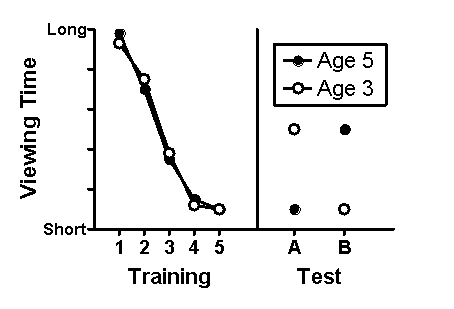 -(Scenario I)This study exploits the well-known finding that infants generally will _____ objects or scenarios that are _____.
Free
(Multiple Choice)
4.9/5 (87)
(87) Correct Answer:Verified
VerifiedB
Use the following to answer questions
Scenario II
Scenario II is based on the following studies:
Gopnik,A. ,& Astington,J.W.(1988).Children's understanding of representative change and its relation to the understanding of false belief and the appearance-reality distinction.Child Development,59,26-37.
Wimmer,H. ,& Perner,J.(1983).Beliefs about beliefs: Representation and constraining function of wrong beliefs in young children's understanding of deception.Cognition,13(1),103-128.
Wimmer and Perner (1983)first developed a procedure to assess if children have developed a theory of mind.Children were read an illustrated story in which a puppet named Maxi hid a piece of chocolate in one cupboard and then left the room.While Maxi was away,a second puppet entered the room,discovered the chocolate,and hid it in a new location before leaving.The story ended with Maxi's return.Children were asked where Maxi will look for the chocolate.Whereas most 5-year-olds who have developed a theory of mind will report that he will look in the cupboard,most 3-year-olds will report that Maxi will look in the new location.
Using a different procedure,Gopnik and Astington (1988)first arranged a control condition in which children were shown a dollhouse.Inside the dollhouse was an apple.In the presence of the children,the experimenter opened the dollhouse and replaced the apple with a doll.A few minutes later,the children were asked what was currently in the dollhouse and what had previously been in the dollhouse.Only children who answered these questions correctly progressed to the experimental condition.Here,the experimenter showed children a candy box.When they opened it,the children discovered that it contained pencils.When the children were asked what they originally thought was in the box,most 5-year-olds said candy and most 3-year-olds said pencils.
-(Scenario II)Lacking a theory of mind,3-year-olds in Wimmer and Perner's (1983)study demonstrated:
Free
(Multiple Choice)
4.9/5 (90)
(90) Correct Answer:Verified
VerifiedA
Use the following to answer questions
Scenario II
Scenario II is based on the following studies:
Gopnik,A. ,& Astington,J.W.(1988).Children's understanding of representative change and its relation to the understanding of false belief and the appearance-reality distinction.Child Development,59,26-37.
Wimmer,H. ,& Perner,J.(1983).Beliefs about beliefs: Representation and constraining function of wrong beliefs in young children's understanding of deception.Cognition,13(1),103-128.
Wimmer and Perner (1983)first developed a procedure to assess if children have developed a theory of mind.Children were read an illustrated story in which a puppet named Maxi hid a piece of chocolate in one cupboard and then left the room.While Maxi was away,a second puppet entered the room,discovered the chocolate,and hid it in a new location before leaving.The story ended with Maxi's return.Children were asked where Maxi will look for the chocolate.Whereas most 5-year-olds who have developed a theory of mind will report that he will look in the cupboard,most 3-year-olds will report that Maxi will look in the new location.
Using a different procedure,Gopnik and Astington (1988)first arranged a control condition in which children were shown a dollhouse.Inside the dollhouse was an apple.In the presence of the children,the experimenter opened the dollhouse and replaced the apple with a doll.A few minutes later,the children were asked what was currently in the dollhouse and what had previously been in the dollhouse.Only children who answered these questions correctly progressed to the experimental condition.Here,the experimenter showed children a candy box.When they opened it,the children discovered that it contained pencils.When the children were asked what they originally thought was in the box,most 5-year-olds said candy and most 3-year-olds said pencils.
-(Scenario II)In order to respond CORRECTLY in Wimmer and Perner's (1983)study,children need to:
(Multiple Choice)
4.8/5 (83)
(83) Use the following to answer questions
Scenario II
Scenario II is based on the following studies:
Gopnik,A. ,& Astington,J.W.(1988).Children's understanding of representative change and its relation to the understanding of false belief and the appearance-reality distinction.Child Development,59,26-37.
Wimmer,H. ,& Perner,J.(1983).Beliefs about beliefs: Representation and constraining function of wrong beliefs in young children's understanding of deception.Cognition,13(1),103-128.
Wimmer and Perner (1983)first developed a procedure to assess if children have developed a theory of mind.Children were read an illustrated story in which a puppet named Maxi hid a piece of chocolate in one cupboard and then left the room.While Maxi was away,a second puppet entered the room,discovered the chocolate,and hid it in a new location before leaving.The story ended with Maxi's return.Children were asked where Maxi will look for the chocolate.Whereas most 5-year-olds who have developed a theory of mind will report that he will look in the cupboard,most 3-year-olds will report that Maxi will look in the new location.
Using a different procedure,Gopnik and Astington (1988)first arranged a control condition in which children were shown a dollhouse.Inside the dollhouse was an apple.In the presence of the children,the experimenter opened the dollhouse and replaced the apple with a doll.A few minutes later,the children were asked what was currently in the dollhouse and what had previously been in the dollhouse.Only children who answered these questions correctly progressed to the experimental condition.Here,the experimenter showed children a candy box.When they opened it,the children discovered that it contained pencils.When the children were asked what they originally thought was in the box,most 5-year-olds said candy and most 3-year-olds said pencils.
-(Scenario II)Wimmer and Perner's (1983)procedure is commonly referred to as a _____ test.
(Multiple Choice)
4.9/5 (84)
(84) Use the following to answer questions
Scenario II
Scenario II is based on the following studies:
Gopnik,A. ,& Astington,J.W.(1988).Children's understanding of representative change and its relation to the understanding of false belief and the appearance-reality distinction.Child Development,59,26-37.
Wimmer,H. ,& Perner,J.(1983).Beliefs about beliefs: Representation and constraining function of wrong beliefs in young children's understanding of deception.Cognition,13(1),103-128.
Wimmer and Perner (1983)first developed a procedure to assess if children have developed a theory of mind.Children were read an illustrated story in which a puppet named Maxi hid a piece of chocolate in one cupboard and then left the room.While Maxi was away,a second puppet entered the room,discovered the chocolate,and hid it in a new location before leaving.The story ended with Maxi's return.Children were asked where Maxi will look for the chocolate.Whereas most 5-year-olds who have developed a theory of mind will report that he will look in the cupboard,most 3-year-olds will report that Maxi will look in the new location.
Using a different procedure,Gopnik and Astington (1988)first arranged a control condition in which children were shown a dollhouse.Inside the dollhouse was an apple.In the presence of the children,the experimenter opened the dollhouse and replaced the apple with a doll.A few minutes later,the children were asked what was currently in the dollhouse and what had previously been in the dollhouse.Only children who answered these questions correctly progressed to the experimental condition.Here,the experimenter showed children a candy box.When they opened it,the children discovered that it contained pencils.When the children were asked what they originally thought was in the box,most 5-year-olds said candy and most 3-year-olds said pencils.
-(Scenario II)The fact that 3-year olds in the Gopnik and Astington (1988)study responded accurately in the control condition but inaccurately in the experimental condition:
(Multiple Choice)
4.8/5 (67)
(67) Use the following to answer questions
Scenario I
Scenario I is based on and presents fabricated results consistent with the following study:
Kim,I.K. ,& Spelke,E.S.(1992).Infants' sensitivity to effects of gravity on visual object motion.Journal of Experimental Psychology: Human Perception and Performance,18(2),385-393.
Kim and Spelke (1992)investigated the extent to which infants have expectancies of gravitational effects on visual object motion.Infants of 3 and 5 months of age repeatedly watched a video of a ball accelerating as it rolled down an incline until they spent little time actively looking at it.Subsequently,two types of test trials were conducted in randomized order.Type A test trials consisted of a ball slowing down as it rolled up an incline.Type B test trials consisted of a ball slowing down as it rolled down an incline.During all trials,the amount of time looking at each visual display was recorded.Fabricated data consistent with the major finding of this study are presented in Figure 11.1.
Figure 11.1
Note that "Age 5" and "Age 3" in the legend refer to months of age.
-(Scenario I)Which inference is TRUE based on the data shown in Figure 11.1?
-(Scenario I)Which inference is TRUE based on the data shown in Figure 11.1? (Multiple Choice)
5.0/5 (70)
(70) Use the following to answer questions
Scenario I
Scenario I is based on and presents fabricated results consistent with the following study:
Kim,I.K. ,& Spelke,E.S.(1992).Infants' sensitivity to effects of gravity on visual object motion.Journal of Experimental Psychology: Human Perception and Performance,18(2),385-393.
Kim and Spelke (1992)investigated the extent to which infants have expectancies of gravitational effects on visual object motion.Infants of 3 and 5 months of age repeatedly watched a video of a ball accelerating as it rolled down an incline until they spent little time actively looking at it.Subsequently,two types of test trials were conducted in randomized order.Type A test trials consisted of a ball slowing down as it rolled up an incline.Type B test trials consisted of a ball slowing down as it rolled down an incline.During all trials,the amount of time looking at each visual display was recorded.Fabricated data consistent with the major finding of this study are presented in Figure 11.1.
Figure 11.1
Note that "Age 5" and "Age 3" in the legend refer to months of age.
-(Scenario I)Based on the data shown in Figure 11.1,which group(s)of infants,if any,appear(s)to possess a concept of gravity?
-(Scenario I)Based on the data shown in Figure 11.1,which group(s)of infants,if any,appear(s)to possess a concept of gravity? (Multiple Choice)
5.0/5 (81)
(81) Use the following to answer questions
Scenario II
Scenario II is based on the following studies:
Gopnik,A. ,& Astington,J.W.(1988).Children's understanding of representative change and its relation to the understanding of false belief and the appearance-reality distinction.Child Development,59,26-37.
Wimmer,H. ,& Perner,J.(1983).Beliefs about beliefs: Representation and constraining function of wrong beliefs in young children's understanding of deception.Cognition,13(1),103-128.
Wimmer and Perner (1983)first developed a procedure to assess if children have developed a theory of mind.Children were read an illustrated story in which a puppet named Maxi hid a piece of chocolate in one cupboard and then left the room.While Maxi was away,a second puppet entered the room,discovered the chocolate,and hid it in a new location before leaving.The story ended with Maxi's return.Children were asked where Maxi will look for the chocolate.Whereas most 5-year-olds who have developed a theory of mind will report that he will look in the cupboard,most 3-year-olds will report that Maxi will look in the new location.
Using a different procedure,Gopnik and Astington (1988)first arranged a control condition in which children were shown a dollhouse.Inside the dollhouse was an apple.In the presence of the children,the experimenter opened the dollhouse and replaced the apple with a doll.A few minutes later,the children were asked what was currently in the dollhouse and what had previously been in the dollhouse.Only children who answered these questions correctly progressed to the experimental condition.Here,the experimenter showed children a candy box.When they opened it,the children discovered that it contained pencils.When the children were asked what they originally thought was in the box,most 5-year-olds said candy and most 3-year-olds said pencils.
-(Scenario II)Which explanation of the general findings by Wimmer and Perner (1983)does the control condition conducted by Gopnik and Astington (1988)support?
(Multiple Choice)
4.8/5 (65)
(65) Use the following to answer questions
Scenario I
Scenario I is based on and presents fabricated results consistent with the following study:
Kim,I.K. ,& Spelke,E.S.(1992).Infants' sensitivity to effects of gravity on visual object motion.Journal of Experimental Psychology: Human Perception and Performance,18(2),385-393.
Kim and Spelke (1992)investigated the extent to which infants have expectancies of gravitational effects on visual object motion.Infants of 3 and 5 months of age repeatedly watched a video of a ball accelerating as it rolled down an incline until they spent little time actively looking at it.Subsequently,two types of test trials were conducted in randomized order.Type A test trials consisted of a ball slowing down as it rolled up an incline.Type B test trials consisted of a ball slowing down as it rolled down an incline.During all trials,the amount of time looking at each visual display was recorded.Fabricated data consistent with the major finding of this study are presented in Figure 11.1.
Figure 11.1
Note that "Age 5" and "Age 3" in the legend refer to months of age.
-(Scenario I)Kim and Spelke (1992)utilized a simple form of learning termed _____ to investigate their research question.
-(Scenario I)Kim and Spelke (1992)utilized a simple form of learning termed _____ to investigate their research question. (Multiple Choice)
4.8/5 (70)
(70) Use the following to answer questions
Scenario I
Scenario I is based on and presents fabricated results consistent with the following study:
Kim,I.K. ,& Spelke,E.S.(1992).Infants' sensitivity to effects of gravity on visual object motion.Journal of Experimental Psychology: Human Perception and Performance,18(2),385-393.
Kim and Spelke (1992)investigated the extent to which infants have expectancies of gravitational effects on visual object motion.Infants of 3 and 5 months of age repeatedly watched a video of a ball accelerating as it rolled down an incline until they spent little time actively looking at it.Subsequently,two types of test trials were conducted in randomized order.Type A test trials consisted of a ball slowing down as it rolled up an incline.Type B test trials consisted of a ball slowing down as it rolled down an incline.During all trials,the amount of time looking at each visual display was recorded.Fabricated data consistent with the major finding of this study are presented in Figure 11.1.
Figure 11.1
Note that "Age 5" and "Age 3" in the legend refer to months of age.
-(Scenario I)Which explanation is MOST likely for the decreased looking time across training trials?
-(Scenario I)Which explanation is MOST likely for the decreased looking time across training trials? (Multiple Choice)
4.7/5 (84)
(84) Use the following to answer questions
Scenario I
Scenario I is based on and presents fabricated results consistent with the following study:
Kim,I.K. ,& Spelke,E.S.(1992).Infants' sensitivity to effects of gravity on visual object motion.Journal of Experimental Psychology: Human Perception and Performance,18(2),385-393.
Kim and Spelke (1992)investigated the extent to which infants have expectancies of gravitational effects on visual object motion.Infants of 3 and 5 months of age repeatedly watched a video of a ball accelerating as it rolled down an incline until they spent little time actively looking at it.Subsequently,two types of test trials were conducted in randomized order.Type A test trials consisted of a ball slowing down as it rolled up an incline.Type B test trials consisted of a ball slowing down as it rolled down an incline.During all trials,the amount of time looking at each visual display was recorded.Fabricated data consistent with the major finding of this study are presented in Figure 11.1.
Figure 11.1
Note that "Age 5" and "Age 3" in the legend refer to months of age.
-(Scenario I)Evidence of the presence or absence of gravitational expectancies were operationally defined in terms of:
-(Scenario I)Evidence of the presence or absence of gravitational expectancies were operationally defined in terms of: (Multiple Choice)
4.7/5 (89)
(89) Use the following to answer questions
Scenario II
Scenario II is based on the following studies:
Gopnik,A. ,& Astington,J.W.(1988).Children's understanding of representative change and its relation to the understanding of false belief and the appearance-reality distinction.Child Development,59,26-37.
Wimmer,H. ,& Perner,J.(1983).Beliefs about beliefs: Representation and constraining function of wrong beliefs in young children's understanding of deception.Cognition,13(1),103-128.
Wimmer and Perner (1983)first developed a procedure to assess if children have developed a theory of mind.Children were read an illustrated story in which a puppet named Maxi hid a piece of chocolate in one cupboard and then left the room.While Maxi was away,a second puppet entered the room,discovered the chocolate,and hid it in a new location before leaving.The story ended with Maxi's return.Children were asked where Maxi will look for the chocolate.Whereas most 5-year-olds who have developed a theory of mind will report that he will look in the cupboard,most 3-year-olds will report that Maxi will look in the new location.
Using a different procedure,Gopnik and Astington (1988)first arranged a control condition in which children were shown a dollhouse.Inside the dollhouse was an apple.In the presence of the children,the experimenter opened the dollhouse and replaced the apple with a doll.A few minutes later,the children were asked what was currently in the dollhouse and what had previously been in the dollhouse.Only children who answered these questions correctly progressed to the experimental condition.Here,the experimenter showed children a candy box.When they opened it,the children discovered that it contained pencils.When the children were asked what they originally thought was in the box,most 5-year-olds said candy and most 3-year-olds said pencils.
-(Scenario II)In the Gopnik and Astington (1988)study,the control question "What used to be in the dollhouse?" is analogous to asking children in the Wimmer and Perner (1983)study:
(Multiple Choice)
4.8/5 (83)
(83) Use the following to answer questions
Scenario I
Scenario I is based on and presents fabricated results consistent with the following study:
Kim,I.K. ,& Spelke,E.S.(1992).Infants' sensitivity to effects of gravity on visual object motion.Journal of Experimental Psychology: Human Perception and Performance,18(2),385-393.
Kim and Spelke (1992)investigated the extent to which infants have expectancies of gravitational effects on visual object motion.Infants of 3 and 5 months of age repeatedly watched a video of a ball accelerating as it rolled down an incline until they spent little time actively looking at it.Subsequently,two types of test trials were conducted in randomized order.Type A test trials consisted of a ball slowing down as it rolled up an incline.Type B test trials consisted of a ball slowing down as it rolled down an incline.During all trials,the amount of time looking at each visual display was recorded.Fabricated data consistent with the major finding of this study are presented in Figure 11.1.
Figure 11.1
Note that "Age 5" and "Age 3" in the legend refer to months of age.
-(Scenario I)Which statement pertaining to the test trials is TRUE?
-(Scenario I)Which statement pertaining to the test trials is TRUE? (Multiple Choice)
4.7/5 (92)
(92) 
Filters
- Essay(0)
- Multiple Choice(0)
- Short Answer(0)
- True False(0)
- Matching(0)