



 Chat with AI
Exam 6: Memory-Part B

Exam 1: Evolution of Psychological Science-Part A323 Questions
Exam 1: Evolution of Psychological Science-Part B14 Questions
Exam 1: Evolution of Psychological Science-Part C98 Questions
Exam 1: Evolution of Psychological Science-Part D15 Questions
Exam 1: Evolution of Psychological Science-Part E15 Questions
Exam 2: Methods in Psychology-Part A295 Questions
Exam 2: Methods in Psychology-Part B13 Questions
Exam 2: Methods in Psychology-Part C73 Questions
Exam 2: Methods in Psychology-Part D15 Questions
Exam 2: Methods in Psychology-Part E14 Questions
Exam 3: Neuroscience and Behavior-Part A424 Questions
Exam 3: Neuroscience and Behavior-Part B12 Questions
Exam 3: Neuroscience and Behavior-Part C122 Questions
Exam 3: Neuroscience and Behavior-Part D15 Questions
Exam 3: Neuroscience and Behavior-Part E15 Questions
Exam 4: Sensation and Perception-Part A365 Questions
Exam 4: Sensation and Perception-Part B12 Questions
Exam 4: Sensation and Perception-Part C147 Questions
Exam 4: Sensation and Perception-Part D15 Questions
Exam 4: Sensation and Perception-Part E15 Questions
Exam 5: Consciousness-Part A264 Questions
Exam 5: Consciousness-Part B13 Questions
Exam 5: Consciousness-Part C102 Questions
Exam 5: Consciousness-Part D15 Questions
Exam 5: Consciousness-Part E15 Questions
Exam 6: Memory-Part A346 Questions
Exam 6: Memory-Part B11 Questions
Exam 6: Memory-Part C99 Questions
Exam 6: Memory-Part D15 Questions
Exam 6: Memory-Part E15 Questions
Exam 7: Learning-Part A291 Questions
Exam 7: Learning-Part B13 Questions
Exam 7: Learning-Part C134 Questions
Exam 7: Learning-Part D16 Questions
Exam 7: Learning-Part E15 Questions
Exam 8: Emotion and Motivation-Part A231 Questions
Exam 8: Emotion and Motivation-Part B12 Questions
Exam 8: Emotion and Motivation-Part C91 Questions
Exam 8: Emotion and Motivation-Part D15 Questions
Exam 8: Emotion and Motivation-Part E15 Questions
Exam 9: Language and Thought-Part A242 Questions
Exam 9: Language and Thought-Part B12 Questions
Exam 9: Language and Thought-Part C107 Questions
Exam 9: Language and Thought-Part D15 Questions
Exam 9: Language and Thought-Part E15 Questions
Exam 10: Intelligence-Part A187 Questions
Exam 10: Intelligence-Part B12 Questions
Exam 10: Intelligence-Part C84 Questions
Exam 10: Intelligence-Part D15 Questions
Exam 10: Intelligence-Part E12 Questions
Exam 11: Development-Part A261 Questions
Exam 11: Development-Part B14 Questions
Exam 11: Development-Part C83 Questions
Exam 11: Development-Part D15 Questions
Exam 11: Development-Part E15 Questions
Exam 12: Personality-Part A252 Questions
Exam 12: Personality-Part B12 Questions
Exam 12: Personality-Part C75 Questions
Exam 12: Personality-Part D15 Questions
Exam 12: Personality-Part E15 Questions
Exam 13: Social Psychology-Part A238 Questions
Exam 13: Social Psychology-Part B16 Questions
Exam 13: Social Psychology-Part C81 Questions
Exam 13: Social Psychology-Part D15 Questions
Exam 13: Social Psychology-Part E15 Questions
Exam 14: Stress and Health-Part A186 Questions
Exam 14: Stress and Health-Part B12 Questions
Exam 14: Stress and Health-Part C84 Questions
Exam 14: Stress and Health-Part D15 Questions
Exam 14: Stress and Health-Part E15 Questions
Exam 15: Psychological Disorders-Part A282 Questions
Exam 15: Psychological Disorders-Part B12 Questions
Exam 15: Psychological Disorders-Part C57 Questions
Exam 15: Psychological Disorders-Part D15 Questions
Exam 15: Psychological Disorders-Part E15 Questions
Exam 16: Treatment of Psychological Disorders-Part A212 Questions
Exam 16: Treatment of Psychological Disorders-Part B12 Questions
Exam 16: Treatment of Psychological Disorders-Part C95 Questions
Exam 16: Treatment of Psychological Disorders-Part D14 Questions
Exam 16: Treatment of Psychological Disorders-Part E15 Questions
Exam 17: Psychology Appendix214 Questions
Select questions type


Use the following to answer questions
Scenario II
Famous within psychology,patient HM had parts of his temporal lobes-including his hippocampus-removed to stop incurable and life-threatening epileptic seizures.The surgery was successful;however,patient HM was left with a severe case of anterograde amnesia.Subsequent tests found that his short-term and implicit memory systems were not affected by the surgery.
-(Scenario II)Which memory processes were severely impaired by the surgery?

Free
(Multiple Choice)
4.9/5  (81)
(81) Correct Answer: Verified
A
Use the following to answer questions
Scenario II
Famous within psychology,patient HM had parts of his temporal lobes-including his hippocampus-removed to stop incurable and life-threatening epileptic seizures.The surgery was successful;however,patient HM was left with a severe case of anterograde amnesia.Subsequent tests found that his short-term and implicit memory systems were not affected by the surgery.
-(Scenario II)Based on the information provided,this scenario BEST illustrates which psychological research method?
Free
(Multiple Choice)
4.7/5 (83)
(83) Correct Answer:Verified
VerifiedD
Use the following to answer questions
Scenario I
Scenario I is based on and provides fabricated data consistent with the following study:
Barber,S.J. ,Rajaram,S. ,& Fox,E.B.(2012).Learning and remembering with others: The key role of retrieval in shaping group recall and collective memory.Social Cognition,30(1),121-132.doi:10.1521/soco.2012.30.1.121
In a typical experiment on collaborative memory,participants first encode information individually and later attempt to recall the information either individually or in a small group (collaboratively).While the recall of the collaborative group is better than that of any individual,the summed recall of individuals typically is better than the recall of the collaborative group.This is a phenomenon termed collaborative inhibition.Barber,Rajaram,and Fox (2012)investigated this phenomenon during both the encoding and retrieval stages of memory.
Participants created sentences out of a word bank,which provided for the opportunity to encode this information.After completing this task,participants engaged in an unrelated task-solving mazes-for 10 minutes.Then,in a surprise memory test,they were asked to recall as many words from the word bank as possible (retrieval).
Participants were randomly assigned to one of four groups.In the first group (Alone-Alone),participants were studied individually during both the encoding and retrieval phases of the experiment.In the second group (Alone-Collaborative),participants were studied individually during the encoding phase and studied as part of a three-member team (triad)during the retrieval phase.In the third group (Collaborative-Alone),participants were studied in a triad during the encoding phase but individually during the retrieval phase.Finally,in the fourth group (Collaborative-Collaborative),participants completed both phases of the experiment as part of a triad.
Fabricated results illustrating the major finding of Barber et al.(2012)are presented in Figure 6.1.This figure shows the percentage of words from the word bank accurately recalled as a function of group.For the two groups that experienced the retrieval phase individually,scores represent the summed retrieval of the individuals comprising the group.For the two groups that experienced the retrieval phase as part of a triad,scores simply represent the collaborative performance.
Figure 6.1 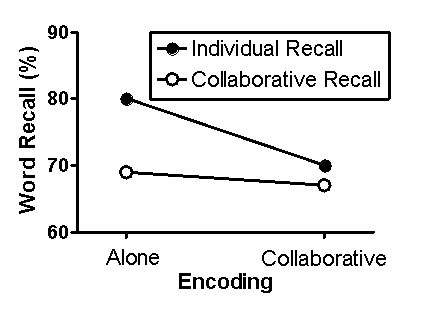 -(Scenario I)Which statement is TRUE?
Free
(Multiple Choice)
4.8/5 (80)
(80) Correct Answer:Verified
VerifiedB
Use the following to answer questions
Scenario I
Scenario I is based on and provides fabricated data consistent with the following study:
Barber,S.J. ,Rajaram,S. ,& Fox,E.B.(2012).Learning and remembering with others: The key role of retrieval in shaping group recall and collective memory.Social Cognition,30(1),121-132.doi:10.1521/soco.2012.30.1.121
In a typical experiment on collaborative memory,participants first encode information individually and later attempt to recall the information either individually or in a small group (collaboratively).While the recall of the collaborative group is better than that of any individual,the summed recall of individuals typically is better than the recall of the collaborative group.This is a phenomenon termed collaborative inhibition.Barber,Rajaram,and Fox (2012)investigated this phenomenon during both the encoding and retrieval stages of memory.
Participants created sentences out of a word bank,which provided for the opportunity to encode this information.After completing this task,participants engaged in an unrelated task-solving mazes-for 10 minutes.Then,in a surprise memory test,they were asked to recall as many words from the word bank as possible (retrieval).
Participants were randomly assigned to one of four groups.In the first group (Alone-Alone),participants were studied individually during both the encoding and retrieval phases of the experiment.In the second group (Alone-Collaborative),participants were studied individually during the encoding phase and studied as part of a three-member team (triad)during the retrieval phase.In the third group (Collaborative-Alone),participants were studied in a triad during the encoding phase but individually during the retrieval phase.Finally,in the fourth group (Collaborative-Collaborative),participants completed both phases of the experiment as part of a triad.
Fabricated results illustrating the major finding of Barber et al.(2012)are presented in Figure 6.1.This figure shows the percentage of words from the word bank accurately recalled as a function of group.For the two groups that experienced the retrieval phase individually,scores represent the summed retrieval of the individuals comprising the group.For the two groups that experienced the retrieval phase as part of a triad,scores simply represent the collaborative performance.
Figure 6.1
-(Scenario I)If interested only in the effects of individual or collaborative encoding on subsequent retrieval,one should examine the:
-(Scenario I)If interested only in the effects of individual or collaborative encoding on subsequent retrieval,one should examine the: (Multiple Choice)
4.7/5 (76)
(76) Use the following to answer questions
Scenario II
Famous within psychology,patient HM had parts of his temporal lobes-including his hippocampus-removed to stop incurable and life-threatening epileptic seizures.The surgery was successful;however,patient HM was left with a severe case of anterograde amnesia.Subsequent tests found that his short-term and implicit memory systems were not affected by the surgery.
-(Scenario II)Suppose that researchers attempted to teach a patient with the same condition as HM how to ride a unicycle.Researchers probably would find that the patient would:
(Multiple Choice)
4.9/5 (90)
(90) Use the following to answer questions
Scenario II
Famous within psychology,patient HM had parts of his temporal lobes-including his hippocampus-removed to stop incurable and life-threatening epileptic seizures.The surgery was successful;however,patient HM was left with a severe case of anterograde amnesia.Subsequent tests found that his short-term and implicit memory systems were not affected by the surgery.
-(Scenario II)As a result of the surgery,HM could NOT:
(Multiple Choice)
4.9/5 (84)
(84) Use the following to answer questions
Scenario I
Scenario I is based on and provides fabricated data consistent with the following study:
Barber,S.J. ,Rajaram,S. ,& Fox,E.B.(2012).Learning and remembering with others: The key role of retrieval in shaping group recall and collective memory.Social Cognition,30(1),121-132.doi:10.1521/soco.2012.30.1.121
In a typical experiment on collaborative memory,participants first encode information individually and later attempt to recall the information either individually or in a small group (collaboratively).While the recall of the collaborative group is better than that of any individual,the summed recall of individuals typically is better than the recall of the collaborative group.This is a phenomenon termed collaborative inhibition.Barber,Rajaram,and Fox (2012)investigated this phenomenon during both the encoding and retrieval stages of memory.
Participants created sentences out of a word bank,which provided for the opportunity to encode this information.After completing this task,participants engaged in an unrelated task-solving mazes-for 10 minutes.Then,in a surprise memory test,they were asked to recall as many words from the word bank as possible (retrieval).
Participants were randomly assigned to one of four groups.In the first group (Alone-Alone),participants were studied individually during both the encoding and retrieval phases of the experiment.In the second group (Alone-Collaborative),participants were studied individually during the encoding phase and studied as part of a three-member team (triad)during the retrieval phase.In the third group (Collaborative-Alone),participants were studied in a triad during the encoding phase but individually during the retrieval phase.Finally,in the fourth group (Collaborative-Collaborative),participants completed both phases of the experiment as part of a triad.
Fabricated results illustrating the major finding of Barber et al.(2012)are presented in Figure 6.1.This figure shows the percentage of words from the word bank accurately recalled as a function of group.For the two groups that experienced the retrieval phase individually,scores represent the summed retrieval of the individuals comprising the group.For the two groups that experienced the retrieval phase as part of a triad,scores simply represent the collaborative performance.
Figure 6.1
-(Scenario I)One possible explanation of collaborative inhibition is social loafing,or the established phenomenon that people do not exert as much effort on a task when studied as part of a group relative to when studied individually.A careful examination of the procedure and results,however,suggests that social loafing does not explain collaborative inhibition because:
-(Scenario I)One possible explanation of collaborative inhibition is social loafing,or the established phenomenon that people do not exert as much effort on a task when studied as part of a group relative to when studied individually.A careful examination of the procedure and results,however,suggests that social loafing does not explain collaborative inhibition because: (Multiple Choice)
4.8/5 (83)
(83) Use the following to answer questions
Scenario I
Scenario I is based on and provides fabricated data consistent with the following study:
Barber,S.J. ,Rajaram,S. ,& Fox,E.B.(2012).Learning and remembering with others: The key role of retrieval in shaping group recall and collective memory.Social Cognition,30(1),121-132.doi:10.1521/soco.2012.30.1.121
In a typical experiment on collaborative memory,participants first encode information individually and later attempt to recall the information either individually or in a small group (collaboratively).While the recall of the collaborative group is better than that of any individual,the summed recall of individuals typically is better than the recall of the collaborative group.This is a phenomenon termed collaborative inhibition.Barber,Rajaram,and Fox (2012)investigated this phenomenon during both the encoding and retrieval stages of memory.
Participants created sentences out of a word bank,which provided for the opportunity to encode this information.After completing this task,participants engaged in an unrelated task-solving mazes-for 10 minutes.Then,in a surprise memory test,they were asked to recall as many words from the word bank as possible (retrieval).
Participants were randomly assigned to one of four groups.In the first group (Alone-Alone),participants were studied individually during both the encoding and retrieval phases of the experiment.In the second group (Alone-Collaborative),participants were studied individually during the encoding phase and studied as part of a three-member team (triad)during the retrieval phase.In the third group (Collaborative-Alone),participants were studied in a triad during the encoding phase but individually during the retrieval phase.Finally,in the fourth group (Collaborative-Collaborative),participants completed both phases of the experiment as part of a triad.
Fabricated results illustrating the major finding of Barber et al.(2012)are presented in Figure 6.1.This figure shows the percentage of words from the word bank accurately recalled as a function of group.For the two groups that experienced the retrieval phase individually,scores represent the summed retrieval of the individuals comprising the group.For the two groups that experienced the retrieval phase as part of a triad,scores simply represent the collaborative performance.
Figure 6.1
-(Scenario I)This experiment examined which type of memory?
-(Scenario I)This experiment examined which type of memory? (Multiple Choice)
5.0/5 (95)
(95) Use the following to answer questions
Scenario II
Famous within psychology,patient HM had parts of his temporal lobes-including his hippocampus-removed to stop incurable and life-threatening epileptic seizures.The surgery was successful;however,patient HM was left with a severe case of anterograde amnesia.Subsequent tests found that his short-term and implicit memory systems were not affected by the surgery.
-(Scenario II)The hippocampus is crucial for:
(Multiple Choice)
5.0/5 (83)
(83) Use the following to answer questions
Scenario I
Scenario I is based on and provides fabricated data consistent with the following study:
Barber,S.J. ,Rajaram,S. ,& Fox,E.B.(2012).Learning and remembering with others: The key role of retrieval in shaping group recall and collective memory.Social Cognition,30(1),121-132.doi:10.1521/soco.2012.30.1.121
In a typical experiment on collaborative memory,participants first encode information individually and later attempt to recall the information either individually or in a small group (collaboratively).While the recall of the collaborative group is better than that of any individual,the summed recall of individuals typically is better than the recall of the collaborative group.This is a phenomenon termed collaborative inhibition.Barber,Rajaram,and Fox (2012)investigated this phenomenon during both the encoding and retrieval stages of memory.
Participants created sentences out of a word bank,which provided for the opportunity to encode this information.After completing this task,participants engaged in an unrelated task-solving mazes-for 10 minutes.Then,in a surprise memory test,they were asked to recall as many words from the word bank as possible (retrieval).
Participants were randomly assigned to one of four groups.In the first group (Alone-Alone),participants were studied individually during both the encoding and retrieval phases of the experiment.In the second group (Alone-Collaborative),participants were studied individually during the encoding phase and studied as part of a three-member team (triad)during the retrieval phase.In the third group (Collaborative-Alone),participants were studied in a triad during the encoding phase but individually during the retrieval phase.Finally,in the fourth group (Collaborative-Collaborative),participants completed both phases of the experiment as part of a triad.
Fabricated results illustrating the major finding of Barber et al.(2012)are presented in Figure 6.1.This figure shows the percentage of words from the word bank accurately recalled as a function of group.For the two groups that experienced the retrieval phase individually,scores represent the summed retrieval of the individuals comprising the group.For the two groups that experienced the retrieval phase as part of a triad,scores simply represent the collaborative performance.
Figure 6.1
-(Scenario I)It can be inferred that the experimenters inserted the maze task between encoding and recall to:
-(Scenario I)It can be inferred that the experimenters inserted the maze task between encoding and recall to: (Multiple Choice)
4.8/5 (93)
(93) Use the following to answer questions
Scenario I
Scenario I is based on and provides fabricated data consistent with the following study:
Barber,S.J. ,Rajaram,S. ,& Fox,E.B.(2012).Learning and remembering with others: The key role of retrieval in shaping group recall and collective memory.Social Cognition,30(1),121-132.doi:10.1521/soco.2012.30.1.121
In a typical experiment on collaborative memory,participants first encode information individually and later attempt to recall the information either individually or in a small group (collaboratively).While the recall of the collaborative group is better than that of any individual,the summed recall of individuals typically is better than the recall of the collaborative group.This is a phenomenon termed collaborative inhibition.Barber,Rajaram,and Fox (2012)investigated this phenomenon during both the encoding and retrieval stages of memory.
Participants created sentences out of a word bank,which provided for the opportunity to encode this information.After completing this task,participants engaged in an unrelated task-solving mazes-for 10 minutes.Then,in a surprise memory test,they were asked to recall as many words from the word bank as possible (retrieval).
Participants were randomly assigned to one of four groups.In the first group (Alone-Alone),participants were studied individually during both the encoding and retrieval phases of the experiment.In the second group (Alone-Collaborative),participants were studied individually during the encoding phase and studied as part of a three-member team (triad)during the retrieval phase.In the third group (Collaborative-Alone),participants were studied in a triad during the encoding phase but individually during the retrieval phase.Finally,in the fourth group (Collaborative-Collaborative),participants completed both phases of the experiment as part of a triad.
Fabricated results illustrating the major finding of Barber et al.(2012)are presented in Figure 6.1.This figure shows the percentage of words from the word bank accurately recalled as a function of group.For the two groups that experienced the retrieval phase individually,scores represent the summed retrieval of the individuals comprising the group.For the two groups that experienced the retrieval phase as part of a triad,scores simply represent the collaborative performance.
Figure 6.1
-(Scenario I)Some degree of collaborative inhibition was observed:
-(Scenario I)Some degree of collaborative inhibition was observed: (Multiple Choice)
4.8/5 (85)
(85) 
Filters
- Essay(0)
- Multiple Choice(0)
- Short Answer(0)
- True False(0)
- Matching(0)