



 Chat with AI
Exam 24: Multistate Corporate Taxation

Exam 1: An Introduction to Taxation and Understanding the Federal Tax Law211 Questions
Exam 2: Working with the Tax Law102 Questions
Exam 3: Computing the Tax180 Questions
Exam 4: Gross Income: Concepts and Inclusions125 Questions
Exam 5: Gross Income: Exclusions113 Questions
Exam 6: Deductions and Losses: In General156 Questions
Exam 7: Deductions and Losses: Certain Business Expenses and Losses94 Questions
Exam 8: Depreciation, Cost Recovery, Amortization, and Depletion120 Questions
Exam 9: Deductions: Employee and Self-Employed-Related Expenses153 Questions
Exam 10: Deductions and Losses: Certain Itemized Deductions104 Questions
Exam 11: Investor Losses130 Questions
Exam 12: Tax Credits and Payments111 Questions
Exam 13: Property Transactions: Determination of Gain or Loss, Basis Considerations, and Nontaxable Exchanges285 Questions
Exam 14: Property Transactions: Capital Gains and Losses, Section 1231, and Recapture Provisions167 Questions
Exam 15: Taxing Business Income60 Questions
Exam 16: Accounting Periods and Methods88 Questions
Exam 17: Corporations: Introduction and Operating Rules108 Questions
Exam 18: Corporations: Organization and Capital Structure109 Questions
Exam 19: Corporations: Distributions Not in Complete Liquidation185 Questions
Exam 20: Corporations: Distributions in Complete Liquidation and an Overview of Reorganizations71 Questions
Exam 21: Partnerships248 Questions
Exam 22: S Corporations129 Questions
Exam 23: Exempt Entities153 Questions
Exam 24: Multistate Corporate Taxation204 Questions
Exam 25: Taxation of International Transactions146 Questions
Exam 26: Tax Practice and Ethics184 Questions
Exam 27: The Federal Gift and Estate Taxes141 Questions
Exam 28: Income Taxation of Trusts and Estates161 Questions
Select questions type


Most states begin the computation of corporate taxable income with an amount from the Federal income tax return.
(True/False)
4.9/5  (75)
(75) The sales/use tax that is employed by most U.S. states does not fall on all retail transactions. Identify at least five sales/use tax exemptions that states often allow, eliminating certain transactions from the tax base.
(Essay)
4.8/5 (79)
(79) In most states, a consolidated corporate income tax return:
(Multiple Choice)
4.9/5 (71)
(71) Almost all of the states allow ________________ treatment to an LLC for income tax purposes.
(Short Answer)
4.7/5 (72)
(72) P.L. 86-272________________ (does/does not) create nexus when the sales representative approves a sale at the customer's location.
(Short Answer)
4.9/5 (70)
(70) An assembly worker earns a $50,000 salary and receives a fringe benefit package worth $15,000. The payroll factor assigns $65,000 for this employee.
(True/False)
4.8/5 (73)
(73) A taxpayer has nexus with a state for sales and use tax purposes if it has a physical presence in the state.
(True/False)
4.8/5 (84)
(84) Guilford Corporation is subject to franchise tax in State Z. The tax is imposed at a rate of 2.5% of the taxpayer's net worth that is apportioned to the state by use of a two factor (sales and property equally weighted) formula. The property factor includes real and tangible personal property, valued at net book value at the end of the taxable year. Sixty percent of Guilford's sales are attributable to Z, and $200,000 of the net book value of Guilford's tangible personal property is located in Z. Determine the Z franchise tax payable by Guilford this year, given the following end-of-the year balance sheet.
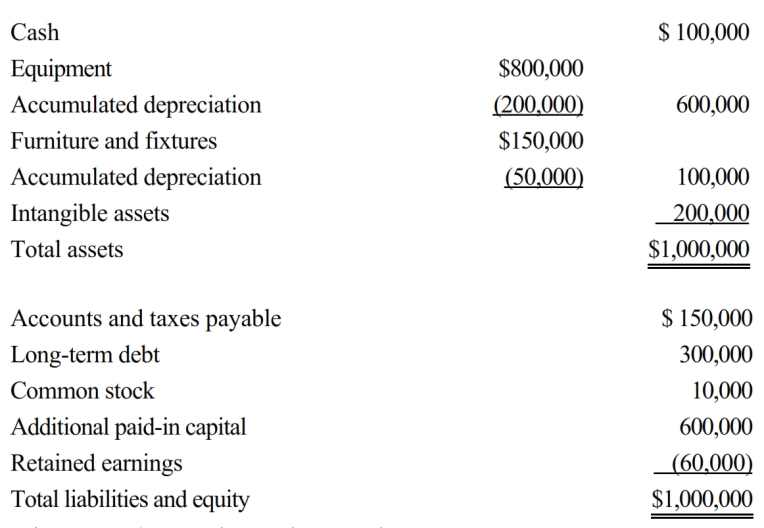
(Multiple Choice)
4.9/5 (78)
(78) Hopper Corporation's property holdings in State E are as follows. 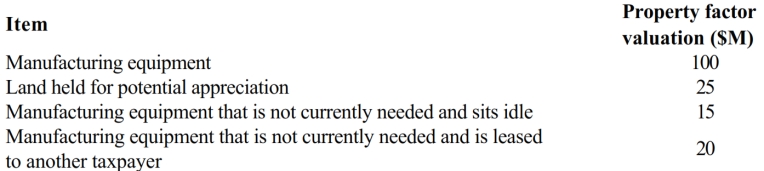 Compute the numerator of Hopper's E property factor.
 (Multiple Choice)
4.9/5 (77)
(77) Typically, a sales/use tax is applied to a retail sale of ________________ property.
(Short Answer)
4.9/5 (77)
(77) Match each of the following items with the appropriate description, in applying the P.L. 86-272 definition of solicitation.
a. More than solicitation, creates nexus
b. Solicitation only, no nexus created
-Checking the customer's inventory to determine whether a reorder is needed.
(Short Answer)
4.8/5 (82)
(82) Franz Corporation is based in State A (corporate income tax rate 10%). It sells its goods to customers in both A and State B (corporate income tax rate 4%). Franz's state taxable income for the year is $1 million, 45% of which relates to B customers. Franz's level of activities in B is insufficient to create nexus there, but A has adopted a throwback rule as to multistate sales. Would Franz reduce its total state income tax liability by creating nexus with B, say by allowing its sales force to make credit decisions? Elaborate.
(Essay)
4.8/5 (64)
(64) General Corporation is taxable in a number of states. This year, General made a $100,000 sale from its A headquarters to a customer in B. This activity is not sufficient for General to create nexus with B. State A applies a throwback rule, but State B does not. In which state(s) will the sale be included in the sales factor numerator?
(Multiple Choice)
4.9/5 (71)
(71) When a ________________ is in effect, out-of-state sales that are not subject to tax in the destination state are pulled back into the sales factor numerator of the origination state.
(Short Answer)
4.8/5 (84)
(84) S corporations flow-through income amounts to its shareholders, and most states require a withholding of shareholder taxes on the allocated amounts.
(True/False)
4.7/5 (72)
(72) Marquardt Corporation realized $900,000 taxable income from the sales of its products in States X and Z. Marquardt's activities establish nexus for income tax purposes in both states. Marquardt's sales, payroll, and property among the states include the following.
 Z utilizes an equally weighted three-factor apportionment formula. Marquardt is incorporated in X. How much of Marquardt's taxable income is apportioned to Z?
 (Multiple Choice)
4.8/5 (75)
(75) Britta Corporation's entire operations are located in State a. Eighty percent ($800,000) of Britta's sales are made in A and the remaining sales ($200,000) are made in State B. B has not adopted a corporate income tax. If A has adopted a throwback rule, the numerator of Britta's A sales factor is:
(Multiple Choice)
4.9/5 (73)
(73) A typical U.S. state piggybacks its collections of the corporate income tax, by letting the Federal government collect and remit the corresponding tax to the state.
(True/False)
4.9/5 (87)
(87) 
Filters
- Essay(0)
- Multiple Choice(0)
- Short Answer(0)
- True False(0)
- Matching(0)