



 Chat with AI
Exam 24: Multistate Corporate Taxation

Exam 1: An Introduction to Taxation and Understanding the Federal Tax Law211 Questions
Exam 2: Working with the Tax Law102 Questions
Exam 3: Computing the Tax180 Questions
Exam 4: Gross Income: Concepts and Inclusions125 Questions
Exam 5: Gross Income: Exclusions113 Questions
Exam 6: Deductions and Losses: In General156 Questions
Exam 7: Deductions and Losses: Certain Business Expenses and Losses94 Questions
Exam 8: Depreciation, Cost Recovery, Amortization, and Depletion120 Questions
Exam 9: Deductions: Employee and Self-Employed-Related Expenses153 Questions
Exam 10: Deductions and Losses: Certain Itemized Deductions104 Questions
Exam 11: Investor Losses130 Questions
Exam 12: Tax Credits and Payments111 Questions
Exam 13: Property Transactions: Determination of Gain or Loss, Basis Considerations, and Nontaxable Exchanges285 Questions
Exam 14: Property Transactions: Capital Gains and Losses, Section 1231, and Recapture Provisions167 Questions
Exam 15: Taxing Business Income60 Questions
Exam 16: Accounting Periods and Methods88 Questions
Exam 17: Corporations: Introduction and Operating Rules108 Questions
Exam 18: Corporations: Organization and Capital Structure109 Questions
Exam 19: Corporations: Distributions Not in Complete Liquidation185 Questions
Exam 20: Corporations: Distributions in Complete Liquidation and an Overview of Reorganizations71 Questions
Exam 21: Partnerships248 Questions
Exam 22: S Corporations129 Questions
Exam 23: Exempt Entities153 Questions
Exam 24: Multistate Corporate Taxation204 Questions
Exam 25: Taxation of International Transactions146 Questions
Exam 26: Tax Practice and Ethics184 Questions
Exam 27: The Federal Gift and Estate Taxes141 Questions
Exam 28: Income Taxation of Trusts and Estates161 Questions
Select questions type


In applying the typical apportionment formula:

Free
(Multiple Choice)
4.9/5  (80)
(80) Correct Answer: Verified
B
Match each of the following events, considered independently, to its likely effect on WillCo's various apportionment factors. WillCo is based in Q and has customers in Q, R, and S. To this point, WillCo has not established nexus with S. More than one choice may be correct.
a. No change in apportionment factors
b. Q apportionment factor increases
c. Q apportionment factor decreases
d. R apportionment factor increases
e. R apportionment factor decreases
f. S apportionment factor increases
g. S apportionment factor decreases
-R adopts an increase in its statutory corporate income tax rates.
Free
(Short Answer)
4.9/5 (75)
(75) Correct Answer:Verified
Verifieda
Federal taxable income is used as the starting point in computing the state's income tax base, but numerous state adjustments or modifications generally are required to:
Free
(Multiple Choice)
5.0/5 (75)
(75) Correct Answer:Verified
VerifiedD
Typically, the state's payroll factor ________________ (does/does not) include the salaries and bonuses paid to its corporate executives.
(Short Answer)
4.9/5 (81)
(81) State and local politicians tend to apply new and increased taxes to taxpayers who are nonresident visitors to the jurisdiction, such as a tax on auto rentals and hotel stays, because the taxpayer cannot vote to reelect (or oust) the lawmaker.
(True/False)
4.7/5 (88)
(88) The starting point in computing state taxable income generally is ________________ .
(Short Answer)
4.8/5 (83)
(83) Match each of the following items with the appropriate description, in determining whether sales/use tax typically must be collected.
a. Taxable
b. Not taxable
-Prescription drugs and medicines purchased by a consumer.
(Short Answer)
4.9/5 (72)
(72) Property taxes generally are collected by local taxing jurisdictions, not the state or Federal governments.
(True/False)
4.8/5 (75)
(75) In determining taxable income for state income tax purposes, interest income from Federal bonds typically constitutes a(n)________________ modification.
(Short Answer)
4.8/5 (78)
(78) In some states, an S corporation must withhold Federal income tax for the proportionate flowthrough income of its shareholders who________________ (are/are not) state residents.
(Short Answer)
4.8/5 (78)
(78) Garcia Corporation is subject to tax in States G, H, and I. Garcia's compensation expense includes the following.
 Officers' salaries are included in the payroll factor for States G and H, but not for I. Compute Garcia's payroll factors for G, H, and I.
 (Essay)
4.9/5 (81)
(81) The most commonly used state income tax apportionment formula is:
(Multiple Choice)
4.8/5 (92)
(92) Kim Corporation, a calendar year taxpayer, has manufacturing facilities in States A and B. A summary of Kim's property holdings follows.
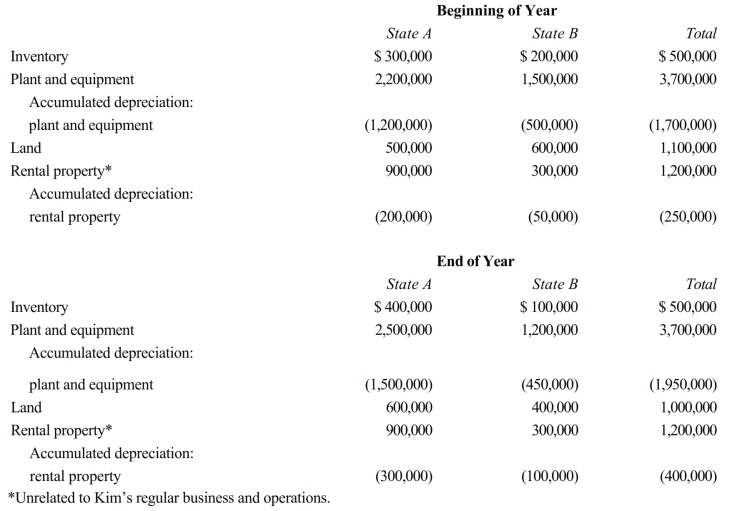 Determine Kim's property factors for the two states. A's statutes provide that the average historical cost of business property is to be included in the property factor. B's statutes provide that the property factor is based on the average depreciated basis of in-state business property.
 (Essay)
4.9/5 (87)
(87) In determining state taxable income, all of the following are adjustments to Federal income except:
(Multiple Choice)
4.8/5 (71)
(71) Match each of the following terms with the appropriate description, in the state income tax formula. Apply the UDITPA rules in your responses.
a. Addition modification
b. Subtraction modification
c. No modification
-State income tax expense.
(Short Answer)
4.7/5 (80)
(80) Match each of the following terms with the appropriate description, in the state income tax formula. Apply the UDITPA rules in your responses.
a. Addition modification
b. Subtraction modification
c. No modification
-Federal depreciation deduction in excess of state amount.
(Short Answer)
4.9/5 (80)
(80) Match each of the following events, considered independently, to its likely effect on WillCo's various apportionment factors. WillCo is based in Q and has customers in Q, R, and S. To this point, WillCo has not established nexus with S. More than one choice may be correct.
a. No change in apportionment factors
b. Q apportionment factor increases
c. Q apportionment factor decreases
d. R apportionment factor increases
e. R apportionment factor decreases
f. S apportionment factor increases
g. S apportionment factor decreases
-Q adopts a throwback rule.
(Short Answer)
4.7/5 (80)
(80) 
Filters
- Essay(0)
- Multiple Choice(0)
- Short Answer(0)
- True False(0)
- Matching(0)