



 Chat with AI
Exam 12: Tax Credits and Payments

Exam 1: An Introduction to Taxation and Understanding the Federal Tax Law211 Questions
Exam 2: Working with the Tax Law102 Questions
Exam 3: Computing the Tax180 Questions
Exam 4: Gross Income: Concepts and Inclusions125 Questions
Exam 5: Gross Income: Exclusions113 Questions
Exam 6: Deductions and Losses: In General156 Questions
Exam 7: Deductions and Losses: Certain Business Expenses and Losses94 Questions
Exam 8: Depreciation, Cost Recovery, Amortization, and Depletion120 Questions
Exam 9: Deductions: Employee and Self-Employed-Related Expenses153 Questions
Exam 10: Deductions and Losses: Certain Itemized Deductions104 Questions
Exam 11: Investor Losses130 Questions
Exam 12: Tax Credits and Payments111 Questions
Exam 13: Property Transactions: Determination of Gain or Loss, Basis Considerations, and Nontaxable Exchanges285 Questions
Exam 14: Property Transactions: Capital Gains and Losses, Section 1231, and Recapture Provisions167 Questions
Exam 15: Taxing Business Income60 Questions
Exam 16: Accounting Periods and Methods88 Questions
Exam 17: Corporations: Introduction and Operating Rules108 Questions
Exam 18: Corporations: Organization and Capital Structure109 Questions
Exam 19: Corporations: Distributions Not in Complete Liquidation185 Questions
Exam 20: Corporations: Distributions in Complete Liquidation and an Overview of Reorganizations71 Questions
Exam 21: Partnerships248 Questions
Exam 22: S Corporations129 Questions
Exam 23: Exempt Entities153 Questions
Exam 24: Multistate Corporate Taxation204 Questions
Exam 25: Taxation of International Transactions146 Questions
Exam 26: Tax Practice and Ethics184 Questions
Exam 27: The Federal Gift and Estate Taxes141 Questions
Exam 28: Income Taxation of Trusts and Estates161 Questions
Select questions type


Which of the following statements concerning the credit for child and dependent care expenses is not correct?

Free
(Multiple Choice)
4.8/5  (71)
(71) Correct Answer: Verified
D
The maximum credit for child and dependent care expenses is $2,100 if only one spouse is employed and the other spouse is a full-time student.
Free
(True/False)
4.7/5 (80)
(80) Correct Answer:Verified
VerifiedTrue
A taxpayer who qualifies for the low-income housing credit claims the credit over a 20-year period.
Free
(True/False)
4.9/5 (79)
(79) Correct Answer:Verified
VerifiedFalse
If an employee holds two jobs during the year, an overwithholding of FICA tax always will result.
(True/False)
4.9/5 (79)
(79) Unused foreign tax credits can be carried back three years and forward fifteen years.
(True/False)
4.9/5 (78)
(78) Pat generated self-employment income in 2018 of $76,000. The self-employment tax is:
(Multiple Choice)
4.8/5 (93)
(93) Cheryl is single, has one child (age 6), and files as head of household during 2018. Her salary for the year is $19,500. She qualifies for an earned income credit of the following amount.
(Multiple Choice)
4.8/5 (70)
(70) Cardinal Corporation hires two persons certified to be eligible employees for the work opportunity tax credit under the general rules (e.g., food stamp recipients), each of whom is paid $9,000 during the year. As a result of this event, Cardinal Corporation may claim a work opportunity credit of:
(Multiple Choice)
4.7/5 (79)
(79) The low-income housing credit is available to low-income tenants who reside in qualifying low-income housing.
(True/False)
5.0/5 (75)
(75) Which of the following statements is true regarding the education tax credits?
(Multiple Choice)
4.8/5 (85)
(85) Steve records a tentative general business credit of $110,000 for the current year. His net regular tax liability before t general business credit is $125,000, and his tentative minimum tax is $100,000. Compute Steve's allowable general business credit for the year.
(Essay)
4.7/5 (78)
(78) The purpose of the work opportunity tax credit is to encourage employers to hire individuals from specified target groups traditionally subject to high rates of unemployment.
(True/False)
4.8/5 (74)
(74) In the event that overwithholding of FICA tax occurs because the taxpayer has more than one employer, the excess amount should be claimed as a credit on the Federal income tax return of the employee.
(True/False)
4.8/5 (80)
(80) In 2018, George and Martha are married and file a joint tax return claiming their two children, ages 10 and 8 as dependents. Assuming their AGI is $119,650, George and Martha's child tax credit is:
(Multiple Choice)
4.9/5 (85)
(85) Child care payments to a relative are not eligible for the credit for child and dependent care expenses if the relative is a child (under age 19) of the taxpayer.
(True/False)
4.8/5 (92)
(92) Ahmad is considering making a $10,000 investment in a venture which its promoter promises will generate immediate tax benefits for him. Ahmad, who normally itemizes his deductions, is in the 28% marginal tax bracket. If the investment is of a type where the taxpayer may claim either a tax credit of 25% of the amount of the expenditure or an itemized deduction for the amount of the investment, what treatment normally would be most beneficial to Ahmad and by how much will Ahmad's tax liability decline because of the investment?
(Multiple Choice)
4.7/5 (87)
(87) Employers are encouraged by the work opportunity tax credit to hire individuals who have been long-term recipients of family assistance welfare benefits.
(True/False)
4.8/5 (74)
(74) In January 2018, Tammy acquired an office building in downtown Syracuse, New York for $400,000. The building was constructed in 1932 and is a certified historic structure. Of the $400,000 cost, $40,000 was allocated to the land.
Tammy immediately placed the building into service, but she quickly realized that substantial renovation would be required to keep and attract new tenants. The renovations, costing $600,000, were of the type that qualifies for the rehabilitation credit. The improvements were completed in October 2018.
a. Compute Tammy's rehabilitation tax credit for the year of acquisition.
b. Determine the cost recovery deduction for 2018.
c. What is the basis in the property at the end of its first year of use by Tammy?
(Essay)
4.9/5 (71)
(71) The ceiling amounts and percentages for 2018 for the two portions of the self-employment tax are: 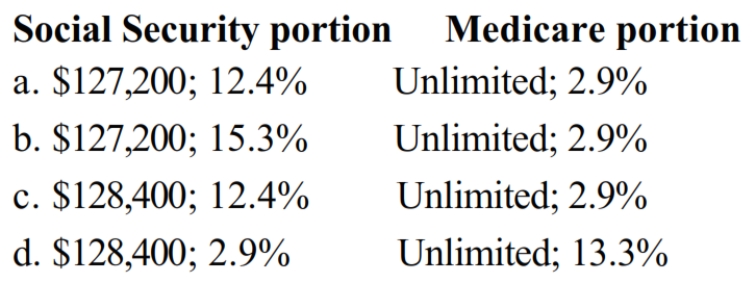
(Short Answer)
4.8/5 (85)
(85) A taxpayer may qualify for the credit for child and dependent care expenses if the taxpayer's dependent is under age 17.
(True/False)
4.8/5 (85)
(85) 
Filters
- Essay(0)
- Multiple Choice(0)
- Short Answer(0)
- True False(0)
- Matching(0)