



 Chat with AI
Exam 17: Monopolistic Competition and Advertising

Exam 1: The Big Ideas253 Questions
Exam 2: The Power of Trade and Comparative239 Questions
Exam 3: Supply and Demand249 Questions
Exam 4: Equilibrium256 Questions
Exam 5: Elasticity and Its Applications271 Questions
Exam 6: Taxes and Subsidies225 Questions
Exam 7: The Price System275 Questions
Exam 8: Price Ceilings and Floors327 Questions
Exam 9: International Trade195 Questions
Exam 10: Externalities- When the Price Is Not Right273 Questions
Exam 11: Costs and Profit Maximization Under Competition217 Questions
Exam 12: Competition and the Invisible Hand144 Questions
Exam 13: Monopoly233 Questions
Exam 14: Price Discrimination262 Questions
Exam 15: Oligopoly and Game Theory218 Questions
Exam 16: Competing for Monopoly160 Questions
Exam 17: Monopolistic Competition and Advertising113 Questions
Exam 18: Labor Markets262 Questions
Exam 19: Public Goods and the Tragedy of the Commons244 Questions
Exam 20: Political Economy and Public Choice306 Questions
Exam 21: Economics, Ethics, and Public Policy241 Questions
Exam 22: Managing Incentives263 Questions
Exam 23: Stock Markets and Personal Finance271 Questions
Exam 24: Price Discrimination151 Questions
Exam 25: Consumer Choice145 Questions
Select questions type


As long as profits are possible, more firms will enter the market, reducing the profits to each individual firm in a monopolistic competition.
(True/False)
4.8/5  (72)
(72) In the 1990s, fast food restaurants refused to make special orders-there was no way to "hold the tomatoes." When Burger King branded itself as the place where you could "have it your way" and allowed special orders, it enjoyed an advantage over other fast food restaurants. Until other firms copied it, what was Burger King's position?
(Multiple Choice)
4.7/5 (73)
(73) A monopolistically competitive firm continues to make profits so long as P > AC.
(True/False)
5.0/5 (78)
(78) As of 2010, it was more common to see advertisements for the iPad in Silicon Valley than in Berlin.
(True/False)
4.9/5 (83)
(83) The monopolistic model helps explain both the negative and positive features of advertising.
(True/False)
4.8/5 (79)
(79) Figure: Monopolistic Competition II 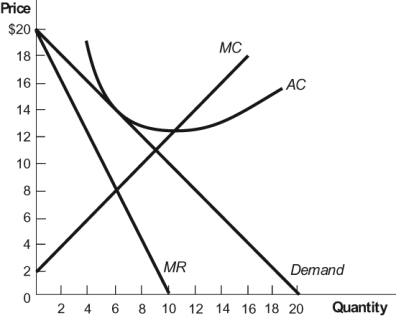 The monopolistically competitive firm in this diagram is in ______ equilibrium and charging a price of ______.
 (Multiple Choice)
4.8/5 (81)
(81) Advertising is not about trying to change our minds and is only about information.
(True/False)
4.8/5 (77)
(77) Which of the following is/are TRUE?
I. A monopolistic competitive firm sets price > MC.
II. A monopolistic competitive firm sets price = MC.
III. A monopolistic competitive firm operates at MC = MR.
(Multiple Choice)
4.8/5 (80)
(80) In the long run, monopolistically competitive firms end up producing at a price equal to that of competitive markets.
(True/False)
4.9/5 (80)
(80) As more firms enter a monopolistically competitive market, the individual firm's demand curve:
(Multiple Choice)
4.9/5 (73)
(73) In 2010, which was the location of more advertisement for the iPad?
(Multiple Choice)
4.9/5 (83)
(83) In a stable, monopolistically competitive market for restaurants there are:
(Multiple Choice)
4.9/5 (80)
(80) Use the following to answer questions:
Figure: Monopolistic Competition 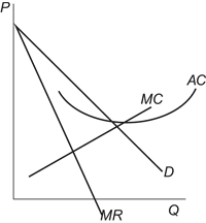 -(Figure: Monopolistic Competition) Refer to the figure. Suppose the figure represents a firm that operates in a monopolistic competitive market. In this market, in the long run you would expect:
 (Multiple Choice)
4.7/5 (79)
(79) 
Filters
- Essay(0)
- Multiple Choice(0)
- Short Answer(0)
- True False(0)
- Matching(0)