



 Chat with AI
Exam 17: Monopolistic Competition and Advertising

Exam 1: The Big Ideas253 Questions
Exam 2: The Power of Trade and Comparative239 Questions
Exam 3: Supply and Demand249 Questions
Exam 4: Equilibrium256 Questions
Exam 5: Elasticity and Its Applications271 Questions
Exam 6: Taxes and Subsidies225 Questions
Exam 7: The Price System275 Questions
Exam 8: Price Ceilings and Floors327 Questions
Exam 9: International Trade195 Questions
Exam 10: Externalities- When the Price Is Not Right273 Questions
Exam 11: Costs and Profit Maximization Under Competition217 Questions
Exam 12: Competition and the Invisible Hand144 Questions
Exam 13: Monopoly233 Questions
Exam 14: Price Discrimination262 Questions
Exam 15: Oligopoly and Game Theory218 Questions
Exam 16: Competing for Monopoly160 Questions
Exam 17: Monopolistic Competition and Advertising113 Questions
Exam 18: Labor Markets262 Questions
Exam 19: Public Goods and the Tragedy of the Commons244 Questions
Exam 20: Political Economy and Public Choice306 Questions
Exam 21: Economics, Ethics, and Public Policy241 Questions
Exam 22: Managing Incentives263 Questions
Exam 23: Stock Markets and Personal Finance271 Questions
Exam 24: Price Discrimination151 Questions
Exam 25: Consumer Choice145 Questions
Select questions type


Which of the following is NOT an example of product differentiation?
(Multiple Choice)
4.8/5  (81)
(81) When does a monopolistic competitive industry experience other entrants into the market?
(Essay)
4.8/5 (80)
(80) Persuasion ads can deepen our enjoyment of products by evoking good memories.
(True/False)
4.8/5 (81)
(81) The movie The Invention of Lying takes place in a world where everyone can only tell the absolute truth. An advertisement for Coke admits there is nothing new about the product and that it's basically just brown sugar water. It ends with the tagline: "Coke. It's very famous." How is Coke using advertising in this fictional advertisement?
(Multiple Choice)
4.8/5 (89)
(89) Use the following to answer questions:
Figure: Monopolistic Competition 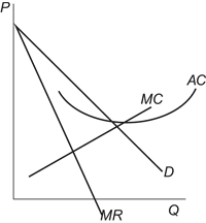 -(Figure: Monopolistic Competition) Refer to the figure. Suppose the figure represents a firm that operates in a monopolistically competitive market. In the long run you would expect:
 (Multiple Choice)
4.9/5 (74)
(74) Advertising is sometimes simply about trying to change our minds.
(True/False)
4.8/5 (83)
(83) Consumers benefit from advertising:
I. by gaining product information.
II. by being persuaded to try a new product they might like.
III. when the ad provides a signal of the product's quality.
IV. if the ad leads to a lower price for the product.
(Multiple Choice)
4.8/5 (84)
(84) Monopolistic competitive products are usually _____ advertised.
(Multiple Choice)
4.8/5 (73)
(73) Advertising can make potential customers more interested in buying, or at least sampling the product.
(True/False)
4.9/5 (78)
(78) Perfectly competitive firms will not advertise because there is no gain from selling additional units of the product.
(True/False)
4.7/5 (60)
(60) When an advertisement serves as a signaling device, it provides potential customers with:
(Multiple Choice)
4.9/5 (69)
(69) Owning a small oil well is a good example of a monopolistically competitive market.
(True/False)
4.7/5 (75)
(75) As more firms enter a monopolistically competitive market, the market demand curve:
(Multiple Choice)
4.9/5 (85)
(85) 
Filters
- Essay(0)
- Multiple Choice(0)
- Short Answer(0)
- True False(0)
- Matching(0)