



 Chat with AI
Exam 23: Stock Markets and Personal Finance

Exam 1: The Big Ideas253 Questions
Exam 2: The Power of Trade and Comparative239 Questions
Exam 3: Supply and Demand249 Questions
Exam 4: Equilibrium256 Questions
Exam 5: Elasticity and Its Applications271 Questions
Exam 6: Taxes and Subsidies225 Questions
Exam 7: The Price System275 Questions
Exam 8: Price Ceilings and Floors327 Questions
Exam 9: International Trade195 Questions
Exam 10: Externalities- When the Price Is Not Right273 Questions
Exam 11: Costs and Profit Maximization Under Competition217 Questions
Exam 12: Competition and the Invisible Hand144 Questions
Exam 13: Monopoly233 Questions
Exam 14: Price Discrimination262 Questions
Exam 15: Oligopoly and Game Theory218 Questions
Exam 16: Competing for Monopoly160 Questions
Exam 17: Monopolistic Competition and Advertising113 Questions
Exam 18: Labor Markets262 Questions
Exam 19: Public Goods and the Tragedy of the Commons244 Questions
Exam 20: Political Economy and Public Choice306 Questions
Exam 21: Economics, Ethics, and Public Policy241 Questions
Exam 22: Managing Incentives263 Questions
Exam 23: Stock Markets and Personal Finance271 Questions
Exam 24: Price Discrimination151 Questions
Exam 25: Consumer Choice145 Questions
Select questions type


An individual who buys__________ has a poor diversification strategy.
(Multiple Choice)
4.7/5  (77)
(77) John Stossel's investment strategy of ______ beat 90% of the experts' portfolios.
(Multiple Choice)
4.8/5 (74)
(74) According to the rule of 70, a stock portfolio growing at a rate of 3.5% will double approximately every ______ years.
(Multiple Choice)
4.8/5 (76)
(76) The riskiest stocks are those that have a high positive correlation with the market as a whole.
(True/False)
4.9/5 (80)
(80) According to the rule of 70, if the interest rate on a bank deposit is 5% per year, how long will it take for the bank deposit to double in value?
(Multiple Choice)
4.8/5 (85)
(85) Some skeptical economists say that successful brokers like Warren Buffett are:
(Multiple Choice)
4.8/5 (80)
(80) Figure: Risk 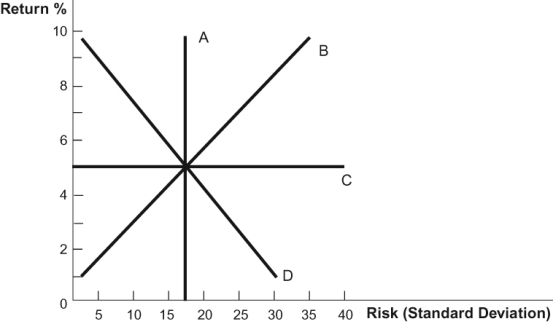 Refer to the figure. Which curve in the diagram correctly identifies the relationship between risk and return?
 (Multiple Choice)
4.9/5 (82)
(82) Someone who purchased stock in___________ seems to have followed a diversification strategy.
(Multiple Choice)
4.9/5 (86)
(86) Compared to stocks, art investments have _____ monetary returns because they offer ______ nonpecuniary returns.
(Multiple Choice)
4.9/5 (74)
(74) Which of the following is TRUE of mutual funds?
I. Active funds generally give higher returns than passive funds.
II. Most mutual funds generally give higher returns than broad stock indexes.
(Multiple Choice)
4.9/5 (79)
(79) 
Filters
- Essay(0)
- Multiple Choice(0)
- Short Answer(0)
- True False(0)
- Matching(0)