



 Chat with AI
Exam 23: Stock Markets and Personal Finance

Exam 1: The Big Ideas253 Questions
Exam 2: The Power of Trade and Comparative239 Questions
Exam 3: Supply and Demand249 Questions
Exam 4: Equilibrium256 Questions
Exam 5: Elasticity and Its Applications271 Questions
Exam 6: Taxes and Subsidies225 Questions
Exam 7: The Price System275 Questions
Exam 8: Price Ceilings and Floors327 Questions
Exam 9: International Trade195 Questions
Exam 10: Externalities- When the Price Is Not Right273 Questions
Exam 11: Costs and Profit Maximization Under Competition217 Questions
Exam 12: Competition and the Invisible Hand144 Questions
Exam 13: Monopoly233 Questions
Exam 14: Price Discrimination262 Questions
Exam 15: Oligopoly and Game Theory218 Questions
Exam 16: Competing for Monopoly160 Questions
Exam 17: Monopolistic Competition and Advertising113 Questions
Exam 18: Labor Markets262 Questions
Exam 19: Public Goods and the Tragedy of the Commons244 Questions
Exam 20: Political Economy and Public Choice306 Questions
Exam 21: Economics, Ethics, and Public Policy241 Questions
Exam 22: Managing Incentives263 Questions
Exam 23: Stock Markets and Personal Finance271 Questions
Exam 24: Price Discrimination151 Questions
Exam 25: Consumer Choice145 Questions
Select questions type


If the efficient markets hypothesis is valid, then a person should:
I. buy mutual funds.
II. diversify.
III. follow a buy-and-hold strategy.
(Multiple Choice)
4.9/5  (74)
(74) Which of the following are advantages of saving your money in a mutual fund?
I. You have professional fund management.
II. Mutual funds have always outperformed the S&P 500.
III. People with smaller amounts of money can diversify risk.
(Multiple Choice)
4.7/5 (85)
(85) The efficient markets hypothesis suggests that it is no better to invest in a mutual fund that has performed well for 5 years in a row than one that has performed poorly for 5 years in a row.
(True/False)
4.8/5 (75)
(75) After adjusting for risk, the expected return on different assets should be:
(Multiple Choice)
4.8/5 (90)
(90) You cannot get rich, on average, by buying and selling on public information.
(True/False)
4.9/5 (81)
(81) If a person follows a buy-and-hold strategy, she will initially hold stocks:
(Multiple Choice)
4.9/5 (82)
(82) Table: Investment
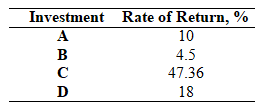 Refer to the table. Rank the investments in order from the least risky to the most risky.
 (Multiple Choice)
4.8/5 (91)
(91) Why does it make sense to avoid paying high fees when investing with mutual funds or stock brokers?
(Multiple Choice)
4.8/5 (73)
(73) Popular U.S. stock indexes include:
I. FDIC
II. Dow Jones Industrial Average
III. NASDAQ
(Multiple Choice)
4.8/5 (85)
(85) 
Filters
- Essay(0)
- Multiple Choice(0)
- Short Answer(0)
- True False(0)
- Matching(0)