



 Chat with AI
Exam 23: Stock Markets and Personal Finance

Exam 1: The Big Ideas253 Questions
Exam 2: The Power of Trade and Comparative239 Questions
Exam 3: Supply and Demand249 Questions
Exam 4: Equilibrium256 Questions
Exam 5: Elasticity and Its Applications271 Questions
Exam 6: Taxes and Subsidies225 Questions
Exam 7: The Price System275 Questions
Exam 8: Price Ceilings and Floors327 Questions
Exam 9: International Trade195 Questions
Exam 10: Externalities- When the Price Is Not Right273 Questions
Exam 11: Costs and Profit Maximization Under Competition217 Questions
Exam 12: Competition and the Invisible Hand144 Questions
Exam 13: Monopoly233 Questions
Exam 14: Price Discrimination262 Questions
Exam 15: Oligopoly and Game Theory218 Questions
Exam 16: Competing for Monopoly160 Questions
Exam 17: Monopolistic Competition and Advertising113 Questions
Exam 18: Labor Markets262 Questions
Exam 19: Public Goods and the Tragedy of the Commons244 Questions
Exam 20: Political Economy and Public Choice306 Questions
Exam 21: Economics, Ethics, and Public Policy241 Questions
Exam 22: Managing Incentives263 Questions
Exam 23: Stock Markets and Personal Finance271 Questions
Exam 24: Price Discrimination151 Questions
Exam 25: Consumer Choice145 Questions
Select questions type


To diversify, an engineer working in an electric power-generating plant should invest in:
(Multiple Choice)
5.0/5  (88)
(88) Consider the market for ABC Company's stock. What should happen to the stock for this company if there is a rumor that the company is set to merge with another very profitable company?
(Multiple Choice)
4.8/5 (60)
(60) According to the efficient markets hypothesis, stock prices:
(Multiple Choice)
4.7/5 (82)
(82) What rule of thumb generates the number of periods required for an investment to double at a given interest rate?
(Multiple Choice)
4.8/5 (93)
(93) The investment approach of one of TIAA-CREF's mutual funds is: "[This fund]. . .seeks a favorable long-term rate of return from a diversified portfolio selected to track the overall market for common stocks publicly traded in the United States, as represented by a broad stock market index." This fund is a(n):
(Multiple Choice)
4.8/5 (90)
(90) For a person holding a mutual fund, compounding the returns on the fund leads to a higher total return in the future than without compounding.
(True/False)
4.8/5 (70)
(70) As a result of the disaster at Chernobyl, related stock prices changed within:
(Multiple Choice)
4.9/5 (76)
(76) Table: Mutual Funds
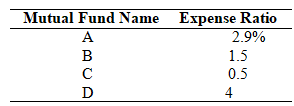 Refer to the table. Which mutual fund would be best for a retirement savings plan?
 (Multiple Choice)
4.8/5 (74)
(74) According to the efficient markets hypothesis, the prices of traded assets, such as stocks and bonds, reflect all publicly traded information.
(True/False)
4.8/5 (70)
(70) Which of the following investment instruments would a risk-averse individual choose?
(Multiple Choice)
4.8/5 (66)
(66) If each of the approximately 320,000 securities and financial service agents in the United States bet on whether the market would go up or down for each of the next 10 years by flipping a coin, we would expect that approximately 312 agents would have been right 10 years in a row. This example suggests that:
(Multiple Choice)
4.8/5 (85)
(85) Because stock indexes offer higher returns than bonds historically, the rule of 70 implies that we should invest:
(Multiple Choice)
4.9/5 (86)
(86) Paying an expert to help pick stocks will likely yield better returns than most alternative strategies for stock selection.
(True/False)
4.7/5 (75)
(75) 
Filters
- Essay(0)
- Multiple Choice(0)
- Short Answer(0)
- True False(0)
- Matching(0)