



 Chat with AI
Exam 25: Consumer Choice

Exam 1: The Big Ideas253 Questions
Exam 2: The Power of Trade and Comparative239 Questions
Exam 3: Supply and Demand249 Questions
Exam 4: Equilibrium256 Questions
Exam 5: Elasticity and Its Applications271 Questions
Exam 6: Taxes and Subsidies225 Questions
Exam 7: The Price System275 Questions
Exam 8: Price Ceilings and Floors327 Questions
Exam 9: International Trade195 Questions
Exam 10: Externalities- When the Price Is Not Right273 Questions
Exam 11: Costs and Profit Maximization Under Competition217 Questions
Exam 12: Competition and the Invisible Hand144 Questions
Exam 13: Monopoly233 Questions
Exam 14: Price Discrimination262 Questions
Exam 15: Oligopoly and Game Theory218 Questions
Exam 16: Competing for Monopoly160 Questions
Exam 17: Monopolistic Competition and Advertising113 Questions
Exam 18: Labor Markets262 Questions
Exam 19: Public Goods and the Tragedy of the Commons244 Questions
Exam 20: Political Economy and Public Choice306 Questions
Exam 21: Economics, Ethics, and Public Policy241 Questions
Exam 22: Managing Incentives263 Questions
Exam 23: Stock Markets and Personal Finance271 Questions
Exam 24: Price Discrimination151 Questions
Exam 25: Consumer Choice145 Questions
Select questions type


If there are only two goods in the economy, chocolate and peanut butter, and the price of chocolate falls, the new utility-maximizing bundle for a typical consumer would entail consuming _____ peanut butter and ______ chocolate.
(Multiple Choice)
4.9/5  (73)
(73) A bar owner must decide how best to raise revenues. A cover charge will allow him to offer cheaper drink prices. If the owner does decide to require a cover charge and offer cheaper drinks, how much should it be to avoid losing customers? Explain.
(Essay)
4.8/5 (86)
(86) If the marginal utility per dollar for hamburgers is 2, and the marginal utility per dollar for pizza is 1, then this consumer should consume more hamburgers.
(True/False)
4.8/5 (84)
(84) The slope of the indifference curve is equal to the marginal rate of substitution.
(True/False)
5.0/5 (64)
(64) Use the following to answer questions:
Figure: Income and Substitution Effects  -(Figure: Income and Substitution Effects) Refer to the figure. The consumer is initially in equilibrium at Point A then moves to Point B. What is the substitution effect from the price change?
 (Multiple Choice)
4.9/5 (88)
(88) If another unit of good X gives a consumer 15 additional units of satisfaction, and another unit of good Y gives 45 additional units of satisfaction, the MRS is equal to one-third.
(True/False)
4.7/5 (74)
(74) If the marginal utility per dollar for hamburgers is higher than the marginal utility per dollar for tacos, then to maximize utility the consumer should only consume hamburgers.
(True/False)
4.8/5 (85)
(85) Amy purchased four cantaloupes at $2 each and three watermelons at $4 each. If Amy is following the optimal consumption rule, the marginal utility of the fourth cantaloupe and third watermelon are:
(Multiple Choice)
4.8/5 (84)
(84) Use the following to answer questions:
Figure: Optimal Choice 2  -(Figure: Optimal Choice 2) Refer to the figure. This figure represents indifference curves of a consumer who purchases flip-flops and sneakers. If the dotted line represents this consumer's budget constraint, then bundle D on the graph:
 (Multiple Choice)
4.9/5 (79)
(79) Figure: Work Leisure 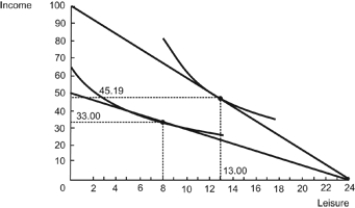 Refer to the figure. Which statement is FALSE?
 (Multiple Choice)
4.8/5 (80)
(80) If you purchase a ticket to a concert but then lose the ticket, a rational consumer would:
(Multiple Choice)
4.7/5 (94)
(94) Figure: Labor Supply 2 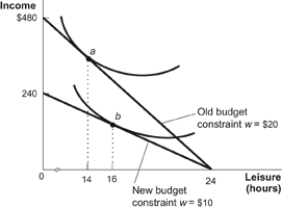 Refer to the figure. The figure represents the budget constraint and indifference curves for the labor-leisure decision of a consumer when the wage rate falls from $20 to $10. For this worker:
 (Multiple Choice)
4.9/5 (75)
(75) If the marginal utility per dollar for hamburgers is higher than the marginal utility per dollar for tacos, then in order to maximize utility the consumer should only consume hamburgers.
(True/False)
4.9/5 (95)
(95) Which of the following methods have been used to reduce the disincentive effects of welfare on labor supply?
I. The government reduces welfare benefits by $1 of every $1 of labor income earned.
II. The government limits the amount of time that someone can collect welfare.
III. The government provides an Earned Income Tax Credit that supplements the income of the working poor.
(Multiple Choice)
4.8/5 (83)
(83) At the consumer's optimal consumption bundle, the MRSXY is 4, and the marginal utility of good X is 8. What is the marginal utility of good Y?
(Multiple Choice)
4.9/5 (76)
(76) Use the following to answer questions:
Figure: Budget Constraint 2  -Figure: Budget Constraints 3
 Refer to the figure. What could have caused the shift in the budget constraint?
-Figure: Budget Constraints 3 Refer to the figure. What could have caused the shift in the budget constraint? (Multiple Choice)
4.9/5 (82)
(82) Use the following to answer questions:
Figure: Coffee and Comic Books  -(Figure: Coffee and Comic Books) Refer to the figure. A consumer has $5 to spend on comic books (priced at $1 per comic book) and coffee (priced at $1 per cup). Using the figure, how many comic books and cups of coffee will this consumer purchase?
 (Multiple Choice)
4.8/5 (82)
(82) Use the following to answer questions:
Figure: Indifference Curve  -(Figure: Indifference Curve) Refer to the figure. This figure represents the indifference curve of a consumer who purchases flip-flops and sneakers. Which statement is TRUE?
 (Multiple Choice)
4.8/5 (95)
(95) 
Filters
- Essay(0)
- Multiple Choice(0)
- Short Answer(0)
- True False(0)
- Matching(0)