



 Chat with AI
Exam 25: Consumer Choice

Exam 1: The Big Ideas253 Questions
Exam 2: The Power of Trade and Comparative239 Questions
Exam 3: Supply and Demand249 Questions
Exam 4: Equilibrium256 Questions
Exam 5: Elasticity and Its Applications271 Questions
Exam 6: Taxes and Subsidies225 Questions
Exam 7: The Price System275 Questions
Exam 8: Price Ceilings and Floors327 Questions
Exam 9: International Trade195 Questions
Exam 10: Externalities- When the Price Is Not Right273 Questions
Exam 11: Costs and Profit Maximization Under Competition217 Questions
Exam 12: Competition and the Invisible Hand144 Questions
Exam 13: Monopoly233 Questions
Exam 14: Price Discrimination262 Questions
Exam 15: Oligopoly and Game Theory218 Questions
Exam 16: Competing for Monopoly160 Questions
Exam 17: Monopolistic Competition and Advertising113 Questions
Exam 18: Labor Markets262 Questions
Exam 19: Public Goods and the Tragedy of the Commons244 Questions
Exam 20: Political Economy and Public Choice306 Questions
Exam 21: Economics, Ethics, and Public Policy241 Questions
Exam 22: Managing Incentives263 Questions
Exam 23: Stock Markets and Personal Finance271 Questions
Exam 24: Price Discrimination151 Questions
Exam 25: Consumer Choice145 Questions
Select questions type


Use the following to answer question 13:
Figure: Water vs. Soda 2 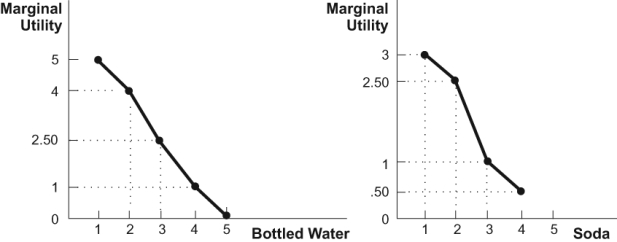 -(Figure: Water vs. Soda 2) Refer to the figure. These figures show the marginal utility Janet receives when she consumes bottled water and soda. Both water and soda cost $1 each. If Janet has $5 in income, what mix of bottled water and soda will maximize Janet's utility?
 (Multiple Choice)
4.9/5  (72)
(72) As one moves down along an indifference curve, the slope of the indifference curve typically:
(Multiple Choice)
4.9/5 (76)
(76) Use the following to answer questions:
Figure: Income and Substitution Effects 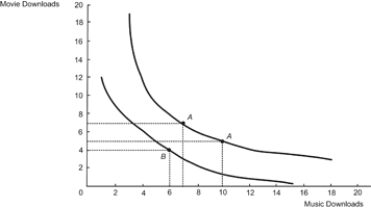 -(Figure: Income and Substitution Effects) Refer to the figure. What caused this consumer to switch optimal consumption bundles from Bundle A to Bundle B?
 (Multiple Choice)
4.8/5 (78)
(78) If the price of good X is $10 and price of good Y is $15, the slope of the budget constraint is -1.5.
(True/False)
4.7/5 (88)
(88) If another unit of good X gives a consumer 15 additional units of satisfaction, and another unit of good Y gives 45 additional units of satisfaction, the MRS is equal to 1/3.
(True/False)
4.7/5 (90)
(90) If an individual's labor supply curve is downward sloping, this indicates that:
(Multiple Choice)
4.9/5 (80)
(80) If the budget constraint shifts northeast or away from the origin, the consumer can afford:
(Multiple Choice)
4.9/5 (87)
(87) Use the following to answer questions:
Figure: Water vs. Soda 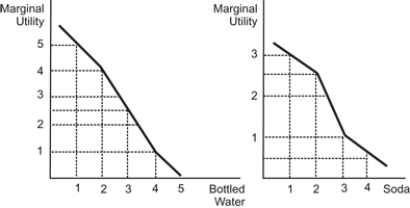 -(Figure: Water vs. Soda) Refer to the figure. The figure represents the marginal utility Janet receives when she consumes bottled water and soda. The prices of bottled water and sodas are both $1 each. Janet has $2 to spend and consumes two bottles of water and no soda.
 (Multiple Choice)
4.9/5 (84)
(84) An increase in the price of a good leads to a(n) ______ in the marginal utility per dollar of that good, and thus a(n) ______ in the quantity purchased.
(Multiple Choice)
4.9/5 (83)
(83) Constant marginal utility means that one's first apple in a sitting is ______ one's second apple in the same sitting.
(Multiple Choice)
4.7/5 (82)
(82) Assume that the unit price of good A is $3, and the unit price of good B is $5. If an individual has income of $43, which consumption bundles of (good A, good B) is on the edge of the budget constraint?
(Multiple Choice)
4.8/5 (90)
(90) Use the following to answer questions:
Figure: Income and Substitution Effects
-(Figure: Income and Substitution Effects) Refer to the figure. The consumer is initially in equilibrium at Point A then moves to Point B. What is the income effect from the price change?
-(Figure: Income and Substitution Effects) Refer to the figure. The consumer is initially in equilibrium at Point A then moves to Point B. What is the income effect from the price change? (Multiple Choice)
4.9/5 (76)
(76) The conventional demand curve appears strange to many students since the dependent variable (quantity) is on the vertical axis and the independent variable (price) is on the horizontal axis. We generally describe our demand as "If apples cost $1, then I'd be willing to buy four apples" instead of "If I want four apples, then I'd be willing to pay $1 per apple." Which concept reframes the dependent and independent variables so the orientation is more intuitive?
(Multiple Choice)
4.9/5 (75)
(75) When the price of a good changes, ______ influence(s) the change in consumption.
(Multiple Choice)
4.8/5 (86)
(86) Assume that the unit price of good A is $2, and the unit price of good B is $5. If an individual has income of $30, which consumption bundles of (good A, good B) is on the edge of the budget constraint?
(Multiple Choice)
4.8/5 (79)
(79) The demand curve is downward sloping due to diminishing marginal utility.
(True/False)
4.9/5 (67)
(67) Consumption Bundle A contains 6 donuts and 2 cups of coffee, and consumption Bundle B contains 4 donuts and 1.5 cups of coffee. Bundle A and Bundle B could lie on the same indifference curve.
(True/False)
4.8/5 (67)
(67) Use the following to answer questions:
Figure: Indifference Curve 2 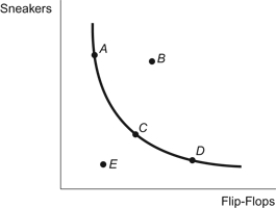 -(Figure: Indifference Curve 2) Refer to the figure. Which statement is true?
 (Multiple Choice)
5.0/5 (83)
(83) 
Filters
- Essay(0)
- Multiple Choice(0)
- Short Answer(0)
- True False(0)
- Matching(0)