



 Chat with AI
Exam 25: Consumer Choice

Exam 1: The Big Ideas253 Questions
Exam 2: The Power of Trade and Comparative239 Questions
Exam 3: Supply and Demand249 Questions
Exam 4: Equilibrium256 Questions
Exam 5: Elasticity and Its Applications271 Questions
Exam 6: Taxes and Subsidies225 Questions
Exam 7: The Price System275 Questions
Exam 8: Price Ceilings and Floors327 Questions
Exam 9: International Trade195 Questions
Exam 10: Externalities- When the Price Is Not Right273 Questions
Exam 11: Costs and Profit Maximization Under Competition217 Questions
Exam 12: Competition and the Invisible Hand144 Questions
Exam 13: Monopoly233 Questions
Exam 14: Price Discrimination262 Questions
Exam 15: Oligopoly and Game Theory218 Questions
Exam 16: Competing for Monopoly160 Questions
Exam 17: Monopolistic Competition and Advertising113 Questions
Exam 18: Labor Markets262 Questions
Exam 19: Public Goods and the Tragedy of the Commons244 Questions
Exam 20: Political Economy and Public Choice306 Questions
Exam 21: Economics, Ethics, and Public Policy241 Questions
Exam 22: Managing Incentives263 Questions
Exam 23: Stock Markets and Personal Finance271 Questions
Exam 24: Price Discrimination151 Questions
Exam 25: Consumer Choice145 Questions
Select questions type


Use the following to answer questions:
Figure: Budget Constraint 2 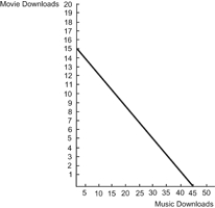 -(Figure: Budget Constraint 2) Refer to the figure. What is the relative price of music downloads to movie downloads?
 (Multiple Choice)
4.7/5  (75)
(75) As one moves down along an indifference curve, the curve typically:
(Multiple Choice)
4.9/5 (80)
(80) Assume that the unit price of good A is $4, and the unit price of good B is $5. If an individual has income of $44, which consumption bundles of (good A, good B) is on the edge of the budget constraint?
(Multiple Choice)
4.8/5 (91)
(91) If there are only two goods in the economy, chocolate and peanut butter, and the price of chocolate falls, the new utility-maximizing bundle for a typical consumer would entail consuming ______ peanut butter and ______ chocolate.
(Multiple Choice)
4.9/5 (81)
(81) The slope of the indifference curve is equal to the marginal rate of substitution.
(True/False)
4.7/5 (88)
(88) In consumer choice, one maximizes ______ subject to a budget constraint.
(Multiple Choice)
4.9/5 (81)
(81) Diminishing marginal utility means that one's first apple in a sitting is ______ one's second apple in the same sitting.
(Multiple Choice)
4.8/5 (98)
(98) Use the following to answer questions:
Figure: Music and Movie Downloads 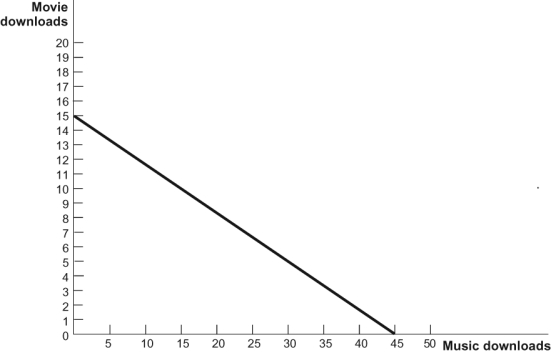 -(Figure: Music and Movie Downloads) Refer to the figure. This figure shows Stan's $45 budget constraint for movie and music downloads each month. What is the price per movie and music download?
 (Multiple Choice)
4.8/5 (70)
(70) A budget constraint shows all affordable bundles of goods given income and prices.
(True/False)
4.9/5 (86)
(86) When the income effect from a wage increase is greater than the substitution effect, the supply curve for labor:
(Multiple Choice)
4.8/5 (85)
(85) At the consumer's utility maximizing bundle that uses all of her budget, the slope of the budget constraint is ______ the slope of the indifference curve.
(Multiple Choice)
4.8/5 (82)
(82) Use the following to answer questions:
Figure: Budget Constraint 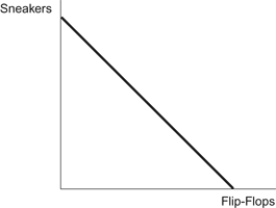 -(Figure: Budget Constraint) Refer to the figure. The slope of the budget constraint in the figure above is equal to:
 (Multiple Choice)
4.8/5 (85)
(85) Use the following to answer questions:
Figure: Budget Constraint
-(Figure: Budget Constraint) Refer to the figure. If the price of sneakers rises, then the budget constraint in the figure will:
-(Figure: Budget Constraint) Refer to the figure. If the price of sneakers rises, then the budget constraint in the figure will: (Multiple Choice)
5.0/5 (74)
(74) In equilibrium, the ratio of marginal utility to price for two respective goods is equal.
(True/False)
4.8/5 (77)
(77) If an indifference curve is straight (i.e., it doesn't "bow" inward), the marginal rate of substitution is always constant.
(True/False)
4.9/5 (80)
(80) Figure: Marginal Rate of Substitution 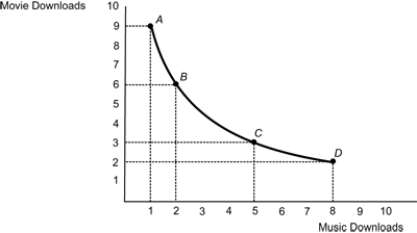 Refer to the figure. What is the marginal rate of substitution (MRS) between Bundle A and Bundle B?
 (Multiple Choice)
4.9/5 (76)
(76) 
Filters
- Essay(0)
- Multiple Choice(0)
- Short Answer(0)
- True False(0)
- Matching(0)