



 Chat with AI
Exam 4: Protein Structure

Exam 1: Principles of Biochemistry98 Questions
Exam 2: Physical Biochemistry: Energy Conversion,water,and Membranes99 Questions
Exam 3: Nucleic Acid Structure and Function100 Questions
Exam 4: Protein Structure100 Questions
Exam 5: Methods in Protein Biochemistry98 Questions
Exam 6: Protein Function113 Questions
Exam 7: Enzyme Mechanisms105 Questions
Exam 8: Cell Signaling Systems102 Questions
Exam 9: Glycolysis: a Paradigm of Metabolic Regulation100 Questions
Exam 10: The Citrate Cycle100 Questions
Exam 11: Oxidative Phosphorylation98 Questions
Exam 12: Photosynthesis100 Questions
Exam 13: Carbohydrate Structure and Function100 Questions
Exam 14: Carbohydrate Metabolism100 Questions
Exam 15: Lipid Structure and Function98 Questions
Exam 16: Lipid Metabolism100 Questions
Exam 17: Amino Acid Metabolism100 Questions
Exam 18: Nucleotide Metabolism98 Questions
Exam 19: Metabolic Integration101 Questions
Exam 20: Dna Replication, repair, and Recombination99 Questions
Exam 21: Rna Synthesis, processing, and Gene Silencing100 Questions
Exam 22: Protein Synthesis, posttranslational Modification, and Transport100 Questions
Exam 23: Gene Regulation99 Questions
Select questions type


After analyzing all the structures of proteins found in the Protein Data Bank,scientists have found that four general classes of protein structures exist,based on their secondary structure themes.Name the four classes of general protein structures.
(Essay)
4.8/5  (83)
(83) Shown is the titration curve for the amino acid aspartic acid.Draw the predominant protonation state of aspartic acid found at point A in the curve. 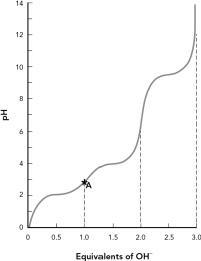
(Essay)
4.9/5 (86)
(86) The peptide bond is stronger than the ester bond.What structural feature of the peptide bond gives it additional bond strength?
(Multiple Choice)
4.9/5 (87)
(87) In the multi-subunit protein family called immunoglobulins,the different subunits are held together by both covalent and noncovalent forces.What are the covalent forces that hold subunits together in immunoglobulins?
(Essay)
4.9/5 (73)
(73) All of the following are stabilizing forces in maintaining a stable protein tertiary (3  )structure,EXCEPT
 (Multiple Choice)
4.9/5 (87)
(87) Use the table below and write out the amino acid sequence coded by the following RNA sequence: AUG_CAC_AGG_UGA. 
(Short Answer)
4.8/5 (88)
(88) Cystic fibrosis results from the misfolding of proteins that never get the chance to properly insert into the membranes of lung epithelial cells and perform their function.This is generally referred to as a __________ disease.
(Multiple Choice)
4.8/5 (81)
(81) In a standard  -helix,__________ H bonds and __________ dipole moments are found per amino acid,which stabilizes the
 -helical structure.
-helix,__________ H bonds and __________ dipole moments are found per amino acid,which stabilizes the
-helical structure. (Multiple Choice)
4.8/5 (84)
(84) Use the table below and the following RNA sequence to determine which reading frame would give rise to the shortest peptide,or which reading frame gives rise to the first stop codon.
Frame: 1 2 3
RNA: GCG CCC CCU AAC AGG UAG CUG CGG UUC CUG 
(Essay)
4.9/5 (81)
(81) What is the approximate net charge of the molecule shown below at pH 7? 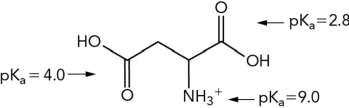
(Multiple Choice)
4.8/5 (65)
(65) Of the 20 common amino acids,how many have a chiral  -carbon?
 (Multiple Choice)
4.9/5 (84)
(84) Protein secondary structures such as  -helices and
 -sheets are stabilized mainly by
-helices and
-sheets are stabilized mainly by (Multiple Choice)
4.8/5 (81)
(81) How many possible protein primary structures are there for a tripeptide given the 20 amino acids?
(Multiple Choice)
4.9/5 (88)
(88) For the alanine titration curve shown below,which best describes point A? 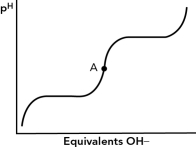
(Multiple Choice)
4.8/5 (84)
(84) Which of the following statements regarding protein domains is true?
(Multiple Choice)
4.7/5 (73)
(73) 
Filters
- Essay(0)
- Multiple Choice(0)
- Short Answer(0)
- True False(0)
- Matching(0)