



 Chat with AI
Exam 24: Aggregate Demand and Aggregate Supply Analysis

Exam 1: Economics: Foundations and Models142 Questions
Exam 2: Trade-Offs, comparative Advantage, and the Market System152 Questions
Exam 3: Where Prices Come From: the Interaction of Demand and Supply149 Questions
Exam 4: Economic Efficiency, government Price Setting, and Taxes137 Questions
Exam 5: Externalities, environmental Policy, and Public Goods139 Questions
Exam 6: Elasticity: The Responsiveness of Demand and Supply149 Questions
Exam 7: The Economics of Health Care117 Questions
Exam 8: Firms, the Stock Market, and Corporate Governance140 Questions
Exam 9: Comparative Advantage and the Gains From International Trade124 Questions
Exam 10: Consumer Choice and Behavioral Economics154 Questions
Exam 11: Technology, production, and Costs174 Questions
Exam 12: Firms in Perfectly Competitive Markets153 Questions
Exam 13: Monopolistic Competition: The Competitive Model in a More Realistic Setting137 Questions
Exam 14: Oligopoly: Firms in Less Competitive Markets129 Questions
Exam 15: Monopoly and Antitrust Policy148 Questions
Exam 16: Pricing Strategy134 Questions
Exam 17: The Markets for Labor and Other Factors of Production149 Questions
Exam 18: Public Choice, taxes, and the Distribution of Income134 Questions
Exam 19: GDP: Measuring Total Production and Income135 Questions
Exam 20: Unemployment and Inflation148 Questions
Exam 21: Economic Growth, the Financial System, and Business Cycles130 Questions
Exam 22: Long-Run Economic Growth: Sources and Policies134 Questions
Exam 23: Aggregate Expenditure and Output in the Short Run157 Questions
Exam 24: Aggregate Demand and Aggregate Supply Analysis145 Questions
Exam 25: Money, banks, and the Federal Reserve System144 Questions
Exam 26: Monetary Policy145 Questions
Exam 27: Fiscal Policy155 Questions
Exam 28: Inflation, unemployment, and Federal Reserve Policy135 Questions
Exam 29: Macroeconomics in an Open Economy145 Questions
Exam 30: The International Financial System139 Questions
Select questions type


Spending on the war in Afghanistan is essentially categorized as government purchases.How do increases in spending on the war in Afghanistan affect the aggregate demand curve?
(Multiple Choice)
4.9/5  (71)
(71) According to Marx,which of the following factors of production did not contribute anything of value to production?
(Multiple Choice)
4.7/5 (78)
(78) Figure 24-1 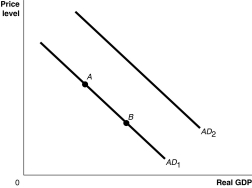 -Refer to Figure 24-1.Ceteris paribus,an increase in households' expectations of their future income would be represented by a movement from
 (Multiple Choice)
4.8/5 (83)
(83) Figure 24-1
-Refer to Figure 24-1.Ceteris paribus,an increase in the price level would be represented by a movement from
-Refer to Figure 24-1.Ceteris paribus,an increase in the price level would be represented by a movement from (Multiple Choice)
4.9/5 (88)
(88) Which of the following will shift the aggregate demand curve to the right,ceteris paribus?
(Multiple Choice)
4.8/5 (87)
(87) When potential GDP increases,long-run aggregate supply also increases.
(True/False)
4.9/5 (71)
(71) When the price level in the United States falls relative to the price level of other countries,________ will fall,________ will rise,and ________ will rise.
(Multiple Choice)
4.7/5 (95)
(95) If workers and firms have rational expectations,they form their expectations using
(Multiple Choice)
4.7/5 (73)
(73) The long-run adjustment to a negative supply shock results in
(Multiple Choice)
4.9/5 (79)
(79) Figure 24-2 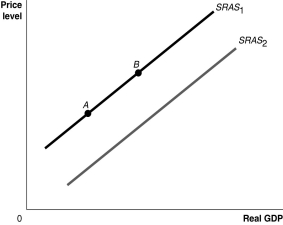 -Refer to Figure 24-2.Ceteris paribus,an increase in the price level would be represented by a movement from
 (Multiple Choice)
4.9/5 (77)
(77) Figure 24-2
-Refer to Figure 24-2.Ceteris paribus,an increase in the expected future price level would be represented by a movement from
-Refer to Figure 24-2.Ceteris paribus,an increase in the expected future price level would be represented by a movement from (Multiple Choice)
4.9/5 (95)
(95) If the U.S.dollar decreases in value relative to other currencies,how does this affect the aggregate demand curve?
(Multiple Choice)
4.9/5 (91)
(91) Figure 24-2
-Refer to Figure 24-2.Ceteris paribus,an increase in workers and firms adjusting to having previously overestimated the price level would be represented by a movement from
-Refer to Figure 24-2.Ceteris paribus,an increase in workers and firms adjusting to having previously overestimated the price level would be represented by a movement from (Multiple Choice)
4.9/5 (70)
(70) A supply shock causes the long-run aggregate supply curve to shift left,decreasing the price level.
(True/False)
4.9/5 (87)
(87) Because of the slope of the aggregate demand curve,we can say that
(Multiple Choice)
4.7/5 (85)
(85) Suppose there has been an increase in investment.As a result,real GDP will ________ in the short run,and ________ in the long run.
(Multiple Choice)
4.9/5 (70)
(70) In the dynamic aggregate demand and aggregate supply model,what is the result of aggregate demand increasing slower than potential real GDP?
(Essay)
4.9/5 (83)
(83) 
Filters
- Essay(0)
- Multiple Choice(0)
- Short Answer(0)
- True False(0)
- Matching(0)