



 Chat with AI
Exam 27: Fiscal Policy

Exam 1: Economics: Foundations and Models142 Questions
Exam 2: Trade-Offs, comparative Advantage, and the Market System152 Questions
Exam 3: Where Prices Come From: the Interaction of Demand and Supply149 Questions
Exam 4: Economic Efficiency, government Price Setting, and Taxes137 Questions
Exam 5: Externalities, environmental Policy, and Public Goods139 Questions
Exam 6: Elasticity: The Responsiveness of Demand and Supply149 Questions
Exam 7: The Economics of Health Care117 Questions
Exam 8: Firms, the Stock Market, and Corporate Governance140 Questions
Exam 9: Comparative Advantage and the Gains From International Trade124 Questions
Exam 10: Consumer Choice and Behavioral Economics154 Questions
Exam 11: Technology, production, and Costs174 Questions
Exam 12: Firms in Perfectly Competitive Markets153 Questions
Exam 13: Monopolistic Competition: The Competitive Model in a More Realistic Setting137 Questions
Exam 14: Oligopoly: Firms in Less Competitive Markets129 Questions
Exam 15: Monopoly and Antitrust Policy148 Questions
Exam 16: Pricing Strategy134 Questions
Exam 17: The Markets for Labor and Other Factors of Production149 Questions
Exam 18: Public Choice, taxes, and the Distribution of Income134 Questions
Exam 19: GDP: Measuring Total Production and Income135 Questions
Exam 20: Unemployment and Inflation148 Questions
Exam 21: Economic Growth, the Financial System, and Business Cycles130 Questions
Exam 22: Long-Run Economic Growth: Sources and Policies134 Questions
Exam 23: Aggregate Expenditure and Output in the Short Run157 Questions
Exam 24: Aggregate Demand and Aggregate Supply Analysis145 Questions
Exam 25: Money, banks, and the Federal Reserve System144 Questions
Exam 26: Monetary Policy145 Questions
Exam 27: Fiscal Policy155 Questions
Exam 28: Inflation, unemployment, and Federal Reserve Policy135 Questions
Exam 29: Macroeconomics in an Open Economy145 Questions
Exam 30: The International Financial System139 Questions
Select questions type


Figure 27-1 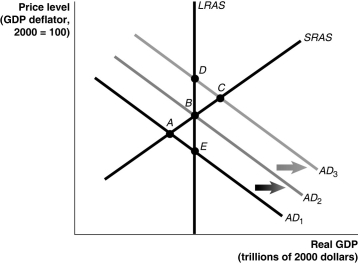 -Refer to Figure 27-1.Suppose the economy is in short-run equilibrium below potential GDP and Congress and the president lower taxes to move the economy back to long-run equilibrium.Using the static AD-AS model in the figure above,this would be depicted as a movement from
A) A to B.
B) B to C.
C) C to B.
D) B to A.
E) A to E.
-Refer to Figure 27-1.Suppose the economy is in short-run equilibrium below potential GDP and Congress and the president lower taxes to move the economy back to long-run equilibrium.Using the static AD-AS model in the figure above,this would be depicted as a movement from
A) A to B.
B) B to C.
C) C to B.
D) B to A.
E) A to E. (Not Answered)
This question doesn't have any answer yet
The cyclically adjusted budget deficit or surplus measures what the deficit or surplus would be if the economy was
(Multiple Choice)
5.0/5  (86)
(86) In early 2008,the housing crisis and rising oil prices increased the risk of recession in the United States.What fiscal policy action was taken by Congress and the president to counter these events?
(Multiple Choice)
5.0/5 (86)
(86) In the long run,most economists agree that a permanent increase in government spending leads to ________ crowding out of private spending.
(Multiple Choice)
4.8/5 (80)
(80) Social Security began as a "pay-as-you-go" system,meaning that payments to current retirees were paid
(Multiple Choice)
4.8/5 (75)
(75) The largest and fastest-growing category of federal government expenditures is
(Multiple Choice)
4.9/5 (74)
(74) The automatic budget surpluses and budget deficits that occur in the federal budget over the business cycle
(Multiple Choice)
4.9/5 (79)
(79) The tax multiplier equals the change in ________ divided by the change in ________.
(Multiple Choice)
4.8/5 (68)
(68) Does expansionary fiscal policy directly increase the money supply? Isn't it true that the president and Congress fight recessions by spending more money?
(Essay)
4.9/5 (84)
(84) The three categories of federal government expenditures,in addition to government purchases,are
(Multiple Choice)
4.9/5 (88)
(88) What are the key differences between how we illustrate an expansionary fiscal policy in the basic aggregate demand and aggregate supply model and in the dynamic aggregate demand and aggregate supply model?
(Essay)
4.8/5 (77)
(77) The federal government debt as a percentage of GDP fell during the period
(Multiple Choice)
4.8/5 (78)
(78) An increase in individual income taxes ________ disposable income,which ________ consumption spending.
(Multiple Choice)
4.9/5 (79)
(79) The Social Security and Medicare programs have been a failure in terms of reducing poverty among elderly U.S.citizens.
(True/False)
4.8/5 (99)
(99) The Federal Reserve plays a larger role than Congress and the president in stabilizing the economy because
(Multiple Choice)
4.8/5 (74)
(74) The majority of the federal government debt is held by government agencies.
(True/False)
4.9/5 (79)
(79) Figure 27-2 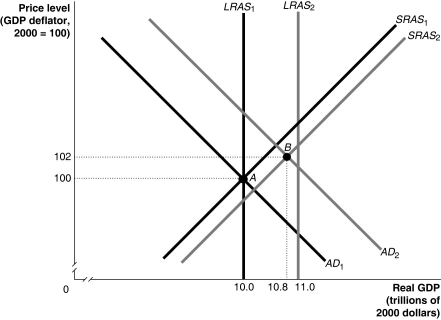 -Refer to Figure 27-2.In the dynamic model of AD-AS in the figure above,if the economy is at point A in year 1 and is expected to go to point B in year 2,Congress and the president would most likely
 (Multiple Choice)
4.9/5 (79)
(79) The aggregate demand curve will shift to the right ________ the initial increase in government purchases.
(Multiple Choice)
4.7/5 (81)
(81) 
Filters
- Essay(0)
- Multiple Choice(0)
- Short Answer(0)
- True False(0)
- Matching(0)