



 Chat with AI
Exam 28: Inflation, unemployment, and Federal Reserve Policy

Exam 1: Economics: Foundations and Models142 Questions
Exam 2: Trade-Offs, comparative Advantage, and the Market System152 Questions
Exam 3: Where Prices Come From: the Interaction of Demand and Supply149 Questions
Exam 4: Economic Efficiency, government Price Setting, and Taxes137 Questions
Exam 5: Externalities, environmental Policy, and Public Goods139 Questions
Exam 6: Elasticity: The Responsiveness of Demand and Supply149 Questions
Exam 7: The Economics of Health Care117 Questions
Exam 8: Firms, the Stock Market, and Corporate Governance140 Questions
Exam 9: Comparative Advantage and the Gains From International Trade124 Questions
Exam 10: Consumer Choice and Behavioral Economics154 Questions
Exam 11: Technology, production, and Costs174 Questions
Exam 12: Firms in Perfectly Competitive Markets153 Questions
Exam 13: Monopolistic Competition: The Competitive Model in a More Realistic Setting137 Questions
Exam 14: Oligopoly: Firms in Less Competitive Markets129 Questions
Exam 15: Monopoly and Antitrust Policy148 Questions
Exam 16: Pricing Strategy134 Questions
Exam 17: The Markets for Labor and Other Factors of Production149 Questions
Exam 18: Public Choice, taxes, and the Distribution of Income134 Questions
Exam 19: GDP: Measuring Total Production and Income135 Questions
Exam 20: Unemployment and Inflation148 Questions
Exam 21: Economic Growth, the Financial System, and Business Cycles130 Questions
Exam 22: Long-Run Economic Growth: Sources and Policies134 Questions
Exam 23: Aggregate Expenditure and Output in the Short Run157 Questions
Exam 24: Aggregate Demand and Aggregate Supply Analysis145 Questions
Exam 25: Money, banks, and the Federal Reserve System144 Questions
Exam 26: Monetary Policy145 Questions
Exam 27: Fiscal Policy155 Questions
Exam 28: Inflation, unemployment, and Federal Reserve Policy135 Questions
Exam 29: Macroeconomics in an Open Economy145 Questions
Exam 30: The International Financial System139 Questions
Select questions type


Last year,the unemployment rate was 4 percent and the inflation rate was 3 percent.If the natural rate of unemployment is 3 percent,how do you expect inflation to change?
(Essay)
4.9/5  (65)
(65) The key to understanding the short-run trade-off behind the Phillips curve is that an increase in inflation will decrease unemployment if the inflation is ________ by both workers and firms.
(Multiple Choice)
4.9/5 (68)
(68) If expectations are adaptive,how will the economy adjust to a new long-run equilibrium in response to contractionary monetary policy? Support your answer with a graph of the Phillips curve.
(Essay)
4.9/5 (74)
(74) Figure 28-2  -Refer to Figure 28-2.Suppose the economy is at point C in the figure above.If workers adjust their expectations of inflation,which of the following will be true?
 (Multiple Choice)
4.8/5 (67)
(67) If actual inflation is less than expected inflation,which of the following will be true?
(Multiple Choice)
4.8/5 (92)
(92) In the long run,the Federal Reserve can control which of the following?
(Multiple Choice)
4.9/5 (95)
(95) When individuals use all available information about an economic variable to make a decision,expectations are
(Multiple Choice)
4.8/5 (71)
(71) According to the short-run Phillips curve,the unemployment rate and the inflation rate are
(Multiple Choice)
4.9/5 (70)
(70) How would you expect the Fed to respond to a negative supply shock in the economy?
(Essay)
4.7/5 (89)
(89) Ceteris paribus,in the short run following a decrease in the rate of growth in Aggregate Demand,we would expect to see an increase in the rate of unemployment and a decrease in the rate of inflation.
(True/False)
4.8/5 (86)
(86) Over the past two decades,whenever changes in Fed policy have been announced,
(Multiple Choice)
5.0/5 (86)
(86) Figure 28-1  -Refer to Figure 28-1.Suppose that the economy is currently at point A on the short-run Phillips curve in the figure above,and the unemployment rate at A is the natural rate.If the economy was to move to point C,which of the following must be true?
 (Multiple Choice)
4.9/5 (77)
(77) In conducting monetary policy,how has the Federal Reserve enhanced its credibility?
(Multiple Choice)
5.0/5 (81)
(81) If actual inflation is greater than expected inflation,what is the relationship between the actual real wage and the expected real wage?
(Multiple Choice)
4.9/5 (81)
(81) The long-run Phillips curve is ________ than the short-run Phillips curve.
(Multiple Choice)
4.8/5 (77)
(77) Figure 28-3 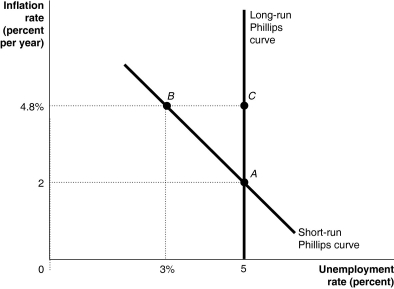 -Refer to Figure 28-3.If firms and workers have rational expectations,an expansionary monetary policy will cause the short-run equilibrium to move from
A) point B to point C.
B) point C to point A.
C) point A to point B.
D) point B to point A.
E) point A to point C.
-Refer to Figure 28-3.If firms and workers have rational expectations,an expansionary monetary policy will cause the short-run equilibrium to move from
A) point B to point C.
B) point C to point A.
C) point A to point B.
D) point B to point A.
E) point A to point C. (Not Answered)
This question doesn't have any answer yet
Workers at a local mining company are paid $25.60 per hour,and they have incorporated a 3 percent annual raise in their contracts to account for expected inflation.Explain how unexpected inflation of 5 percent will affect the real wage and the unemployment rate.
(Essay)
4.8/5 (73)
(73) If the Federal Reserve chooses to fight high inflation with contractionary monetary policy and firms and consumers expect this policy to reduce inflation,which of the following would you expect to see?
(Multiple Choice)
5.0/5 (86)
(86) When will an increase in aggregate demand not result in lower unemployment rates in the short run?
(Essay)
4.9/5 (76)
(76) 
Filters
- Essay(0)
- Multiple Choice(0)
- Short Answer(0)
- True False(0)
- Matching(0)