



 Chat with AI
Exam 3: Where Prices Come From: the Interaction of Demand and Supply

Exam 1: Economics: Foundations and Models142 Questions
Exam 2: Trade-Offs, comparative Advantage, and the Market System152 Questions
Exam 3: Where Prices Come From: the Interaction of Demand and Supply149 Questions
Exam 4: Economic Efficiency, government Price Setting, and Taxes137 Questions
Exam 5: Externalities, environmental Policy, and Public Goods139 Questions
Exam 6: Elasticity: The Responsiveness of Demand and Supply149 Questions
Exam 7: The Economics of Health Care117 Questions
Exam 8: Firms, the Stock Market, and Corporate Governance140 Questions
Exam 9: Comparative Advantage and the Gains From International Trade124 Questions
Exam 10: Consumer Choice and Behavioral Economics154 Questions
Exam 11: Technology, production, and Costs174 Questions
Exam 12: Firms in Perfectly Competitive Markets153 Questions
Exam 13: Monopolistic Competition: The Competitive Model in a More Realistic Setting137 Questions
Exam 14: Oligopoly: Firms in Less Competitive Markets129 Questions
Exam 15: Monopoly and Antitrust Policy148 Questions
Exam 16: Pricing Strategy134 Questions
Exam 17: The Markets for Labor and Other Factors of Production149 Questions
Exam 18: Public Choice, taxes, and the Distribution of Income134 Questions
Exam 19: GDP: Measuring Total Production and Income135 Questions
Exam 20: Unemployment and Inflation148 Questions
Exam 21: Economic Growth, the Financial System, and Business Cycles130 Questions
Exam 22: Long-Run Economic Growth: Sources and Policies134 Questions
Exam 23: Aggregate Expenditure and Output in the Short Run157 Questions
Exam 24: Aggregate Demand and Aggregate Supply Analysis145 Questions
Exam 25: Money, banks, and the Federal Reserve System144 Questions
Exam 26: Monetary Policy145 Questions
Exam 27: Fiscal Policy155 Questions
Exam 28: Inflation, unemployment, and Federal Reserve Policy135 Questions
Exam 29: Macroeconomics in an Open Economy145 Questions
Exam 30: The International Financial System139 Questions
Select questions type


Which of the following would shift the supply curve for MP3 players to the right?
(Multiple Choice)
4.7/5  (71)
(71) Nearly a quarter of China's 1.3 billion people are under the age of 15.How will this affect high school enrollment over the next fifteen years? The labor market over the next fifteen years?
(Essay)
4.7/5 (77)
(77) If the Apple iPad and the Samsung Galaxy Tab are considered substitutes,then,other things equal,an increase in the price of the iPad will
(Multiple Choice)
4.9/5 (86)
(86) "The price of compact fluorescent light bulbs fell because of improvements in production technology.As a result,the demand for incandescent light bulbs decreased.This caused the price of incandescent light bulbs to fall; as the price of incandescent light bulbs fell the demand for incandescent light bulbs decreased even further." Evaluate this statement.
(Multiple Choice)
4.8/5 (79)
(79) Table 3-1
 -Refer to Table 3-1.The table above shows the demand schedules for loose-leaf tea of two individuals (Sunil and Mia)and the rest of the market.If the price of loose-leaf tea rises from $3 to $4,the market quantity demanded would
 (Multiple Choice)
4.9/5 (78)
(78) Select the phrase that correctly completes the following statement."A positive change in technology caused an increase in the supply of flat-screen televisions.As a result ________."
(Multiple Choice)
4.7/5 (79)
(79) Assume that both the demand curve and the supply curve for MP3 players shift to the right but the demand curve shifts more than the supply curve.As a result
(Multiple Choice)
4.9/5 (81)
(81) Table 3-1
-Refer to Table 3-1.The table above shows the demand schedules for loose-leaf tea of two individuals (Sunil and Mia)and the rest of the market.At a price of $5,the quantity demanded in the market would be
-Refer to Table 3-1.The table above shows the demand schedules for loose-leaf tea of two individuals (Sunil and Mia)and the rest of the market.At a price of $5,the quantity demanded in the market would be (Multiple Choice)
4.8/5 (86)
(86) By drawing a demand curve with ________ on the vertical axis and ________ on the horizontal axis,economists assume that the most important determinant of the demand for a good is the ________ of the good.
(Multiple Choice)
4.9/5 (71)
(71) Figure 3-4  -Refer to Figure 3-4.If the current market price is $10,the market will achieve equilibrium by
 (Multiple Choice)
4.8/5 (86)
(86) For each of the following pairs of products state which are complements,which are substitutes,and which are unrelated.
a.Digital camera and memory stick
b.7Up and Mountain Dew
c.Swimsuits and flip-flops
d.Tylenol and cat food
e.Photocopier and paper
(Essay)
4.9/5 (76)
(76) Figure 3-8 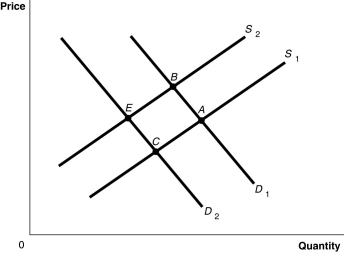 -Refer to Figure 3-8.The graph in this figure illustrates an initial competitive equilibrium in the market for apples at the intersection of D1 and S1 (point
A) The equilibrium point will move from A to B.
A)) If there is a shortage of apples how will the equilibrium point change?
B) The equilibrium point will move from A to C.
C) There will be no change in the equilibrium point.
D) The equilibrium point will move from A to E.
-Refer to Figure 3-8.The graph in this figure illustrates an initial competitive equilibrium in the market for apples at the intersection of D1 and S1 (point
A) The equilibrium point will move from A to B.
A)) If there is a shortage of apples how will the equilibrium point change?
B) The equilibrium point will move from A to C.
C) There will be no change in the equilibrium point.
D) The equilibrium point will move from A to E. (Not Answered)
This question doesn't have any answer yet
Studies have shown links between calcium consumption and a reduction in osteoporosis.How does this affect the market for calcium?
(Multiple Choice)
4.8/5 (74)
(74) In October,market analysts predict that the price of platinum will fall in November.What happens in the platinum market in October,holding everything else constant?
(Multiple Choice)
4.8/5 (63)
(63) Olive oil producers want to sell more olive oil at a higher price.Which of the following events would have this effect?
(Multiple Choice)
4.8/5 (83)
(83) Ranchers can raise either cattle or sheep on their land.Which of the following would cause the supply of sheep to increase?
(Multiple Choice)
4.8/5 (72)
(72) In each of the following situations,list what will happen to the equilibrium price and the equilibrium quantity for a particular product,which is a normal good.
a.The population increases and the price of inputs increase
b.The price of a complement increases and technology advances
c.The number of firms in the market increases and income increases
d.Price is expected to increase in the future
e.Consumer preference increases and the price of a substitute in production decreases
(Essay)
5.0/5 (90)
(90) If a firm has an incentive to increase supply now and decrease supply in the future,the firm expects that the
(Multiple Choice)
4.7/5 (84)
(84) Figure 3-5  -Refer to Figure 3-5.In a free market such as that depicted above,a surplus is eliminated by
 (Multiple Choice)
4.9/5 (89)
(89) 
Filters
- Essay(0)
- Multiple Choice(0)
- Short Answer(0)
- True False(0)
- Matching(0)