



 Chat with AI
Exam 17: Monetary Policy

Exam 1: Economics: Foundations and Models160 Questions
Exam 2: Trade-Offs, comparative Advantage, and the Market System191 Questions
Exam 3: Where Prices Come From: the Interaction of Demand and Supply241 Questions
Exam 4: Market Efficiency and Market Failure226 Questions
Exam 5: The Economics of Healthcare169 Questions
Exam 6: Firms,the Stock Market,and Corporate Governance255 Questions
Exam 7: Consumer Choice and Elasticity270 Questions
Exam 8: Technology, production, and Costs277 Questions
Exam 9: Firms in Perfectly Competitive Markets351 Questions
Exam 10: Monopoly and Antitrust253 Questions
Exam 11: Monopolistic Competition and Oligopoly304 Questions
Exam 12: GDP: Measuring Total Production and Income200 Questions
Exam 13: Unemployment and Inflation207 Questions
Exam 14: Economic Growth, the Financial System and Business Cycles172 Questions
Exam 15: Aggregate Demand and Aggregate Supply Analysis120 Questions
Exam 16: Money, banks, and the Federal Reserve System139 Questions
Exam 17: Monetary Policy180 Questions
Exam 18: Fiscal Policy131 Questions
Exam 19: Comparative Advantage, international Trade, and Exchange Rates247 Questions
Select questions type


Increases in government spending will lower the long-term growth rate of GDP if it lowers ________ spending,and the government purchases ________ goods and not ________ goods.
(Multiple Choice)
5.0/5  (79)
(79) If the federal government's expenditures are less than its tax revenues,then
(Multiple Choice)
4.8/5 (88)
(88) Suppose that the nominal wage,the expected and actual price levels,and the expected and actual inflation rates for a hypothetical economy in 2013 are presented in the following table.What is the expected real wage rate in 2013? 
(Multiple Choice)
4.9/5 (85)
(85) Explain why crowding out might still occur even if the increase in government spending is funded by borrowing on global financial markets.
(Essay)
4.9/5 (77)
(77) What is the difference between federal purchases and federal expenditures?
(Essay)
4.8/5 (78)
(78) Just as real GDP ________ potential GDP in the long run,the unemployment rate ________ the natural rate of unemployment in the long-run.
(Multiple Choice)
4.8/5 (74)
(74) Slow growth in aggregate demand leads to ________ inflation and ________ unemployment.
(Multiple Choice)
4.7/5 (96)
(96) Using the following table,answer the following questions.The numbers in the table are in billions of dollars.
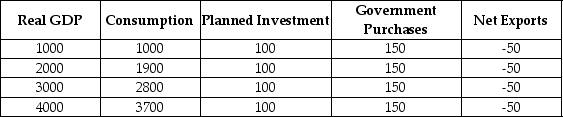 a. What is the equilibrium level of real GDP?
b. What is the MPC?
c. If potential GDP is $4000 billion,is the economy at full employment? If not,what is the condition of the economy?
d. If the economy is not at full employment,by how much should government spending increase so that the economy can move to the full employment level of GDP?
a. What is the equilibrium level of real GDP?
b. What is the MPC?
c. If potential GDP is $4000 billion,is the economy at full employment? If not,what is the condition of the economy?
d. If the economy is not at full employment,by how much should government spending increase so that the economy can move to the full employment level of GDP? (Essay)
4.9/5 (78)
(78) A(n)________ in private expenditure as a result of a(n)________ in government purchases is called crowding out.
(Multiple Choice)
4.7/5 (86)
(86) Figure 17.7 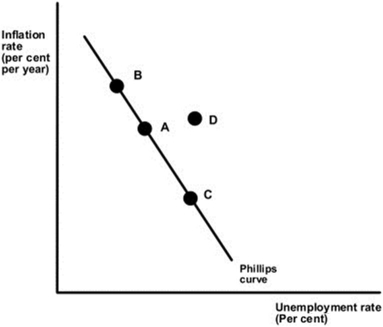 -Suppose that the economy is at point A on the Phillips curve in Figure 17.7.If the aggregate demand curve shifts to the right by the same amount as long-run aggregate supply,then the economy will
 (Multiple Choice)
4.7/5 (84)
(84) What is the government purchases multiplier if the tax rate is 0.1 and the marginal propensity to consume is 0.9? Assume the economy is closed.
(Multiple Choice)
4.7/5 (70)
(70) Assume that the economy is in the state described by the following table.
 Draw a dynamic aggregate demand and aggregate supply diagram to illustrate the state of the economy in year 1 and year 2,assuming that no policy is pursued.Then illustrate the appropriate fiscal policy to use in this situation.Assume that the policy results in the economy producing at potential GDP.Provide an explanation.
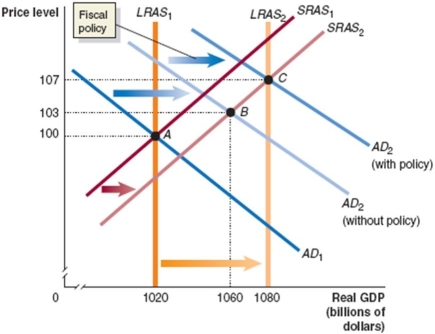
Draw a dynamic aggregate demand and aggregate supply diagram to illustrate the state of the economy in year 1 and year 2,assuming that no policy is pursued.Then illustrate the appropriate fiscal policy to use in this situation.Assume that the policy results in the economy producing at potential GDP.Provide an explanation. (Essay)
4.8/5 (77)
(77) If policy makers implement expansionary fiscal policy and do not take into account crowding out,equilibrium GDP is likely to
(Multiple Choice)
4.7/5 (80)
(80) The largest share of Australian federal government welfare payments in 2013/14 went to
(Multiple Choice)
4.8/5 (81)
(81) Government budget deficits can lead to higher real interest rates,which will reduce private investment.
(True/False)
4.9/5 (68)
(68) A federal budget deficit acts as an automatic stabiliser because
(Multiple Choice)
4.8/5 (85)
(85) Which of the following is considered expansionary fiscal policy?
(Multiple Choice)
4.7/5 (82)
(82) Government net debt in Australia was highest in which of the following time periods?
(Multiple Choice)
4.9/5 (81)
(81) 
Filters
- Essay(0)
- Multiple Choice(0)
- Short Answer(0)
- True False(0)
- Matching(0)