



 Chat with AI
Exam 11: Monopolistic Competition and Oligopoly

Exam 1: Economics: Foundations and Models160 Questions
Exam 2: Trade-Offs, comparative Advantage, and the Market System191 Questions
Exam 3: Where Prices Come From: the Interaction of Demand and Supply241 Questions
Exam 4: Market Efficiency and Market Failure226 Questions
Exam 5: The Economics of Healthcare169 Questions
Exam 6: Firms,the Stock Market,and Corporate Governance255 Questions
Exam 7: Consumer Choice and Elasticity270 Questions
Exam 8: Technology, production, and Costs277 Questions
Exam 9: Firms in Perfectly Competitive Markets351 Questions
Exam 10: Monopoly and Antitrust253 Questions
Exam 11: Monopolistic Competition and Oligopoly304 Questions
Exam 12: GDP: Measuring Total Production and Income200 Questions
Exam 13: Unemployment and Inflation207 Questions
Exam 14: Economic Growth, the Financial System and Business Cycles172 Questions
Exam 15: Aggregate Demand and Aggregate Supply Analysis120 Questions
Exam 16: Money, banks, and the Federal Reserve System139 Questions
Exam 17: Monetary Policy180 Questions
Exam 18: Fiscal Policy131 Questions
Exam 19: Comparative Advantage, international Trade, and Exchange Rates247 Questions
Select questions type


State the Coase theorem.

Free
(Essay)
4.9/5  (79)
(79) Correct Answer: Verified
The Coase theorem states that if transactions costs are low,private bargaining will result in an efficient solution to the problem of externalities,regardless of the initial assignment of property rights.
Economic efficiency in a competitive market is achieved when
Free
(Multiple Choice)
4.9/5 (85)
(85) Correct Answer:Verified
VerifiedC
The efficient output level of a public good occurs where the
(Multiple Choice)
4.8/5 (77)
(77) For certain public projects such as building a dam on a river or a bridge to an island,what procedure is a government likely to use to determine what quantity of a public good should be supplied?
(Multiple Choice)
4.9/5 (69)
(69) Suppose a tax equal to the value of the marginal external cost at the optimal output is imposed on a pollution-generating good.All of the following will result from the tax except
(Multiple Choice)
4.9/5 (86)
(86) The social cost of cutting trees for firewood in a government forest is
(Multiple Choice)
4.8/5 (78)
(78) 'When it comes to public goods,individuals do not reveal their true preferences because it is not in their self-interest to do so.' Evaluate this statement.
(Essay)
4.7/5 (72)
(72) Suppose a negative externality exists in a market.If transactions costs are low and parties are willing to bargain,then,according to the Coase theorem
(Multiple Choice)
4.7/5 (74)
(74) Figure 11-1  -Refer to Figure 11-1.The figure above represents the market for pecans.Assume that this is a competitive market.Which of the following is true?
 (Multiple Choice)
4.8/5 (79)
(79) Figure 11-6  Suppose there are several paper mills producing paper for a market. These mills, located upstream from a fishing village, discharge a large amount of wastewater into the river. The waste material affects the number of fish in the river, and the use of the river for recreation and as a public water supply source. Figure 11-6 shows the paper market. Use this Figure to answer the following question(s).
-Refer to Figure 11-6.What does S1 represent?
Suppose there are several paper mills producing paper for a market. These mills, located upstream from a fishing village, discharge a large amount of wastewater into the river. The waste material affects the number of fish in the river, and the use of the river for recreation and as a public water supply source. Figure 11-6 shows the paper market. Use this Figure to answer the following question(s).
-Refer to Figure 11-6.What does S1 represent? (Multiple Choice)
5.0/5 (85)
(85) When there is a negative externality,the private cost of production ________ the social cost of production.
(Multiple Choice)
4.8/5 (95)
(95) Figure 11-7 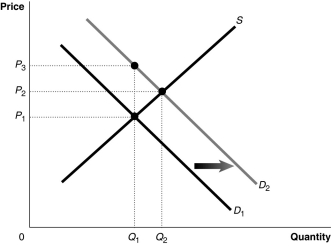 Figure 11-7 shows a market with an externality. The current market equilibrium output of Q1 is not the economically efficient output. The economically efficient output is Q2.
-Refer to Figure 11-7.If,because of an externality,the economically efficient output is Q2 and not the current equilibrium output of Q1,what does D2 represent?
Figure 11-7 shows a market with an externality. The current market equilibrium output of Q1 is not the economically efficient output. The economically efficient output is Q2.
-Refer to Figure 11-7.If,because of an externality,the economically efficient output is Q2 and not the current equilibrium output of Q1,what does D2 represent? (Multiple Choice)
4.9/5 (88)
(88) Figure 11-16 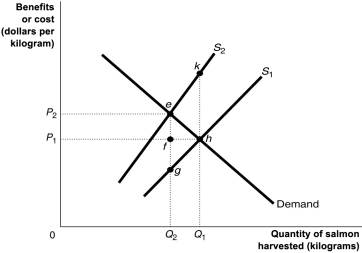 Figure 11-16 shows the market for Atlantic salmon, a common resource. The current market equilibrium output of Q1 is not the economically efficient output. The economically efficient output is Q2.
-Refer to Figure 11-16.Identify the area that shows the deadweight loss from overfishing.
Figure 11-16 shows the market for Atlantic salmon, a common resource. The current market equilibrium output of Q1 is not the economically efficient output. The economically efficient output is Q2.
-Refer to Figure 11-16.Identify the area that shows the deadweight loss from overfishing. (Multiple Choice)
4.9/5 (73)
(73) Experience with patents in the pharmaceutical industry shows that when patents on drugs expire,
(Multiple Choice)
4.7/5 (86)
(86) State whether each of the following goods and services is non-rival,non-excludable or both:
a.A toll road
b.A public park
c.A lighthouse
d.An art museum
e.A radio broadcast of 'A Prairie Home Companion'
(Essay)
4.9/5 (78)
(78) If a state requires all drivers to purchase auto insurance,insurance companies still face the problem of
(Multiple Choice)
4.8/5 (85)
(85) A key difficulty facing insurance companies is that people know more about their health than do insurance companies,and that those people who are seriously ill are the most likely to want to obtain health insurance.What is this phenomenon called?
(Multiple Choice)
4.9/5 (84)
(84) When people who buy insurance change their behaviour after the purchase because they are protected from loss by the insurance,the insurance market is said to face the problem of
(Multiple Choice)
4.7/5 (81)
(81) 
Filters
- Essay(0)
- Multiple Choice(0)
- Short Answer(0)
- True False(0)
- Matching(0)