



 Chat with AI
Exam 16: Money, banks, and the Federal Reserve System

Exam 1: Economics: Foundations and Models160 Questions
Exam 2: Trade-Offs, comparative Advantage, and the Market System191 Questions
Exam 3: Where Prices Come From: the Interaction of Demand and Supply241 Questions
Exam 4: Market Efficiency and Market Failure226 Questions
Exam 5: The Economics of Healthcare169 Questions
Exam 6: Firms,the Stock Market,and Corporate Governance255 Questions
Exam 7: Consumer Choice and Elasticity270 Questions
Exam 8: Technology, production, and Costs277 Questions
Exam 9: Firms in Perfectly Competitive Markets351 Questions
Exam 10: Monopoly and Antitrust253 Questions
Exam 11: Monopolistic Competition and Oligopoly304 Questions
Exam 12: GDP: Measuring Total Production and Income200 Questions
Exam 13: Unemployment and Inflation207 Questions
Exam 14: Economic Growth, the Financial System and Business Cycles172 Questions
Exam 15: Aggregate Demand and Aggregate Supply Analysis120 Questions
Exam 16: Money, banks, and the Federal Reserve System139 Questions
Exam 17: Monetary Policy180 Questions
Exam 18: Fiscal Policy131 Questions
Exam 19: Comparative Advantage, international Trade, and Exchange Rates247 Questions
Select questions type


The money demand curve is downward sloping because

Free
(Multiple Choice)
4.7/5  (87)
(87) Correct Answer: Verified
B
Figure 16.2 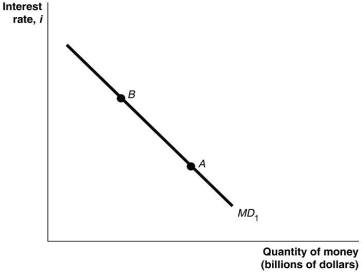 -Refer to Figure 16.2.In this figure,a movement from point A to point B would be caused by
Free
(Multiple Choice)
4.9/5 (77)
(77) Correct Answer:Verified
VerifiedD
Explain how a decrease in the tax rate on interest earned on savings would affect savings,investment,the interest rate,and economic growth.
(Essay)
4.9/5 (76)
(76) The Reserve Bank of Australia has its independence from the government guaranteed by the Australian Constitution.
(True/False)
5.0/5 (69)
(69) A government could use control of a central bank to further its political interests by
(Multiple Choice)
4.8/5 (89)
(89) If technological change increases the profitability of new investment for firms,then the ________ curve for loanable funds will shift to the ________ and the equilibrium real interest rate will ________.
(Multiple Choice)
4.9/5 (76)
(76) Use the dynamic aggregate demand and aggregate supply model to explain what monetary policy stance the Reserve Bank of Australia should take if the economy is entering a period of high inflation.
(Essay)
4.9/5 (66)
(66) The money market model is concerned with ________ and the loanable funds market model is concerned with ________.
(Multiple Choice)
4.8/5 (80)
(80) Figure 16.4 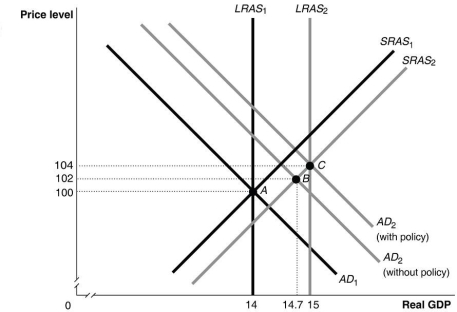 -Refer to Figure 16.4.In this figure,suppose the economy in Year 1 is at point A and expected in Year 2 to be at point B.Which of the following policies could the Reserve Bank of Australia use to move the economy to point C?
 (Multiple Choice)
4.7/5 (90)
(90) The demand for loanable funds has a ________ slope because,the lower the interest rate,the ________ number of investment projects are profitable,and the ________ the quantity of loanable funds demanded.
(Multiple Choice)
4.8/5 (69)
(69) Figure 16.6 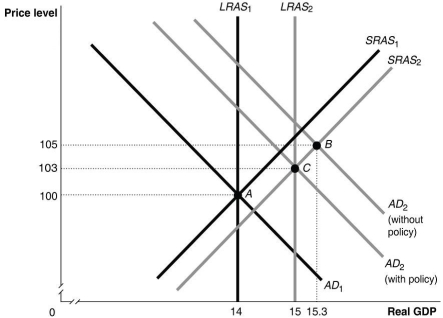 -Refer to Figure 16.6.In this figure,suppose the economy in Year 1 is at point A and expected in Year 2 to be at point B.Which of the following policies could the Reserve Bank of Australia use to move the economy to point C?
 (Multiple Choice)
4.8/5 (72)
(72) A rise in interest rates will lead to a negative income effect for households that are net borrowers.
(True/False)
4.7/5 (78)
(78) Which of the following is the main goal of monetary policy in Australia?
(Multiple Choice)
4.8/5 (87)
(87) An increase in the real interest rate results in which of the following?
(Multiple Choice)
4.7/5 (77)
(77) 
Filters
- Essay(0)
- Multiple Choice(0)
- Short Answer(0)
- True False(0)
- Matching(0)