



 Chat with AI
Exam 17: Monetary Policy

Exam 1: Economics: Foundations and Models160 Questions
Exam 2: Trade-Offs, comparative Advantage, and the Market System191 Questions
Exam 3: Where Prices Come From: the Interaction of Demand and Supply241 Questions
Exam 4: Market Efficiency and Market Failure226 Questions
Exam 5: The Economics of Healthcare169 Questions
Exam 6: Firms,the Stock Market,and Corporate Governance255 Questions
Exam 7: Consumer Choice and Elasticity270 Questions
Exam 8: Technology, production, and Costs277 Questions
Exam 9: Firms in Perfectly Competitive Markets351 Questions
Exam 10: Monopoly and Antitrust253 Questions
Exam 11: Monopolistic Competition and Oligopoly304 Questions
Exam 12: GDP: Measuring Total Production and Income200 Questions
Exam 13: Unemployment and Inflation207 Questions
Exam 14: Economic Growth, the Financial System and Business Cycles172 Questions
Exam 15: Aggregate Demand and Aggregate Supply Analysis120 Questions
Exam 16: Money, banks, and the Federal Reserve System139 Questions
Exam 17: Monetary Policy180 Questions
Exam 18: Fiscal Policy131 Questions
Exam 19: Comparative Advantage, international Trade, and Exchange Rates247 Questions
Select questions type


Give examples of automatic stabilisers.Explain how automatic stabilisers work when there is an economic boom.
(Essay)
4.8/5  (77)
(77) Figure 17.6 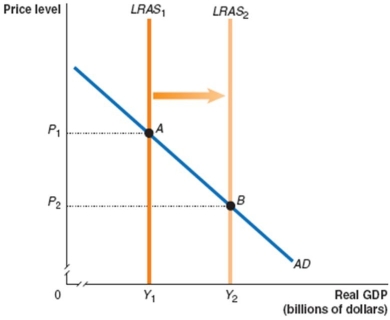 -Suppose the federal government reduces income taxes.Assume that the movement from A to B in Figure 17.6 represents normal growth in the economy before the tax change.If the tax change is not effective and labour supply and savings do not increase because of the tax change,then the tax change will
 (Multiple Choice)
4.9/5 (87)
(87) Figure 17.7 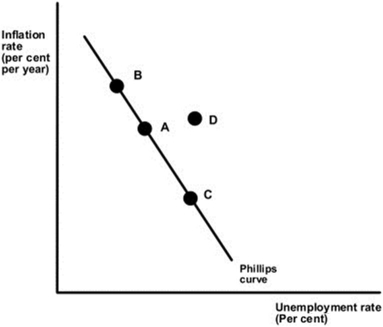 -Suppose that the economy is at point A on the Phillips curve in Figure 17.7.If the aggregate demand curve shifts to the right by less than the long-run aggregate supply,then the economy will
 (Multiple Choice)
4.8/5 (95)
(95) Long lags associated with the legislative process in implementing fiscal policy can make it more difficult to use than monetary policy.
(True/False)
4.7/5 (75)
(75) If the government purchases multiplier equals 2,and real GDP is $14 trillion with potential GDP $14.5 trillion,then government purchases would need to increase by ________ to restore the economy to potential GDP.
(Multiple Choice)
4.9/5 (70)
(70) Show the effects of tax reduction and simplification using the dynamic aggregate demand and supply model.To simplify the analysis,assume that the aggregate demand curve does not change.How does the analysis change if the tax change does not change labour supply and has little or no effect on savings and investment? 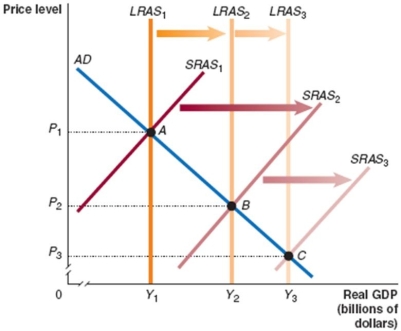
(Essay)
5.0/5 (73)
(73) Figure 17.2 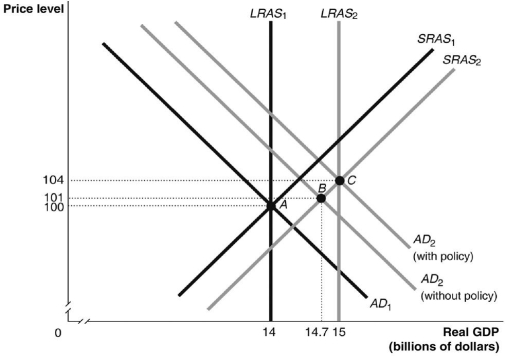 -In Figure 17.2,suppose the economy in Year 1 is at point A and expected in Year 2 to be at point B.Which of the following policies could the government use to move the economy to point C?
 (Multiple Choice)
4.7/5 (76)
(76) It can be ________ difficult to effectively time fiscal policy than monetary policy because ________.
(Multiple Choice)
4.8/5 (67)
(67) What is the formula for the multiplier? Explain why this formula is considered to be too simple.
(Essay)
4.8/5 (73)
(73) During economic contractions,government expenditure automatically
(Multiple Choice)
4.9/5 (72)
(72) Figure 17.4 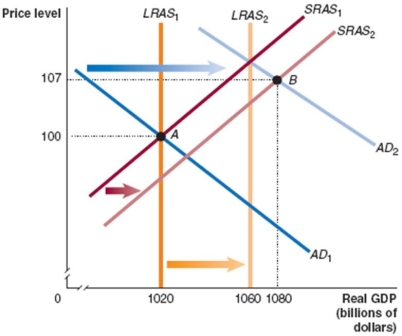 -To try to combat inflation,the government could
 (Multiple Choice)
4.8/5 (96)
(96) A deliberate policy change in taxes and government spending to influence the level of aggregate demand is called
(Multiple Choice)
4.7/5 (88)
(88) Suppose the federal budget is balanced when GDP is at potential GDP.If equilibrium GDP falls below potential
(Multiple Choice)
4.8/5 (81)
(81) How could the existence of unemployment benefits or other transfer programs reduce the severity of an economic contraction?
(Essay)
4.9/5 (77)
(77) An equal increase in government purchases and taxes will cause
(Multiple Choice)
5.0/5 (72)
(72) Figure 17.4
-In Figure 17.4,if fiscal policy is successful at moving the economy from point B to equilibrium at potential GDP,which of the following will occur?
-In Figure 17.4,if fiscal policy is successful at moving the economy from point B to equilibrium at potential GDP,which of the following will occur? (Multiple Choice)
4.9/5 (76)
(76) 
Filters
- Essay(0)
- Multiple Choice(0)
- Short Answer(0)
- True False(0)
- Matching(0)