



 Chat with AI
Exam 17: Monetary Policy

Exam 1: Economics: Foundations and Models160 Questions
Exam 2: Trade-Offs, comparative Advantage, and the Market System191 Questions
Exam 3: Where Prices Come From: the Interaction of Demand and Supply241 Questions
Exam 4: Market Efficiency and Market Failure226 Questions
Exam 5: The Economics of Healthcare169 Questions
Exam 6: Firms,the Stock Market,and Corporate Governance255 Questions
Exam 7: Consumer Choice and Elasticity270 Questions
Exam 8: Technology, production, and Costs277 Questions
Exam 9: Firms in Perfectly Competitive Markets351 Questions
Exam 10: Monopoly and Antitrust253 Questions
Exam 11: Monopolistic Competition and Oligopoly304 Questions
Exam 12: GDP: Measuring Total Production and Income200 Questions
Exam 13: Unemployment and Inflation207 Questions
Exam 14: Economic Growth, the Financial System and Business Cycles172 Questions
Exam 15: Aggregate Demand and Aggregate Supply Analysis120 Questions
Exam 16: Money, banks, and the Federal Reserve System139 Questions
Exam 17: Monetary Policy180 Questions
Exam 18: Fiscal Policy131 Questions
Exam 19: Comparative Advantage, international Trade, and Exchange Rates247 Questions
Select questions type


Which is the largest source of federal government revenue and which is the largest single area of government expenditure in Australia?
(Essay)
4.9/5  (79)
(79) Tax reduction and simplification should ________ long-run aggregate supply and ________ aggregate demand.
(Multiple Choice)
4.8/5 (70)
(70) Consider the hypothetical information in the following table for potential GDP,real GDP and the price level in 2013 and in 2014 if the government does not use fiscal policy.  If the government wants to keep real GDP at its potential level in 2014,it should
 (Multiple Choice)
4.8/5 (87)
(87) An increase in government purchases of $200 billion will shift the aggregate demand curve to the right by
(Multiple Choice)
4.9/5 (86)
(86) If the government wanted to try to counteract the effects of a recession,it could
(Multiple Choice)
4.9/5 (97)
(97) Poorly timed discretionary policy can do more harm than good.Getting the timing right with fiscal policy is generally
(Multiple Choice)
4.8/5 (70)
(70) An increase in income taxes will reduce the rate of increase in aggregate demand but will have no effect on aggregate supply.
(True/False)
4.8/5 (86)
(86) If the economy is growing beyond potential GDP,which of the following would be an appropriate fiscal policy to bring the economy back to long-run aggregate supply? An increase in
(Multiple Choice)
4.8/5 (87)
(87) If the economy were in a recession,we would expect government expenditure to be
(Multiple Choice)
4.9/5 (70)
(70) The largest source of revenue for the Australian federal government is
(Multiple Choice)
4.8/5 (84)
(84) Borrowing to pay for long-term capital expenditures makes sense as the benefits are received
(Multiple Choice)
4.8/5 (71)
(71) If workers fail to believe that rising inflation will eventually result in comparable increases in wages,but firms do understand this,then there is a
(Multiple Choice)
4.8/5 (91)
(91) An increase in government spending may expedite recovery from a recession in the short run,but in the long run,this policy may
(Multiple Choice)
4.8/5 (89)
(89) Calculate the government purchases multiplier if the marginal propensity to consume equals 0.8,the tax rate is 0.1,and the marginal propensity to import equals 0.2.
(Multiple Choice)
4.8/5 (74)
(74) Explain how lowered taxes on capital gains and dividends might increase aggregate supply.
(Essay)
4.7/5 (81)
(81) Figure 17.5 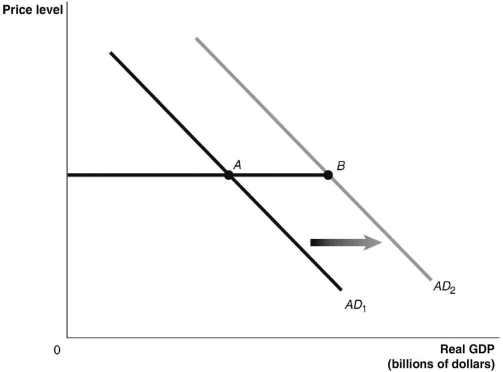 -Refer to Figure 17.5.If government purchases increase by $100 billion and lead to an ultimate increase in aggregate demand as shown in the graph,the difference in real GDP between point A and point B will be
 (Multiple Choice)
4.8/5 (86)
(86) Consider the hypothetical information in the following table for potential GDP,real GDP and the price level in 2013 and in 2014 if the government does not use fiscal policy.  If the government wants to keep real GDP at its potential level in 2014,it should
 (Multiple Choice)
4.9/5 (84)
(84) 
Filters
- Essay(0)
- Multiple Choice(0)
- Short Answer(0)
- True False(0)
- Matching(0)