



 Chat with AI
Exam 17: Monetary Policy

Exam 1: Economics: Foundations and Models160 Questions
Exam 2: Trade-Offs, comparative Advantage, and the Market System191 Questions
Exam 3: Where Prices Come From: the Interaction of Demand and Supply241 Questions
Exam 4: Market Efficiency and Market Failure226 Questions
Exam 5: The Economics of Healthcare169 Questions
Exam 6: Firms,the Stock Market,and Corporate Governance255 Questions
Exam 7: Consumer Choice and Elasticity270 Questions
Exam 8: Technology, production, and Costs277 Questions
Exam 9: Firms in Perfectly Competitive Markets351 Questions
Exam 10: Monopoly and Antitrust253 Questions
Exam 11: Monopolistic Competition and Oligopoly304 Questions
Exam 12: GDP: Measuring Total Production and Income200 Questions
Exam 13: Unemployment and Inflation207 Questions
Exam 14: Economic Growth, the Financial System and Business Cycles172 Questions
Exam 15: Aggregate Demand and Aggregate Supply Analysis120 Questions
Exam 16: Money, banks, and the Federal Reserve System139 Questions
Exam 17: Monetary Policy180 Questions
Exam 18: Fiscal Policy131 Questions
Exam 19: Comparative Advantage, international Trade, and Exchange Rates247 Questions
Select questions type


Accumulating debt can be a problem for the federal government because
(Multiple Choice)
4.8/5  (82)
(82) The government purchases multiplier will be larger if the marginal income tax rate increases.
(True/False)
4.9/5 (84)
(84) Suppose that the nominal wage,the expected and actual price levels,and the expected and actual inflation rates for a hypothetical economy in 2013 are presented in the following table.  Given the data,the economy is at an unemployment rate
 (Multiple Choice)
4.7/5 (87)
(87) The multiplier effect is the series of ________ increases in ________ expenditures that result from an initial increase in ________ expenditures.
(Multiple Choice)
4.9/5 (74)
(74) The cyclically adjusted budget deficit calculates the budget surplus or deficit if the economy
(Multiple Choice)
4.7/5 (95)
(95) Suppose real GDP is $1.3 trillion and potential GDP is $1.35 trillion.If the government increases government purchases by $0.5 trillion,then the economy will be brought to equilibrium at potential GDP.
(True/False)
4.9/5 (87)
(87) If the multiplier is 10,the marginal propensity to consume must be 0.1.
(True/False)
4.8/5 (85)
(85) Figure 17.3 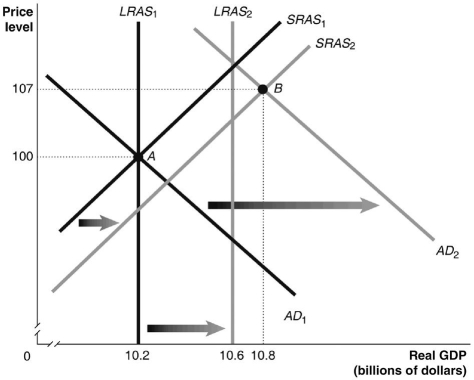 -Refer to Figure 17.3.Given that the economy has moved from A to B in the graph above,which of the following would be the appropriate fiscal policy to achieve potential GDP?
 (Multiple Choice)
5.0/5 (77)
(77) If the marginal propensity to save is 0.35,the multiplier is 2.86.
(True/False)
4.8/5 (71)
(71) A law requiring the government to balance its budget in each year would serve as an automatic destabiliser.
(True/False)
4.9/5 (80)
(80) Suppose the economy is in the state described by the following table.
 What problem will occur in the economy if no policy is pursued? What fiscal policy tools could be used to combat the problem? Draw a dynamic aggregate demand and supply graph to illustrate the appropriate fiscal policy to use in this situation.
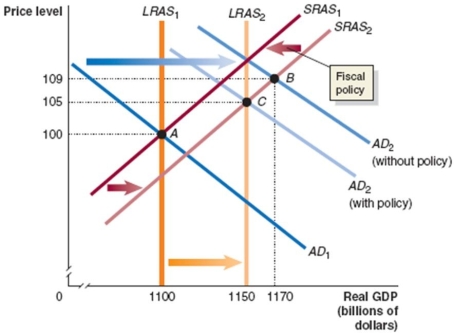
What problem will occur in the economy if no policy is pursued? What fiscal policy tools could be used to combat the problem? Draw a dynamic aggregate demand and supply graph to illustrate the appropriate fiscal policy to use in this situation. (Essay)
4.8/5 (88)
(88) Suppose that the government allocates $1 billion for new roads.It also raises taxes by $1 billion to keep the deficit from growing.If the marginal propensity to consume = 0.9,what is the effect on equilibrium GDP?
(Multiple Choice)
4.9/5 (86)
(86) To counteract the effect of automatic stabilisers during a recession and keep the budget balanced,the federal government would need to ________ government spending,or ________ taxes,which would ________ aggregate demand.
(Multiple Choice)
4.8/5 (74)
(74) If the government wants to try to reduce unemployment,it could ________ spending and/or taxes should be ________.
(Multiple Choice)
4.8/5 (80)
(80) Which of the following is not an explanation for the decline in autonomous expenditure that occurred in Australia during the Great Depression of the 1930s?
(Multiple Choice)
4.8/5 (86)
(86) Tax increases on business income slow down the rate of increase in aggregate demand by decreasing
(Multiple Choice)
4.9/5 (86)
(86) Fiscal policy is quicker to implement than monetary policy as,with fiscal policy,changes can be done immediately by the government,whereas with monetary policy it takes time to change interest rates in financial markets.
(True/False)
4.8/5 (84)
(84) 
Filters
- Essay(0)
- Multiple Choice(0)
- Short Answer(0)
- True False(0)
- Matching(0)