



 Chat with AI
Exam 17: Monetary Policy

Exam 1: Economics: Foundations and Models160 Questions
Exam 2: Trade-Offs, comparative Advantage, and the Market System191 Questions
Exam 3: Where Prices Come From: the Interaction of Demand and Supply241 Questions
Exam 4: Market Efficiency and Market Failure226 Questions
Exam 5: The Economics of Healthcare169 Questions
Exam 6: Firms,the Stock Market,and Corporate Governance255 Questions
Exam 7: Consumer Choice and Elasticity270 Questions
Exam 8: Technology, production, and Costs277 Questions
Exam 9: Firms in Perfectly Competitive Markets351 Questions
Exam 10: Monopoly and Antitrust253 Questions
Exam 11: Monopolistic Competition and Oligopoly304 Questions
Exam 12: GDP: Measuring Total Production and Income200 Questions
Exam 13: Unemployment and Inflation207 Questions
Exam 14: Economic Growth, the Financial System and Business Cycles172 Questions
Exam 15: Aggregate Demand and Aggregate Supply Analysis120 Questions
Exam 16: Money, banks, and the Federal Reserve System139 Questions
Exam 17: Monetary Policy180 Questions
Exam 18: Fiscal Policy131 Questions
Exam 19: Comparative Advantage, international Trade, and Exchange Rates247 Questions
Select questions type


Decreasing government spending ________ the price level and ________ equilibrium real GDP,ceteris paribus.
(Multiple Choice)
4.8/5  (90)
(90) Which of the following is a true statement about the multiplier?
(Multiple Choice)
4.9/5 (87)
(87) Economists think that the marginal propensity to consume for the Australian economy is between 0.9 and 0.95.Based on our simple multiplier formula,this would imply that the multiplier for Australia should be at least 10.However,many economists agree that the spending multiplier is closer to 2.0.What might explain this supposed anomaly?
(Essay)
4.9/5 (84)
(84) During an economic contraction,why is it likely that the federal government budget will move into deficit?
(Essay)
4.8/5 (73)
(73) The federal government debt ________ when the federal government runs a deficit and ________ when the federal government runs a surplus.
(Multiple Choice)
4.9/5 (71)
(71) Figure 17.1 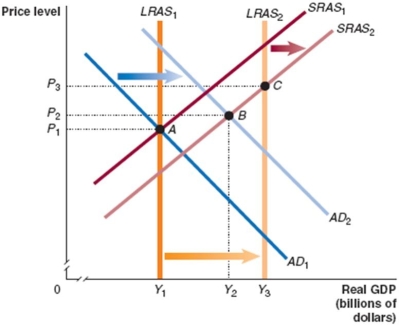 -In Figure 17.1,if fiscal policy successfully moves the economy from point B to equilibrium at potential GDP,this will
 (Multiple Choice)
4.7/5 (73)
(73) Explain why the tax multiplier is different from the government purchases multiplier.
(Essay)
4.8/5 (79)
(79) Which of the following does not function as an automatic stabiliser?
(Multiple Choice)
4.8/5 (71)
(71) According to Friedman and Phelps,if actual inflation is greater than expected inflation
(Multiple Choice)
4.8/5 (75)
(75) Which of the following is a true statement about the multiplier?
(Multiple Choice)
4.8/5 (73)
(73) What is expansionary fiscal policy and under what circumstances would it be used?
(Essay)
4.9/5 (79)
(79) Expansionary fiscal policy is used by the government in an attempt to fight rising inflation.
(True/False)
4.7/5 (74)
(74) A cut in tax rates affects equilibrium real GDP through two channels: ________ disposable income and consumer spending,and ________ the size of the multiplier effect.
(Multiple Choice)
4.7/5 (75)
(75) Government purchases and transfer payments are included in the measure of government expenditure.
(True/False)
4.9/5 (82)
(82) During which decade was government expenditure in Australia the highest as a proportion of GDP?
(Multiple Choice)
5.0/5 (82)
(82) 
Filters
- Essay(0)
- Multiple Choice(0)
- Short Answer(0)
- True False(0)
- Matching(0)