



 Chat with AI
Exam 17: Monetary Policy

Exam 1: Economics: Foundations and Models160 Questions
Exam 2: Trade-Offs, comparative Advantage, and the Market System191 Questions
Exam 3: Where Prices Come From: the Interaction of Demand and Supply241 Questions
Exam 4: Market Efficiency and Market Failure226 Questions
Exam 5: The Economics of Healthcare169 Questions
Exam 6: Firms,the Stock Market,and Corporate Governance255 Questions
Exam 7: Consumer Choice and Elasticity270 Questions
Exam 8: Technology, production, and Costs277 Questions
Exam 9: Firms in Perfectly Competitive Markets351 Questions
Exam 10: Monopoly and Antitrust253 Questions
Exam 11: Monopolistic Competition and Oligopoly304 Questions
Exam 12: GDP: Measuring Total Production and Income200 Questions
Exam 13: Unemployment and Inflation207 Questions
Exam 14: Economic Growth, the Financial System and Business Cycles172 Questions
Exam 15: Aggregate Demand and Aggregate Supply Analysis120 Questions
Exam 16: Money, banks, and the Federal Reserve System139 Questions
Exam 17: Monetary Policy180 Questions
Exam 18: Fiscal Policy131 Questions
Exam 19: Comparative Advantage, international Trade, and Exchange Rates247 Questions
Select questions type


The larger the marginal propensity to save,the smaller the multiplier is.
(True/False)
4.8/5  (81)
(81) A decrease in individual income taxes ________ disposable income,which ________ consumption spending.
(Multiple Choice)
4.8/5 (81)
(81) The tax multiplier is calculated as 'one minus the government purchases multiplier'.
(True/False)
4.8/5 (69)
(69) Suppose real GDP is $13 trillion,potential GDP is $13.5 trillion,and the government plans to use fiscal policy to restore the economy to potential GDP.Assuming a constant price level,the government would need to increase government purchases by
(Multiple Choice)
4.8/5 (71)
(71) Use the following information to draw a graph showing the short-run and long-run Phillips curves.
Natural rate of unemployment = 5 per cent
Current rate of unemployment = 3 per cent
Expected inflation rate = 2.9 per cent
Current inflation rate = 6.2 per cent
(Essay)
4.9/5 (88)
(88) Federal government expenditure as a proportion of GDP in Australia between 1980 and 2010 has varied between
(Multiple Choice)
5.0/5 (65)
(65) Figure 17.4 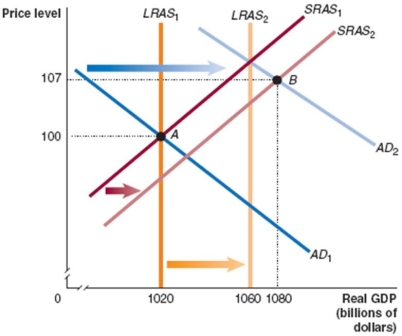 -Given that the economy has moved from A to B in Figure 17.4,which of the following would be the appropriate fiscal policy to achieve potential GDP?
 (Multiple Choice)
4.7/5 (93)
(93) Policy makers in the 1960s believed that there was a structural relationship between unemployment and inflation.This meant that the cost of lower unemployment was a
(Multiple Choice)
4.9/5 (85)
(85) What did Milton Friedman and Edmund Phelps argue about the long-run Phillips curve?
(Essay)
4.9/5 (69)
(69) Figure 17.1 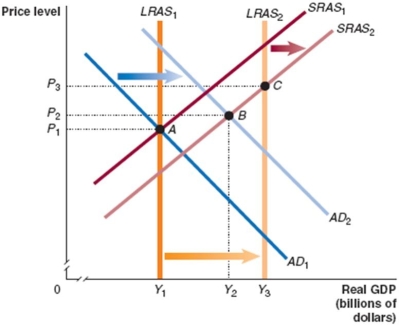 -If the economy moves from A to B in Figure 17.1,which of the following would be the appropriate fiscal policy to achieve potential GDP?
 (Multiple Choice)
4.9/5 (88)
(88) If the absolute value of the tax multiplier equals 1.6,real GDP is $13 trillion,and potential GDP is $13.4 trillion,then taxes would need to be cut by ________ to restore the economy to potential GDP.
(Multiple Choice)
4.7/5 (75)
(75) What is contractionary fiscal policy and under what circumstances would it be used?
(Essay)
5.0/5 (84)
(84) Active changes in tax and spending by government intended to smooth out the business cycle are called ________,and changes in taxes and spending that occur passively over the business cycle are called ________.
(Multiple Choice)
4.8/5 (96)
(96) Which of the following is an example of discretionary fiscal policy?
(Multiple Choice)
4.8/5 (80)
(80) Outline the differences between the government purchases multiplier and the tax multiplier.
(Essay)
4.8/5 (74)
(74) Which of the following is the largest category of Australian federal government expenditures?
(Multiple Choice)
4.9/5 (76)
(76) Assuming a fixed amount of taxes and a closed economy,calculate the value of the government purchases multiplier,the tax multiplier,and the balanced budget multiplier if the marginal propensity to consume equals 0.75.
(Essay)
4.8/5 (83)
(83) 
Filters
- Essay(0)
- Multiple Choice(0)
- Short Answer(0)
- True False(0)
- Matching(0)