



 Chat with AI
Exam 17: Monetary Policy

Exam 1: Economics: Foundations and Models160 Questions
Exam 2: Trade-Offs, comparative Advantage, and the Market System191 Questions
Exam 3: Where Prices Come From: the Interaction of Demand and Supply241 Questions
Exam 4: Market Efficiency and Market Failure226 Questions
Exam 5: The Economics of Healthcare169 Questions
Exam 6: Firms,the Stock Market,and Corporate Governance255 Questions
Exam 7: Consumer Choice and Elasticity270 Questions
Exam 8: Technology, production, and Costs277 Questions
Exam 9: Firms in Perfectly Competitive Markets351 Questions
Exam 10: Monopoly and Antitrust253 Questions
Exam 11: Monopolistic Competition and Oligopoly304 Questions
Exam 12: GDP: Measuring Total Production and Income200 Questions
Exam 13: Unemployment and Inflation207 Questions
Exam 14: Economic Growth, the Financial System and Business Cycles172 Questions
Exam 15: Aggregate Demand and Aggregate Supply Analysis120 Questions
Exam 16: Money, banks, and the Federal Reserve System139 Questions
Exam 17: Monetary Policy180 Questions
Exam 18: Fiscal Policy131 Questions
Exam 19: Comparative Advantage, international Trade, and Exchange Rates247 Questions
Select questions type


Induced taxes and transfer payments reduce the multiplier effects.
(True/False)
4.8/5  (74)
(74) An increase in government spending lowers interest rates and increases the rate of investment in new capital.
(True/False)
4.7/5 (77)
(77) Government expenditure in Australia as a percentage of GDP has consistently trended upward since the 1960s.
(True/False)
4.8/5 (81)
(81) Which of the following would be considered a fiscal policy action?
(Multiple Choice)
4.9/5 (87)
(87) Increasing government debt relative to GDP does not cause which of the following?
(Multiple Choice)
4.9/5 (83)
(83) The nominal wage,expected inflation,and actual inflation for a hypothetical economy in 2012 are presented in the following table.Calculate the actual and expected real wage,assuming the price level is 100 in 2011.Explain how firms will use this information in terms of hiring and what will happen to the unemployment rate.

(Essay)
4.9/5 (76)
(76) The Phillips curve shows the short-run relationship between
(Multiple Choice)
4.9/5 (84)
(84) As the tax wedge associated with a given economic activity gets smaller,we would expect
(Multiple Choice)
4.9/5 (74)
(74) A vertical long-run Phillips curve implies that in the long run there is no trade-off between unemployment and inflation.
(True/False)
4.7/5 (73)
(73) Figure 17.7 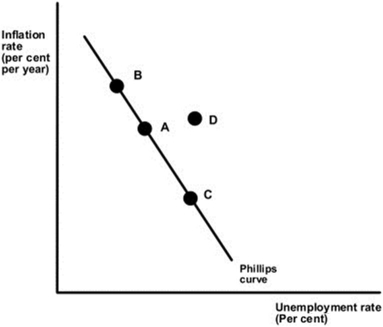 -Suppose the economy is at point A on the Phillips curve in Figure 17.7.If the aggregate demand curve shifts to the right by more than the long-run aggregate supply curve does,then the economy will
 (Multiple Choice)
4.7/5 (65)
(65) If the federal budget has an actual budget surplus of $75 billion,but a cyclically adjusted budget surplus of $50 billion,then the economy must be above potential GDP.
(True/False)
4.8/5 (73)
(73) Fiscal policy is defined as changes in federal ________ and ________ to achieve macroeconomic objectives such as price stability,healthy rates of economic growth,and high employment.
(Multiple Choice)
5.0/5 (78)
(78) In Australia in 2005/06,the federal government had zero net debt for the first time in over
(Multiple Choice)
4.8/5 (75)
(75) Between 1970 and 2014 in Australia,the largest budget deficits occurred
(Multiple Choice)
4.8/5 (78)
(78) Assume in a closed economy that taxes are fixed and the marginal propensity to consume is equal to 0.8.What is the government purchases multiplier?
(Multiple Choice)
4.9/5 (87)
(87) Would a larger multiplier lead to longer and more severe recessions or shorter and less severe recessions? Briefly explain.
(Essay)
4.9/5 (74)
(74) Assume that the federal government gives a $5 billion tax cut.Assume that tax rates are fixed,the economy is closed,and the marginal propensity to consume is 0.75.What happens to equilibrium GDP?
(Multiple Choice)
4.9/5 (86)
(86) Suppose the current equilibrium GDP for a country is $14.5 trillion and potential GDP is $14.3 trillion.Will decreasing government purchases by $200 billion or raising taxes by $200 billion restore the economy to potential GDP? Briefly explain why.
(Essay)
4.7/5 (79)
(79) 
Filters
- Essay(0)
- Multiple Choice(0)
- Short Answer(0)
- True False(0)
- Matching(0)