



 Chat with AI
Exam 18: Electron Transport and Oxidative Phosphorylation

Exam 1: Introduction to the Chemistry of Life56 Questions
Exam 2: Water59 Questions
Exam 3: Nucleotides, nucleic Acids, and Genetic Information67 Questions
Exam 4: Amino Acids68 Questions
Exam 5: Proteins: Primary Structure68 Questions
Exam 6: Proteins: Three-Dimensional Structure60 Questions
Exam 7: Protein Function Part I: Myoglobin and Hemoglobin74 Questions
Exam 8: Carbohydrates66 Questions
Exam 9: Lipids and Biological Membranes58 Questions
Exam 10: Membrane Transport49 Questions
Exam 11: Enzyme Catalysis53 Questions
Exam 12: Enzyme Kinetics, inhibition and Control54 Questions
Exam 13: Biochemical Signaling50 Questions
Exam 14: Introduction to Metabolism52 Questions
Exam 15: Glucose Catabolism50 Questions
Exam 16: Glycogen Metabolism and Gluconeogenesis50 Questions
Exam 17: Citric Acid Cycle50 Questions
Exam 18: Electron Transport and Oxidative Phosphorylation50 Questions
Exam 19: Photosynthesis50 Questions
Exam 20: Lipid Metabolism51 Questions
Exam 21: Amino Acid Metabolism50 Questions
Exam 22: Mammalian Fuel Metabolism: Integration and Regulation50 Questions
Exam 23: Nucleotide Metabolism50 Questions
Exam 24: Nucleic Acid Structure50 Questions
Exam 25: DNA Replication, repair and Recombination50 Questions
Exam 26: Transcription and Rna Processing50 Questions
Exam 27: Protein Synthesis49 Questions
Exam 28: Regulation of Gene Expression50 Questions
Select questions type


Approximately how many ATP molecules are synthesized from the oxidation of 1 NADH?
(Multiple Choice)
4.7/5  (83)
(83) The rate of oxidative phosphorylation
(I)is regulated by the availability of ADP and Pi.
(II)is reduced when the ratio of [NADH]/[NAD+] is high.
(III)increases with a higher concentration of reduced cytochrome c
(IV)is regulated by activity of the ADP-ATP translocator.
(Multiple Choice)
4.9/5 (86)
(86) Matching
Choose the correct answer from the list.Not all the answers will be used.
-The cytochromes within complex III all contain _____ groups.
(Multiple Choice)
4.9/5 (80)
(80) Matching
Choose the correct answer from the list.Not all the answers will be used.
-The inner mitochondrial membrane divides the mitochondrion into the inner membrane space and the ______.
(Multiple Choice)
4.8/5 (85)
(85) ___ the gradient with the synthesis of ATP via oxidative phosphorylation.
(I)The Fo portion of ATP synthase
(II)Thermogenin uncouples
(III)2,4-dinitrophenol (DNP)dissipates
(IV)An ionophore capable of transporting potassium ions across the membrane
(Multiple Choice)
4.9/5 (78)
(78) A typical eukaryotic cell contains up to ____ mitochondria each bound by a smooth outer membrane.
(Multiple Choice)
4.8/5 (75)
(75) Matching
Choose the correct answer from the list.Not all the answers will be used.
-Protons moving through a transmembranc channel by "jumping" through an arrangement of hydrogen-bonded groups are described as moving through a proton ______.
(Multiple Choice)
4.9/5 (77)
(77) An animal with the UCP-1 protein would
(I)generate excess heat.
(II)have lower energy levels.
(III)generate ATP efficiently via oxidative phosphorylation.
(Multiple Choice)
4.9/5 (72)
(72) Based on the information in the chapter,which of the following is TRUE regarding Complex III?
(I)A large portion of Complex III dissociates from the membrane bound portion of the complex.
(II)Complex III contains three identical cytochrome redox centers.
(III)The Q cycle allows stepwise reoxidation of the two electrons from CoQH2.
(IV)A change in conformation of iron sulfur protein (ISP)ensures that the Reiske center is reduced preferentially by CoQ.-.
(Multiple Choice)
4.9/5 (66)
(66) Some degenerative diseases,such as Parkinson's disease,are associated with ______ damage to ______.
(Multiple Choice)
4.7/5 (80)
(80) Which conformation of the active sites in ATP synthase allows binding of substrates?
(Multiple Choice)
5.0/5 (64)
(64) Matching
Choose the correct answer from the list.Not all the answers will be used.
-Cytochrome c oxidase contains four redox centers: two heme groups and two redox centers containing_______.
(Multiple Choice)
4.9/5 (91)
(91) Consider the following half-reactions:
o' = -0.315 V NAD+ + H+ + 2 e- NADH
o' = 0.815 V 1/2 O2 + 2 H+ + 2 e- H2O
What is the o'for the following redox equation?
O2 + 2 NADH + 2 H+ 2 H2O + 2 NAD+
(Multiple Choice)
4.8/5 (89)
(89) According to the proposed reaction sequence presented in the chapter,cytochrome c oxidase obtains a fourth electron from a ____ residue adjacent to the heme a3-ligated O2,thus forming a transient radical.
(Multiple Choice)
4.8/5 (66)
(66) Which of the following is TRUE regarding heme proteins?
(I)Heme groups are capable of transferring electrons across large distances provided that some molecular network exists as a "path."
(II)Heme groups are often buried in protein structure because the protein protects the heme and prevents it from indiscriminately transferring electrons.
(III)The rate of electron transfer from a reduced heme is physiologically significant.
(IV)Heme groups are often differentiated by their absorption spectrum.
(Multiple Choice)
4.9/5 (86)
(86) Antimycin A
(I)inhibition can be restored by addition of succinate.
(II)inhibition can be restored by addition of cytochrome c.
(III)blocks consumption of oxygen.
(IV)blocks transfer of electrons from CoQ to Complex III.
(Multiple Choice)
4.9/5 (69)
(69) Which of the following statements about the mitochondrial inner membrane is TRUE?
(I)The inner membrane is permeable to CO2,H2O,and small ions.
(II)The inner membrane contains several transport proteins and membrane bound
Enzymes.
(III)In general,a higher inner membrane surface area correlates to a higher rate of
Respiration.
(IV)The number of cristae reflects the respiratory activity of the cell.
(Multiple Choice)
4.7/5 (79)
(79) Use the table below to rank the redox centers in order to produce a favorable electron flow.
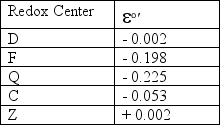
(Multiple Choice)
4.9/5 (77)
(77) Which of the following is TRUE regarding the complexes within the electron transport system?
(I)Complex II contributes twice as many protons to the gradient than Complex I
(II)Inhibition of Complex II would decrease the total number of electrons moving through the electron transport chain.
(III)Inhibition of Complex II would not alter the amount of free energy generated from electrons originating from NADH.
(IV)Complex I can accept electrons with higher potential than Complex II is able to accept.
(Multiple Choice)
4.8/5 (92)
(92) What is the net result of the successive reactions catalyzed by superoxide dismutase and catalase?
(Multiple Choice)
4.8/5 (83)
(83) 
Filters
- Essay(0)
- Multiple Choice(0)
- Short Answer(0)
- True False(0)
- Matching(0)