



 Chat with AI
Exam 22: Long-Run Economic Growth: Sources and Policies

Exam 1: Economics: Foundations and Models444 Questions
Exam 2: Trade-Offs, Comparative Advantage, and the Market System498 Questions
Exam 3: Where Prices Come From: the Interaction of Demand and Supply475 Questions
Exam 4: Economic Efficiency, Government Price Setting, and Taxes419 Questions
Exam 5: Externalities, Environmental Policy, and Public Goods266 Questions
Exam 6: Elasticity: the Responsiveness of Demand and Supply295 Questions
Exam 7: The Economics of Health Care334 Questions
Exam 8: Firms, the Stock Market, and Corporate Governance278 Questions
Exam 9: Comparative Advantage and the Gains From International Trade379 Questions
Exam 10: Consumer Choice and Behavioral Economics302 Questions
Exam 11: Technology, Production, and Costs330 Questions
Exam 12: Firms in Perfectly Competitive Markets298 Questions
Exam 13: Monopolistic Competition: the Competitive Model in a More Realistic Setting276 Questions
Exam 14: Oligopoly: Firms in Less Competitive Markets262 Questions
Exam 15: Monopoly and Antitrust Policy271 Questions
Exam 16: Pricing Strategy263 Questions
Exam 17: The Markets for Labor and Other Factors of Production286 Questions
Exam 18: Public Choice, Taxes, and the Distribution of Income258 Questions
Exam 19: GDP: Measuring Total Production and Income266 Questions
Exam 20: Unemployment and Inflation292 Questions
Exam 21: Economic Growth, the Financial System, and Business Cycles257 Questions
Exam 22: Long-Run Economic Growth: Sources and Policies268 Questions
Exam 23: Aggregate Expenditure and Output in the Short Run306 Questions
Exam 24: Aggregate Demand and Aggregate Supply Analysis284 Questions
Exam 25: Money, Banks, and the Federal Reserve System280 Questions
Exam 26: Monetary Policy277 Questions
Exam 27: Fiscal Policy303 Questions
Exam 28: Inflation, Unemployment, and Federal Reserve Policy257 Questions
Exam 29: Macroeconomics in an Open Economy278 Questions
Exam 30: The International Financial System262 Questions
Select questions type


The lower-income industrial countries are catching up to the higher-income industrial countries in terms of economic growth.
(True/False)
4.8/5  (72)
(72) If real GDP in the United States is growing at an annual rate of 3.2% per capita and Bolivia's real GDP per capita is growing at a rate of 1.3%, which of the following would we expect in the long run? Assume real GDP per capita in the United States begins at a level above that of real GDP per capita in Bolivia.
(Multiple Choice)
4.9/5 (80)
(80) Figure 22-1  -Refer to Figure 22-1. Diminishing marginal returns is illustrated in the per-worker production function in the figure above by a movement from
 (Multiple Choice)
4.7/5 (90)
(90) Figure 22-4 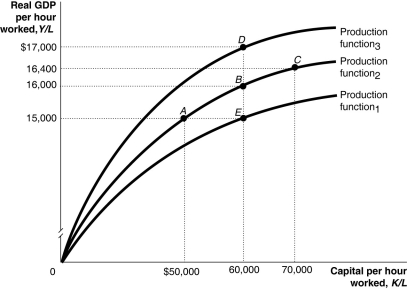 -Refer to Figure 22-4. Using the per-worker production function in the figure above, the largest changes in an economy's standard of living would be achieved by a movement from
 (Multiple Choice)
4.9/5 (85)
(85) As predicted by the economic growth model, countries that start with lower levels of GDP per capita always grow faster than countries that start with higher levels of GDP per capita.
(True/False)
4.8/5 (83)
(83) Figure 22-4
-Refer to Figure 22-4. The movement from A to B to C illustrates
-Refer to Figure 22-4. The movement from A to B to C illustrates (Multiple Choice)
4.9/5 (72)
(72) If the Commerce Department adjusts the growth rate of GDP downward for the first quarter of 2014, and the Bureau of Labor Statistics adjusts the number of hours worked upward for the first quarter of 2014, what will the Bureau of Labor Statistics do in terms of revising the figures on the growth rate of labor productivity for the first quarter of 2014?
(Multiple Choice)
4.8/5 (80)
(80) Globalization is defined as the process of countries becoming ________ open to foreign trade and ________ open to foreign investment.
(Multiple Choice)
4.8/5 (72)
(72) Which of the following would you expect to result in faster economic growth?
(Multiple Choice)
4.8/5 (77)
(77) According to the World Bank, GDP per capita ________ in the least corrupt countries than in the most corrupt countries.
(Multiple Choice)
4.9/5 (95)
(95) Your friend owns a snow cone stand that he works by himself. He produces about 25 snow cones per hour. He wants to be able to produce twice as many snow cones per hour so he buys a second machine. He notices that he can only produce 10 more snow cones an hour. He jokes that he could have doubled his output with the second machine if he only had four hands. Using your knowledge of the production process, explain to your friend what you think has happened when he added more capital to his production process.
(Essay)
4.9/5 (74)
(74) Some economists argue that the productivity slowdown from mid-1970s to mid-1990s actually didn't happen, but just "appeared" to happen because
(Multiple Choice)
4.9/5 (79)
(79) Robert Lucas, a Nobel laureate in economics, argues that there are ________ returns to human capital.
(Multiple Choice)
4.9/5 (77)
(77) Policies to promote growth by increasing saving and investment work through
(Multiple Choice)
4.9/5 (83)
(83) Which of the following is not a reason why low-income countries might experience low economic growth?
(Multiple Choice)
4.8/5 (79)
(79) If real GDP per capita in the United States is $8,000 in 2013, and if real GDP per capita is $12,000 in 2023, what is the total percent change in the growth rate of GDP per capita between 2013 and 2023?
(Multiple Choice)
4.8/5 (77)
(77) When additions of input to a fixed quantity of another input lead to progressively smaller increases in output, we say we are facing
(Multiple Choice)
4.9/5 (89)
(89) 
Filters
- Essay(0)
- Multiple Choice(0)
- Short Answer(0)
- True False(0)
- Matching(0)