



 Chat with AI
Exam 22: Long-Run Economic Growth: Sources and Policies

Exam 1: Economics: Foundations and Models444 Questions
Exam 2: Trade-Offs, Comparative Advantage, and the Market System498 Questions
Exam 3: Where Prices Come From: the Interaction of Demand and Supply475 Questions
Exam 4: Economic Efficiency, Government Price Setting, and Taxes419 Questions
Exam 5: Externalities, Environmental Policy, and Public Goods266 Questions
Exam 6: Elasticity: the Responsiveness of Demand and Supply295 Questions
Exam 7: The Economics of Health Care334 Questions
Exam 8: Firms, the Stock Market, and Corporate Governance278 Questions
Exam 9: Comparative Advantage and the Gains From International Trade379 Questions
Exam 10: Consumer Choice and Behavioral Economics302 Questions
Exam 11: Technology, Production, and Costs330 Questions
Exam 12: Firms in Perfectly Competitive Markets298 Questions
Exam 13: Monopolistic Competition: the Competitive Model in a More Realistic Setting276 Questions
Exam 14: Oligopoly: Firms in Less Competitive Markets262 Questions
Exam 15: Monopoly and Antitrust Policy271 Questions
Exam 16: Pricing Strategy263 Questions
Exam 17: The Markets for Labor and Other Factors of Production286 Questions
Exam 18: Public Choice, Taxes, and the Distribution of Income258 Questions
Exam 19: GDP: Measuring Total Production and Income266 Questions
Exam 20: Unemployment and Inflation292 Questions
Exam 21: Economic Growth, the Financial System, and Business Cycles257 Questions
Exam 22: Long-Run Economic Growth: Sources and Policies268 Questions
Exam 23: Aggregate Expenditure and Output in the Short Run306 Questions
Exam 24: Aggregate Demand and Aggregate Supply Analysis284 Questions
Exam 25: Money, Banks, and the Federal Reserve System280 Questions
Exam 26: Monetary Policy277 Questions
Exam 27: Fiscal Policy303 Questions
Exam 28: Inflation, Unemployment, and Federal Reserve Policy257 Questions
Exam 29: Macroeconomics in an Open Economy278 Questions
Exam 30: The International Financial System262 Questions
Select questions type


Figure 22-1  -Refer to Figure 22-1. Within a country, the impact of wars and revolutions and their subsequent destruction of capital is reflected in the per-worker production function in the figure above by a movement from
 (Multiple Choice)
4.9/5  (92)
(92) During which of the following periods was growth in GDP per capita the strongest?
(Multiple Choice)
4.9/5 (74)
(74) How can economic growth help a country combat "brain drain"?
(Multiple Choice)
4.7/5 (76)
(76) Some economists argue that the apparent slowdown in economic growth in the United States during the mid-1970s may not really have reduced the standard of living because
(Multiple Choice)
4.9/5 (87)
(87) Figure 22-1
-Refer to Figure 22-1. Using the per-worker production function in the figure above, the largest changes in an economy's standard of living would be achieved by a movement from
-Refer to Figure 22-1. Using the per-worker production function in the figure above, the largest changes in an economy's standard of living would be achieved by a movement from (Multiple Choice)
4.9/5 (85)
(85) A patent grants an inventor exclusive rights to a product for how long?
(Multiple Choice)
4.8/5 (77)
(77) One reason why many low-income countries experience low rates of growth is because of poor public education and health.
(True/False)
4.9/5 (82)
(82) Article Summary
Unlike in many nations, when the financial crisis hit in 2008 the Polish economy continued to grow, but due to a current slowdown in exports and domestic demand, Poland is expecting a large outflow of workers. Unemployment was expected to grow to 14 percent in Poland in 2013, and according to Krystyna Iglicka, a demographer at Lazarski University in Warsaw, "…Poles have always treated emigration as a way of improving their lot." Despite earning relatively low salaries in Western European countries, on average just over €2,000 (about $2,660) a month according to the National Bank of Poland, this is still four times more than workers would earn on average by staying in Poland. Iglicka predicts that between 500,000 and 800,000 Poles will emigrate from Poland over the next five years.
Source: Jan Cienski, "Poland braces for fresh exodus of workers," Washington Post, January 22, 2013.
-Refer to the Article Summary. If, after the outflow of workers in Poland, it now takes more capital per hour worked to get the same amount of GDP per hour worked, this indicates ________ the per-worker production function in Poland.
(Multiple Choice)
4.8/5 (90)
(90) Which of the following is an example of foreign direct investment?
(Multiple Choice)
4.7/5 (76)
(76) Developing countries with low saving rates and poor levels of health and education are likely to experience
(Multiple Choice)
4.9/5 (70)
(70) Small differences in economic growth rates result in small differences in living standards.
(True/False)
5.0/5 (66)
(66) If the slope of the per-worker production function is 1/2 in a given range, how will a $10,000 increase in capital per hour worked affect real GDP per hour worked in the same given range?
(Multiple Choice)
4.9/5 (83)
(83) Suppose that in 2013, real GDP grew in Estonia by 3% and the population increased by 5%. Therefore, in 2013, Estonia experienced
(Multiple Choice)
4.9/5 (86)
(86) Significant economic growth did not begin in the world until
(Multiple Choice)
4.9/5 (70)
(70) Figure 22-5 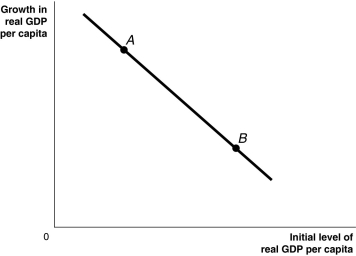 -Refer to Figure 22-5. Based on the "catch-up line" drawn above, poorer countries are more likely to be at a point like ________, where growth in GDP is relatively ________, while richer countries are more likely to be at a point like ________, where growth in GDP is relatively ________.
 (Multiple Choice)
4.9/5 (83)
(83) In the long run, a country will experience an increasing standard of living only if it experiences
(Multiple Choice)
4.8/5 (71)
(71) 
Filters
- Essay(0)
- Multiple Choice(0)
- Short Answer(0)
- True False(0)
- Matching(0)