



 Chat with AI
Exam 22: Long-Run Economic Growth: Sources and Policies

Exam 1: Economics: Foundations and Models444 Questions
Exam 2: Trade-Offs, Comparative Advantage, and the Market System498 Questions
Exam 3: Where Prices Come From: the Interaction of Demand and Supply475 Questions
Exam 4: Economic Efficiency, Government Price Setting, and Taxes419 Questions
Exam 5: Externalities, Environmental Policy, and Public Goods266 Questions
Exam 6: Elasticity: the Responsiveness of Demand and Supply295 Questions
Exam 7: The Economics of Health Care334 Questions
Exam 8: Firms, the Stock Market, and Corporate Governance278 Questions
Exam 9: Comparative Advantage and the Gains From International Trade379 Questions
Exam 10: Consumer Choice and Behavioral Economics302 Questions
Exam 11: Technology, Production, and Costs330 Questions
Exam 12: Firms in Perfectly Competitive Markets298 Questions
Exam 13: Monopolistic Competition: the Competitive Model in a More Realistic Setting276 Questions
Exam 14: Oligopoly: Firms in Less Competitive Markets262 Questions
Exam 15: Monopoly and Antitrust Policy271 Questions
Exam 16: Pricing Strategy263 Questions
Exam 17: The Markets for Labor and Other Factors of Production286 Questions
Exam 18: Public Choice, Taxes, and the Distribution of Income258 Questions
Exam 19: GDP: Measuring Total Production and Income266 Questions
Exam 20: Unemployment and Inflation292 Questions
Exam 21: Economic Growth, the Financial System, and Business Cycles257 Questions
Exam 22: Long-Run Economic Growth: Sources and Policies268 Questions
Exam 23: Aggregate Expenditure and Output in the Short Run306 Questions
Exam 24: Aggregate Demand and Aggregate Supply Analysis284 Questions
Exam 25: Money, Banks, and the Federal Reserve System280 Questions
Exam 26: Monetary Policy277 Questions
Exam 27: Fiscal Policy303 Questions
Exam 28: Inflation, Unemployment, and Federal Reserve Policy257 Questions
Exam 29: Macroeconomics in an Open Economy278 Questions
Exam 30: The International Financial System262 Questions
Select questions type


The purchase or building by a corporation of a facility in a foreign country is called
(Multiple Choice)
4.9/5  (79)
(79) ________ save a ________ of their income. This ________ capital in their economy and raises economic growth.
(Multiple Choice)
4.7/5 (84)
(84) Does globalization promote economic growth, and how does globalization affect the welfare of a given country's citizens?
(Essay)
4.8/5 (89)
(89) According to Douglass North, the Industrial Revolution occurred in England because
(Multiple Choice)
4.9/5 (81)
(81) Which of the following countries had the lowest GDP per capita in 2012?
(Multiple Choice)
4.7/5 (79)
(79) Foreign portfolio investment occurs when an individual or firm buys stock or bonds issued in another country.
(True/False)
4.9/5 (92)
(92) The rapid growth of China's economy relative to the United States has benefitted U.S. consumers because
(Multiple Choice)
4.8/5 (74)
(74) According to Joseph Schumpeter, the theory of creative destruction describes a process by which
(Multiple Choice)
4.8/5 (79)
(79) Which of the following policies are designed specifically to directly promote technological change in an economy?
(Multiple Choice)
4.7/5 (62)
(62) A policy that offers parents a tax reduction based on how much they are saving for their children's college education should ________ the equilibrium level of loanable funds and ________ the rate of long-term growth.
(Multiple Choice)
4.9/5 (66)
(66) Table 22-5
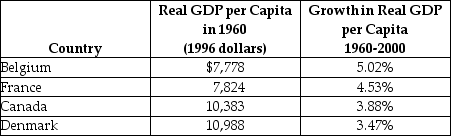 -Refer to Table 22-5. Consider the statistics in the table above in describing the industrialized countries. Are these consistent with the economic growth model? Briefly explain.
 (Essay)
4.8/5 (92)
(92) From 1990-2012, productivity growth in the United States was ________ the growth rates of other high-income countries.
(Multiple Choice)
4.7/5 (73)
(73) How might have the educational system of the United States contributed to the productivity slowdown of the mid-1970s to the mid-1990s?
(Essay)
4.8/5 (83)
(83) Relative to productivity growth in the United States, which of the following countries experienced the largest decline in productivity growth from 1990 to 2012?
(Multiple Choice)
5.0/5 (79)
(79) The productivity slowdown of the mid-1970s can be explained by which of the following?
(Multiple Choice)
4.8/5 (69)
(69) Which of the following countries actually experienced negative economic growth from 1960 to 2010?
(Multiple Choice)
4.9/5 (83)
(83) 
Filters
- Essay(0)
- Multiple Choice(0)
- Short Answer(0)
- True False(0)
- Matching(0)