



 Chat with AI
Exam 22: Long-Run Economic Growth: Sources and Policies

Exam 1: Economics: Foundations and Models444 Questions
Exam 2: Trade-Offs, Comparative Advantage, and the Market System498 Questions
Exam 3: Where Prices Come From: the Interaction of Demand and Supply475 Questions
Exam 4: Economic Efficiency, Government Price Setting, and Taxes419 Questions
Exam 5: Externalities, Environmental Policy, and Public Goods266 Questions
Exam 6: Elasticity: the Responsiveness of Demand and Supply295 Questions
Exam 7: The Economics of Health Care334 Questions
Exam 8: Firms, the Stock Market, and Corporate Governance278 Questions
Exam 9: Comparative Advantage and the Gains From International Trade379 Questions
Exam 10: Consumer Choice and Behavioral Economics302 Questions
Exam 11: Technology, Production, and Costs330 Questions
Exam 12: Firms in Perfectly Competitive Markets298 Questions
Exam 13: Monopolistic Competition: the Competitive Model in a More Realistic Setting276 Questions
Exam 14: Oligopoly: Firms in Less Competitive Markets262 Questions
Exam 15: Monopoly and Antitrust Policy271 Questions
Exam 16: Pricing Strategy263 Questions
Exam 17: The Markets for Labor and Other Factors of Production286 Questions
Exam 18: Public Choice, Taxes, and the Distribution of Income258 Questions
Exam 19: GDP: Measuring Total Production and Income266 Questions
Exam 20: Unemployment and Inflation292 Questions
Exam 21: Economic Growth, the Financial System, and Business Cycles257 Questions
Exam 22: Long-Run Economic Growth: Sources and Policies268 Questions
Exam 23: Aggregate Expenditure and Output in the Short Run306 Questions
Exam 24: Aggregate Demand and Aggregate Supply Analysis284 Questions
Exam 25: Money, Banks, and the Federal Reserve System280 Questions
Exam 26: Monetary Policy277 Questions
Exam 27: Fiscal Policy303 Questions
Exam 28: Inflation, Unemployment, and Federal Reserve Policy257 Questions
Exam 29: Macroeconomics in an Open Economy278 Questions
Exam 30: The International Financial System262 Questions
Select questions type


If there is a change in the ability of a firm to produce a given level of output with a given level of inputs, we say there is
(Multiple Choice)
4.8/5  (68)
(68) Robert Lucas, a Nobel laureate in economics, argues that there are increasing returns to
(Multiple Choice)
4.8/5 (76)
(76) New growth theory states that increases in ________ capital will result in ________ at the ________ level.
(Multiple Choice)
4.9/5 (96)
(96) Table 22-7
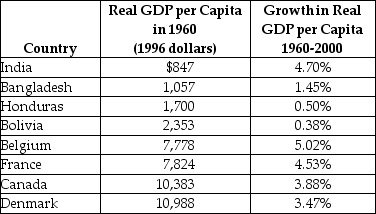 -Refer to Table 22-7. Consider the statistics in the table above in describing the following industrialized and developing countries. Are these consistent with the economic growth model? Briefly explain.
 (Essay)
4.9/5 (86)
(86) Of the following countries, which had the highest level of GDP per capita in 2012?
(Multiple Choice)
4.8/5 (82)
(82) If the slope of the per-worker production function is 1/4 in a given range, how will a $10,000 increase in capital per hour worked affect real GDP per hour worked in the same given range?
(Multiple Choice)
4.8/5 (88)
(88) Table 22-3
 -Using the points on the diagram below, identify which combinations of these points illustrate diminishing returns to capital. Give a brief explanation to support your answer.
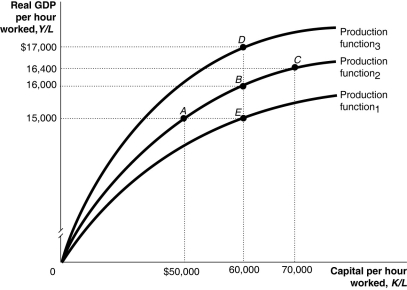
-Using the points on the diagram below, identify which combinations of these points illustrate diminishing returns to capital. Give a brief explanation to support your answer. (Essay)
4.9/5 (74)
(74) Of all industrialized nations, real GDP per capita was the highest in Japan in 2012.
(True/False)
4.9/5 (82)
(82) Which of the following is an example of foreign portfolio investment?
(Multiple Choice)
4.8/5 (79)
(79) You have been hired as an economic advisor for a developing country. You have been asked to focus on education as a means for the country's development. Explain to the prime minister how improving education and training can contribute to his country's economic growth, and why it is important for the government to take a pro-active role in promoting education.
(Essay)
4.7/5 (86)
(86) Over the last three decades in the United States, services have become a smaller fraction of GDP relative to goods.
(True/False)
4.8/5 (72)
(72) Which of the following accurately describes economic growth and standards of living between 1,000,000 B.C. and 1300 A.D.?
(Multiple Choice)
5.0/5 (76)
(76) There has been catch-up among ________, but there has not been catch-up among ________.
(Multiple Choice)
4.8/5 (76)
(76) In a small European country, it is estimated that a $10,000 increase in capital per hour worked will increase real GDP per hour worked by $300. Based on this information, what is the slope of the per-worker production function in this range?
(Multiple Choice)
4.7/5 (80)
(80) Compared to the previous 20 years, productivity growth in the United States increased between 1996 and 2012.
(True/False)
4.9/5 (74)
(74) The period of time from 1,000,000 B.C. to 1300 A.D. was a period of
(Multiple Choice)
4.8/5 (86)
(86) If real GDP per capita in Ireland is estimated to be $7,400 in 2014, what will real GDP per capita be in 2019 if real GDP per capita grows at an annual rate of 2.8%?
(Multiple Choice)
4.8/5 (79)
(79) The rate of growth of productivity in the United States was positive during the 20th century.
(True/False)
4.8/5 (77)
(77) Which of the following policies would not help promote economic growth?
(Multiple Choice)
4.8/5 (84)
(84) 
Filters
- Essay(0)
- Multiple Choice(0)
- Short Answer(0)
- True False(0)
- Matching(0)