



 Chat with AI
Exam 22: Long-Run Economic Growth: Sources and Policies

Exam 1: Economics: Foundations and Models444 Questions
Exam 2: Trade-Offs, Comparative Advantage, and the Market System498 Questions
Exam 3: Where Prices Come From: the Interaction of Demand and Supply475 Questions
Exam 4: Economic Efficiency, Government Price Setting, and Taxes419 Questions
Exam 5: Externalities, Environmental Policy, and Public Goods266 Questions
Exam 6: Elasticity: the Responsiveness of Demand and Supply295 Questions
Exam 7: The Economics of Health Care334 Questions
Exam 8: Firms, the Stock Market, and Corporate Governance278 Questions
Exam 9: Comparative Advantage and the Gains From International Trade379 Questions
Exam 10: Consumer Choice and Behavioral Economics302 Questions
Exam 11: Technology, Production, and Costs330 Questions
Exam 12: Firms in Perfectly Competitive Markets298 Questions
Exam 13: Monopolistic Competition: the Competitive Model in a More Realistic Setting276 Questions
Exam 14: Oligopoly: Firms in Less Competitive Markets262 Questions
Exam 15: Monopoly and Antitrust Policy271 Questions
Exam 16: Pricing Strategy263 Questions
Exam 17: The Markets for Labor and Other Factors of Production286 Questions
Exam 18: Public Choice, Taxes, and the Distribution of Income258 Questions
Exam 19: GDP: Measuring Total Production and Income266 Questions
Exam 20: Unemployment and Inflation292 Questions
Exam 21: Economic Growth, the Financial System, and Business Cycles257 Questions
Exam 22: Long-Run Economic Growth: Sources and Policies268 Questions
Exam 23: Aggregate Expenditure and Output in the Short Run306 Questions
Exam 24: Aggregate Demand and Aggregate Supply Analysis284 Questions
Exam 25: Money, Banks, and the Federal Reserve System280 Questions
Exam 26: Monetary Policy277 Questions
Exam 27: Fiscal Policy303 Questions
Exam 28: Inflation, Unemployment, and Federal Reserve Policy257 Questions
Exam 29: Macroeconomics in an Open Economy278 Questions
Exam 30: The International Financial System262 Questions
Select questions type


Draw a graph of "catch-up" that shows where you would expect to see a country with low saving rates and low levels of health and education. How would you expect real GDP per capita to grow in a country like this? Explain.
(Essay)
4.8/5  (72)
(72) Figure 22-4 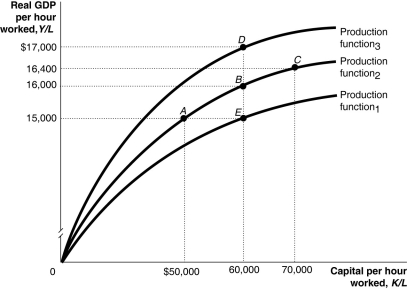 -Refer to Figure 22-4. Suppose the per-worker production function in the figure above represents the production function for the U.S. economy. If the United States decided to cut its support of university research in half, this would cause a movement from
 (Multiple Choice)
4.9/5 (72)
(72) Which of the following countries had the highest GDP per capita in 2012?
(Multiple Choice)
4.9/5 (74)
(74) Most of the countries of Africa are considered newly industrializing countries.
(True/False)
4.9/5 (86)
(86) The key factors in raising standards of living in low-income countries have been increases in
(Multiple Choice)
4.8/5 (81)
(81) Which of the following is not a reason why the Industrial Revolution occurred when and where it did?
(Multiple Choice)
4.9/5 (76)
(76) The purchase by an individual or firm of stock or bonds issued in another country is called
(Multiple Choice)
4.8/5 (66)
(66) The Soviet Union's economy grew rapidly in terms of GDP per hour worked in the 1950s, but eventually this growth slowed. Why did this occur?
(Multiple Choice)
4.9/5 (87)
(87) Figure 22-4
-Refer to Figure 22-4. Within a country, the impact of wars and revolutions and their subsequent destruction of capital is reflected in the per-worker production function in the figure above by a movement from
-Refer to Figure 22-4. Within a country, the impact of wars and revolutions and their subsequent destruction of capital is reflected in the per-worker production function in the figure above by a movement from (Multiple Choice)
4.8/5 (73)
(73) If real GDP per capita in the United States is $8,000 in 2013, and if real GDP per capita is $12,000 in 2023, what is the average annual percent change in the growth rate of GDP per capita between 2013 and 2023?
(Multiple Choice)
4.8/5 (77)
(77) List four types of government policies which can aid economic growth.
(Essay)
4.8/5 (78)
(78) Consider two countries, Alpha and Beta. In Alpha, real GDP per capita is $6,000. In Beta, real GDP per capita is $9,000. Based on the economic growth model, what would you predict about the growth rates in real GDP per capita across these two countries?
(Multiple Choice)
4.9/5 (101)
(101) Which of the following is an example of the way the financial markets in the United States can encourage technological progress more efficiently than other countries?
(Multiple Choice)
4.7/5 (87)
(87) According to new growth theory, the accumulation of ________ capital is subject to diminishing returns at the ________ level, but not at the level of the economy as a whole.
(Multiple Choice)
4.9/5 (84)
(84) Most economic growth in the world occurred between 1,000,000 B.C. and 1300 A.D.
(True/False)
4.9/5 (76)
(76) If GDP per capita rises by 2% between 2013 and 2014, which of the following is necessarily true?
(Multiple Choice)
4.8/5 (78)
(78) You are an economic advisor to the president. You are asked to recommend a policy to promote long-term economic growth in the economy. Which of the following policies would you choose?
(Multiple Choice)
4.9/5 (86)
(86) 
Filters
- Essay(0)
- Multiple Choice(0)
- Short Answer(0)
- True False(0)
- Matching(0)