



 Chat with AI
Exam 7: The Economics of Health Care

Exam 1: Economics: Foundations and Models444 Questions
Exam 2: Trade-Offs, Comparative Advantage, and the Market System498 Questions
Exam 3: Where Prices Come From: the Interaction of Demand and Supply475 Questions
Exam 4: Economic Efficiency, Government Price Setting, and Taxes419 Questions
Exam 5: Externalities, Environmental Policy, and Public Goods266 Questions
Exam 6: Elasticity: the Responsiveness of Demand and Supply295 Questions
Exam 7: The Economics of Health Care334 Questions
Exam 8: Firms, the Stock Market, and Corporate Governance278 Questions
Exam 9: Comparative Advantage and the Gains From International Trade379 Questions
Exam 10: Consumer Choice and Behavioral Economics302 Questions
Exam 11: Technology, Production, and Costs330 Questions
Exam 12: Firms in Perfectly Competitive Markets298 Questions
Exam 13: Monopolistic Competition: the Competitive Model in a More Realistic Setting276 Questions
Exam 14: Oligopoly: Firms in Less Competitive Markets262 Questions
Exam 15: Monopoly and Antitrust Policy271 Questions
Exam 16: Pricing Strategy263 Questions
Exam 17: The Markets for Labor and Other Factors of Production286 Questions
Exam 18: Public Choice, Taxes, and the Distribution of Income258 Questions
Exam 19: GDP: Measuring Total Production and Income266 Questions
Exam 20: Unemployment and Inflation292 Questions
Exam 21: Economic Growth, the Financial System, and Business Cycles257 Questions
Exam 22: Long-Run Economic Growth: Sources and Policies268 Questions
Exam 23: Aggregate Expenditure and Output in the Short Run306 Questions
Exam 24: Aggregate Demand and Aggregate Supply Analysis284 Questions
Exam 25: Money, Banks, and the Federal Reserve System280 Questions
Exam 26: Monetary Policy277 Questions
Exam 27: Fiscal Policy303 Questions
Exam 28: Inflation, Unemployment, and Federal Reserve Policy257 Questions
Exam 29: Macroeconomics in an Open Economy278 Questions
Exam 30: The International Financial System262 Questions
Select questions type


What is the main difference between a single-payer health care system and socialized medicine?
(Essay)
5.0/5  (76)
(76) In the United States, health care spending as a percentage of GDP has declined since 1965.
(True/False)
4.9/5 (103)
(103) The Congressional Budget Office estimates that the Patient Protection and Affordable Care Act (ACA) will
(Multiple Choice)
4.8/5 (78)
(78) The Patient Protection and Affordable Care Act (ACA) is scheduled to be fully implemented by 2019, at which point
(Multiple Choice)
4.9/5 (86)
(86) Adverse selection is a situation in which one party to an economic transaction has less information than the other party.
(True/False)
4.9/5 (73)
(73) Figure 7-2  Figure 7-2 represents the market for vaccinations. Vaccinations are considered a benefit to society, and the figure shows both the marginal private benefit and the marginal social benefit from vaccinations.
-Under current tax law individuals do not pay taxes on health insurance benefits they receive from their employers. As a result
Figure 7-2 represents the market for vaccinations. Vaccinations are considered a benefit to society, and the figure shows both the marginal private benefit and the marginal social benefit from vaccinations.
-Under current tax law individuals do not pay taxes on health insurance benefits they receive from their employers. As a result (Multiple Choice)
4.9/5 (81)
(81) The health care system in ________ is referred to as socialized medicine, under which the government owns most of the hospitals and employs most of the doctors.
(Multiple Choice)
4.9/5 (77)
(77) The health care system in Japan is referred to as ________, under which every resident of Japan is required to enroll in either a private or the government-provided health insurance program.
(Multiple Choice)
4.9/5 (87)
(87) In the United States, health care spending on people over age 65 is ________ on people aged 18 to 24.
(Multiple Choice)
4.8/5 (59)
(59) In the United States in 2012, the percentage of people without some form of private health insurance was about
(Multiple Choice)
4.9/5 (72)
(72) Health insurance companies impose deductibles on policies and co-payments on claims to reduce the problem of adverse selection.
(True/False)
4.9/5 (69)
(69) Of the following high-income countries, which has the lowest number of MRI units per 1 million population?
(Multiple Choice)
4.9/5 (78)
(78) Figure 7-1 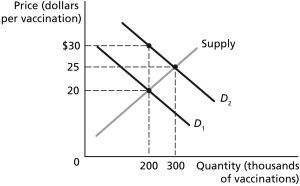 Figure 7-1 represents the market for vaccinations. Vaccinations are considered a benefit to society, and the figure shows both the marginal private benefit and the marginal social benefit from vaccinations.
-Refer to Figure 7-1. At the market equilibrium, the deadweight loss is equal to
Figure 7-1 represents the market for vaccinations. Vaccinations are considered a benefit to society, and the figure shows both the marginal private benefit and the marginal social benefit from vaccinations.
-Refer to Figure 7-1. At the market equilibrium, the deadweight loss is equal to (Multiple Choice)
4.9/5 (80)
(80) Figure 7-5 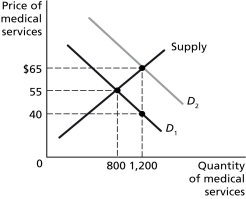 Figure 7-5 represents the market for medical services with and without insurance, and the effect of a third-party payer system on the demand for medical services.
-Refer to Figure 7-5. The efficient price of medical services is
Figure 7-5 represents the market for medical services with and without insurance, and the effect of a third-party payer system on the demand for medical services.
-Refer to Figure 7-5. The efficient price of medical services is (Multiple Choice)
4.9/5 (81)
(81) Pricing insurance policies is made difficult because buyers have more information than sellers. This difficulty is an example of
(Multiple Choice)
4.7/5 (82)
(82) In the United States in 2012, of those companies employing more than 200 workers that offer health care to those workers, about ________ percent of employees accept the coverage.
(Multiple Choice)
5.0/5 (79)
(79) If a state requires all drivers to purchase auto insurance, insurance companies still face the problem of
(Multiple Choice)
4.9/5 (73)
(73) Compared to the United States, health care spending per person in other high-income countries has been
(Multiple Choice)
4.9/5 (83)
(83) In the United States in 2011, over 90 percent of people without health insurance were below the age of 34.
(True/False)
4.8/5 (90)
(90) 
Filters
- Essay(0)
- Multiple Choice(0)
- Short Answer(0)
- True False(0)
- Matching(0)