



 Chat with AI
Exam 7: The Economics of Health Care

Exam 1: Economics: Foundations and Models444 Questions
Exam 2: Trade-Offs, Comparative Advantage, and the Market System498 Questions
Exam 3: Where Prices Come From: the Interaction of Demand and Supply475 Questions
Exam 4: Economic Efficiency, Government Price Setting, and Taxes419 Questions
Exam 5: Externalities, Environmental Policy, and Public Goods266 Questions
Exam 6: Elasticity: the Responsiveness of Demand and Supply295 Questions
Exam 7: The Economics of Health Care334 Questions
Exam 8: Firms, the Stock Market, and Corporate Governance278 Questions
Exam 9: Comparative Advantage and the Gains From International Trade379 Questions
Exam 10: Consumer Choice and Behavioral Economics302 Questions
Exam 11: Technology, Production, and Costs330 Questions
Exam 12: Firms in Perfectly Competitive Markets298 Questions
Exam 13: Monopolistic Competition: the Competitive Model in a More Realistic Setting276 Questions
Exam 14: Oligopoly: Firms in Less Competitive Markets262 Questions
Exam 15: Monopoly and Antitrust Policy271 Questions
Exam 16: Pricing Strategy263 Questions
Exam 17: The Markets for Labor and Other Factors of Production286 Questions
Exam 18: Public Choice, Taxes, and the Distribution of Income258 Questions
Exam 19: GDP: Measuring Total Production and Income266 Questions
Exam 20: Unemployment and Inflation292 Questions
Exam 21: Economic Growth, the Financial System, and Business Cycles257 Questions
Exam 22: Long-Run Economic Growth: Sources and Policies268 Questions
Exam 23: Aggregate Expenditure and Output in the Short Run306 Questions
Exam 24: Aggregate Demand and Aggregate Supply Analysis284 Questions
Exam 25: Money, Banks, and the Federal Reserve System280 Questions
Exam 26: Monetary Policy277 Questions
Exam 27: Fiscal Policy303 Questions
Exam 28: Inflation, Unemployment, and Federal Reserve Policy257 Questions
Exam 29: Macroeconomics in an Open Economy278 Questions
Exam 30: The International Financial System262 Questions
Select questions type


Under the Patient Protection and Affordable Care Act (ACA), residents who do not have health insurance will not be allowed to seek employment.
(True/False)
4.7/5  (85)
(85) "Cost disease" refers to the tendency for high productivity in the service sector to lead to lower costs in those industries.
(True/False)
4.7/5 (89)
(89) The largest government-run health care system in the world, with 1.7 million employees, is the National Health Service (NHS) in the United Kingdom. The NHS receives its funding primarily from
(Multiple Choice)
4.8/5 (91)
(91) Which of the following is not an advantage of risk pooling?
(Multiple Choice)
4.9/5 (79)
(79) The overall mortality rate in the United States has remained fairly constant for the past 30 years.
(True/False)
4.8/5 (95)
(95) The aging of the U.S. population has tended to ________ spending on health care, and the development of new drugs and medical equipment has tended to ________ spending on health care.
(Multiple Choice)
4.9/5 (99)
(99) Of the following high-income countries, which has the highest infant mortality rate?
(Multiple Choice)
4.7/5 (85)
(85) The provision of the Patient Protection and Affordable Care Act (ACA) Insurance companies are required to participate in a high-risk pool that will insure individuals with pre-existing medical conditions who have been unable to buy health insurance for at least six months is the ________ provision.
(Multiple Choice)
4.8/5 (79)
(79) Figure 7-4  Figure 7-4 represents the market for medical services with and without insurance, and the effect of a third-party payer system on the demand for medical services.
-Refer to Figure 7-4. With insurance and a third-party payer system, what price do consumers pay for medical services?
Figure 7-4 represents the market for medical services with and without insurance, and the effect of a third-party payer system on the demand for medical services.
-Refer to Figure 7-4. With insurance and a third-party payer system, what price do consumers pay for medical services? (Multiple Choice)
4.9/5 (84)
(84) On average, people in low-income countries ________ than people in high-income countries.
(Multiple Choice)
4.9/5 (70)
(70) A doctor pursuing the interests of his patients rather than his own interests is an example of the principal-agent problem.
(True/False)
5.0/5 (82)
(82) Figure 7-2  Figure 7-2 represents the market for vaccinations. Vaccinations are considered a benefit to society, and the figure shows both the marginal private benefit and the marginal social benefit from vaccinations.
-Some economists have argued that certain characteristics of the delivery of health care justify government intervention. One of these characteristics is
Figure 7-2 represents the market for vaccinations. Vaccinations are considered a benefit to society, and the figure shows both the marginal private benefit and the marginal social benefit from vaccinations.
-Some economists have argued that certain characteristics of the delivery of health care justify government intervention. One of these characteristics is (Multiple Choice)
4.8/5 (81)
(81) Figure 7-3 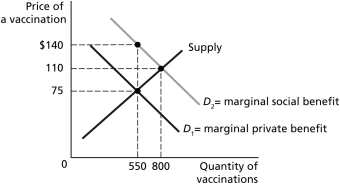 Figure 7-3 shows the effect of a positive externality on the market for vaccinations.
-Refer to Figure 7-3. On the above graph, identify the market equilibrium price and quantity, the efficient equilibrium price and quantity, and the value of the deadweight loss resulting from too few people receiving vaccinations.
Figure 7-3 shows the effect of a positive externality on the market for vaccinations.
-Refer to Figure 7-3. On the above graph, identify the market equilibrium price and quantity, the efficient equilibrium price and quantity, and the value of the deadweight loss resulting from too few people receiving vaccinations. (Essay)
4.8/5 (81)
(81) ________ account(s) for between 1 and 4 percent of health care costs in the United States.
(Multiple Choice)
4.8/5 (77)
(77) The Congressional Budget Office estimates that the additional taxes and fees enacted under the ACA will be enough to pay for the plan and reduce the federal government's budget deficit.
(True/False)
4.8/5 (93)
(93) Typically, the lower the level of income per person in a country, the lower the level of spending per person on health care. This relationship between income and spending indicates that health care is
(Multiple Choice)
5.0/5 (70)
(70) Adverse selection refers to the actions people take after they have entered into a transaction that make the other party to the transaction worse off.
(True/False)
5.0/5 (79)
(79) Some economists and policymakers who are in favor of government-provided health care believe that providing health care will
(Multiple Choice)
4.8/5 (73)
(73) 
Filters
- Essay(0)
- Multiple Choice(0)
- Short Answer(0)
- True False(0)
- Matching(0)