



 Chat with AI
Exam 7: The Economics of Health Care

Exam 1: Economics: Foundations and Models444 Questions
Exam 2: Trade-Offs, Comparative Advantage, and the Market System498 Questions
Exam 3: Where Prices Come From: the Interaction of Demand and Supply475 Questions
Exam 4: Economic Efficiency, Government Price Setting, and Taxes419 Questions
Exam 5: Externalities, Environmental Policy, and Public Goods266 Questions
Exam 6: Elasticity: the Responsiveness of Demand and Supply295 Questions
Exam 7: The Economics of Health Care334 Questions
Exam 8: Firms, the Stock Market, and Corporate Governance278 Questions
Exam 9: Comparative Advantage and the Gains From International Trade379 Questions
Exam 10: Consumer Choice and Behavioral Economics302 Questions
Exam 11: Technology, Production, and Costs330 Questions
Exam 12: Firms in Perfectly Competitive Markets298 Questions
Exam 13: Monopolistic Competition: the Competitive Model in a More Realistic Setting276 Questions
Exam 14: Oligopoly: Firms in Less Competitive Markets262 Questions
Exam 15: Monopoly and Antitrust Policy271 Questions
Exam 16: Pricing Strategy263 Questions
Exam 17: The Markets for Labor and Other Factors of Production286 Questions
Exam 18: Public Choice, Taxes, and the Distribution of Income258 Questions
Exam 19: GDP: Measuring Total Production and Income266 Questions
Exam 20: Unemployment and Inflation292 Questions
Exam 21: Economic Growth, the Financial System, and Business Cycles257 Questions
Exam 22: Long-Run Economic Growth: Sources and Policies268 Questions
Exam 23: Aggregate Expenditure and Output in the Short Run306 Questions
Exam 24: Aggregate Demand and Aggregate Supply Analysis284 Questions
Exam 25: Money, Banks, and the Federal Reserve System280 Questions
Exam 26: Monetary Policy277 Questions
Exam 27: Fiscal Policy303 Questions
Exam 28: Inflation, Unemployment, and Federal Reserve Policy257 Questions
Exam 29: Macroeconomics in an Open Economy278 Questions
Exam 30: The International Financial System262 Questions
Select questions type


Consider a used car market in which half the cars are good and half are bad (lemons). A rational buyer in this market should
(Multiple Choice)
4.8/5  (85)
(85) Figure 7-5  Figure 7-5 represents the market for medical services with and without insurance, and the effect of a third-party payer system on the demand for medical services.
-If an employee receives health insurance through his or her employer, the employer
Figure 7-5 represents the market for medical services with and without insurance, and the effect of a third-party payer system on the demand for medical services.
-If an employee receives health insurance through his or her employer, the employer (Multiple Choice)
4.9/5 (88)
(88) In the United States in 2012, of the firms that employed more than 200 workers that offer health insurance to workers, about ________ of employees did not accept the coverage.
(Multiple Choice)
4.8/5 (79)
(79) The health care system in Canada is referred to as ________, and is a system in which the government provides national health insurance to all Canadian residents.
(Multiple Choice)
4.9/5 (80)
(80) Under the Patient Protection and Affordable Care Act (ACA), insurance companies will be required to participate in a high-risk pool that will cover individuals with pre-existing medical conditions.
(True/False)
4.8/5 (64)
(64) If consumers paid the full price of medical services instead of using health insurance and third-party payers to cover part of the cost, the quantity of medical services provided would increase.
(True/False)
4.9/5 (82)
(82) By the year 2013, health care spending on Medicare, Medicaid, and other U.S. government programs as a percentage of GDP had reached a level of
(Multiple Choice)
5.0/5 (86)
(86) A goal of ________ is to give patients an incentive to pay more attention to the prices of medical services. This would tend to increase economic efficiency by decreasing the costs of medical services
(Multiple Choice)
4.9/5 (79)
(79) Most employees ________ on the value of health insurance provided by employers, and most people ________ when buying individual health insurance policies.
(Multiple Choice)
4.9/5 (72)
(72) The Congressional Budget Office estimates that ________ of the increase in federal spending on Medicare and Medicaid over the next 75 years will be due to increases in the cost of providing health care.
(Multiple Choice)
4.8/5 (87)
(87) Figure 7-5 Figure 7-5 represents the market for medical services with and without insurance, and the effect of a third-party payer system on the demand for medical services.
-Refer to Figure 7-5. With insurance and a third-party payer system, what price do doctors receive for medical services?
Figure 7-5 represents the market for medical services with and without insurance, and the effect of a third-party payer system on the demand for medical services.
-Refer to Figure 7-5. With insurance and a third-party payer system, what price do doctors receive for medical services? (Multiple Choice)
4.7/5 (86)
(86) Figure 7-1  Figure 7-1 represents the market for vaccinations. Vaccinations are considered a benefit to society, and the figure shows both the marginal private benefit and the marginal social benefit from vaccinations.
-In the United States, the bulk of health care spending is paid by health insurance companies. Such a system is also called a third-party payer system where consumers of health care pay a nominal fee and the rest are paid by the health insurance provider. Why might such a system lead to an inefficient outcome?
Figure 7-1 represents the market for vaccinations. Vaccinations are considered a benefit to society, and the figure shows both the marginal private benefit and the marginal social benefit from vaccinations.
-In the United States, the bulk of health care spending is paid by health insurance companies. Such a system is also called a third-party payer system where consumers of health care pay a nominal fee and the rest are paid by the health insurance provider. Why might such a system lead to an inefficient outcome? (Multiple Choice)
4.9/5 (73)
(73) The Congressional Budget Office estimates that most of the increase in federal spending on Medicare and Medicaid will be due to
(Multiple Choice)
4.8/5 (73)
(73) Figure 7-6 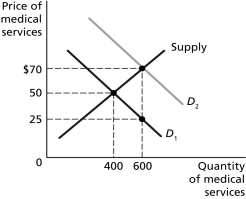 Figure 7-6 represents the supply and demand for medical services with and without a third-party payer.
-Refer to Figure 7-6. Answer the following questions:
1. What would be the equilibrium price and quantity if consumers had to pay the full price of medical services?
2. With insurance acting as a third-party payer, what price will consumers pay for medical service?
3. With insurance acting as a third-party payer, what price will doctors receive for medical service?
4. With insurance acting as a third-party payer, what will be the equilibrium quantity of medical services?
5. With insurance acting as a third-party payer, what will be the value of the deadweight loss?
Figure 7-6 represents the supply and demand for medical services with and without a third-party payer.
-Refer to Figure 7-6. Answer the following questions:
1. What would be the equilibrium price and quantity if consumers had to pay the full price of medical services?
2. With insurance acting as a third-party payer, what price will consumers pay for medical service?
3. With insurance acting as a third-party payer, what price will doctors receive for medical service?
4. With insurance acting as a third-party payer, what will be the equilibrium quantity of medical services?
5. With insurance acting as a third-party payer, what will be the value of the deadweight loss? (Short Answer)
4.8/5 (84)
(84) In the 1973 movie Save the Tiger, Jack Lemmon plays Harry Stoner, the CEO of a clothing manufacturer whose business has fallen on hard times. At one point in the movie, Stoner convinces his partner to hire someone to burn one of their buildings to collect on their insurance policy. What term refers to the information problem that led the insurance company to sell a policy for this building to Stoner and his partner?
(Multiple Choice)
4.7/5 (74)
(74) Which of the following reforms could potentially reduce spending on health care without reducing the effectiveness of health care received?
(Multiple Choice)
4.9/5 (79)
(79) Changes in the health of the average person are relatively unimportant as an indicator of changes in the standard of living.
(True/False)
5.0/5 (84)
(84) A contract under which a buyer agrees to make payments in exchange for the provider agreeing to pay some or all of the buyer's medical bills is referred to as
(Multiple Choice)
4.8/5 (82)
(82) Because consumers who have insurance provided by their employers usually only pay a deductible for a visit to the doctor's office,
(Multiple Choice)
4.9/5 (71)
(71) 
Filters
- Essay(0)
- Multiple Choice(0)
- Short Answer(0)
- True False(0)
- Matching(0)