



 Chat with AI
Exam 7: The Economics of Health Care

Exam 1: Economics: Foundations and Models444 Questions
Exam 2: Trade-Offs, Comparative Advantage, and the Market System498 Questions
Exam 3: Where Prices Come From: the Interaction of Demand and Supply475 Questions
Exam 4: Economic Efficiency, Government Price Setting, and Taxes419 Questions
Exam 5: Externalities, Environmental Policy, and Public Goods266 Questions
Exam 6: Elasticity: the Responsiveness of Demand and Supply295 Questions
Exam 7: The Economics of Health Care334 Questions
Exam 8: Firms, the Stock Market, and Corporate Governance278 Questions
Exam 9: Comparative Advantage and the Gains From International Trade379 Questions
Exam 10: Consumer Choice and Behavioral Economics302 Questions
Exam 11: Technology, Production, and Costs330 Questions
Exam 12: Firms in Perfectly Competitive Markets298 Questions
Exam 13: Monopolistic Competition: the Competitive Model in a More Realistic Setting276 Questions
Exam 14: Oligopoly: Firms in Less Competitive Markets262 Questions
Exam 15: Monopoly and Antitrust Policy271 Questions
Exam 16: Pricing Strategy263 Questions
Exam 17: The Markets for Labor and Other Factors of Production286 Questions
Exam 18: Public Choice, Taxes, and the Distribution of Income258 Questions
Exam 19: GDP: Measuring Total Production and Income266 Questions
Exam 20: Unemployment and Inflation292 Questions
Exam 21: Economic Growth, the Financial System, and Business Cycles257 Questions
Exam 22: Long-Run Economic Growth: Sources and Policies268 Questions
Exam 23: Aggregate Expenditure and Output in the Short Run306 Questions
Exam 24: Aggregate Demand and Aggregate Supply Analysis284 Questions
Exam 25: Money, Banks, and the Federal Reserve System280 Questions
Exam 26: Monetary Policy277 Questions
Exam 27: Fiscal Policy303 Questions
Exam 28: Inflation, Unemployment, and Federal Reserve Policy257 Questions
Exam 29: Macroeconomics in an Open Economy278 Questions
Exam 30: The International Financial System262 Questions
Select questions type


In the United States, consumers usually pay less than the true cost of medical treatment because of ________.
(Multiple Choice)
4.9/5  (86)
(86) Figure 7-4  Figure 7-4 represents the market for medical services with and without insurance, and the effect of a third-party payer system on the demand for medical services.
-Of the following U.S. presidents, which was the first to propose a national health insurance program to Congress?
Figure 7-4 represents the market for medical services with and without insurance, and the effect of a third-party payer system on the demand for medical services.
-Of the following U.S. presidents, which was the first to propose a national health insurance program to Congress? (Multiple Choice)
5.0/5 (83)
(83) The Pre-Existing Condition Insurance Plan is a federally administered part of the Affordable Care Act, and is designed for people with pre-existing medical conditions to obtain insurance. By offering health insurance to all U.S. citizens with pre-existing medical conditions, the Pre-Existing Condition Insurance Plan
(Multiple Choice)
4.7/5 (71)
(71) In the United States, health care spending on people ________ is six times greater than on people ________.
(Multiple Choice)
4.8/5 (80)
(80) Of the following high-income countries, which has the highest number of CT scanners per 1 million population?
(Multiple Choice)
4.7/5 (72)
(72) Suppose that in a market for used cars, there are good used cars and bad used cars (lemons). Consumers are willing to pay as much as $6,000 for a good used car but only $1,000 for a lemon. Sellers of good used cars value their cars at $5,000 each and sellers of lemons value their cars at $800 each. Buyers cannot tell if a used car is reliable or is a lemon. Based on this information, what is the likely outcome in the market for used cars?
(Multiple Choice)
4.9/5 (67)
(67) In the United States from 1981 to 2011, deaths from all of the following declined substantially except
(Multiple Choice)
4.8/5 (82)
(82) In which of the following countries does health insurance not pay for most preventive care procedures?
(Multiple Choice)
4.9/5 (78)
(78) Figure 7-5 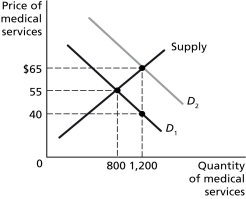 Figure 7-5 represents the market for medical services with and without insurance, and the effect of a third-party payer system on the demand for medical services.
-Which of the following is not part of the "individual mandate" provision of the Patient Protection and Affordable Care Act (ACA)?
Figure 7-5 represents the market for medical services with and without insurance, and the effect of a third-party payer system on the demand for medical services.
-Which of the following is not part of the "individual mandate" provision of the Patient Protection and Affordable Care Act (ACA)? (Multiple Choice)
4.9/5 (80)
(80) Substantial co-payments are typically not required as a part of the health care system in
(Multiple Choice)
4.9/5 (90)
(90) Of the following high-income countries, which has the lowest mortality ratio for cancer?
(Multiple Choice)
4.9/5 (70)
(70) Because of the ________ of vaccinations, economic efficiency would be improved if more people were vaccinated.
(Multiple Choice)
4.8/5 (76)
(76) Since 1981, deaths from cardiovascular diseases have decreased in the United States.
(True/False)
4.9/5 (85)
(85) Between 1981 and 2011, the overall mortality rate in the United States
(Multiple Choice)
4.8/5 (79)
(79) In the United States in 2012, the percentage of people who received health insurance through a government program was about
(Multiple Choice)
4.8/5 (80)
(80) The health care system in ________ is referred to as a single-payer health care system, and is a system in which the government provides national health insurance to all residents.
(Multiple Choice)
4.7/5 (78)
(78) In the United States, consumers usually pay ________ than the true cost of medical treatment because of ________.
(Multiple Choice)
5.0/5 (85)
(85) Under the Patient Protection and Affordable Care Act (ACA), every company with more than 200 employees must offer health insurance to its employees and must automatically enroll them in the plan.
(True/False)
4.7/5 (76)
(76) Figure 7-4 Figure 7-4 represents the market for medical services with and without insurance, and the effect of a third-party payer system on the demand for medical services.
-When consumers pay only a fraction of the true cost of medical services, their demand increases. The marginal cost of producing these extra services
Figure 7-4 represents the market for medical services with and without insurance, and the effect of a third-party payer system on the demand for medical services.
-When consumers pay only a fraction of the true cost of medical services, their demand increases. The marginal cost of producing these extra services (Multiple Choice)
4.8/5 (70)
(70) 
Filters
- Essay(0)
- Multiple Choice(0)
- Short Answer(0)
- True False(0)
- Matching(0)