



 Chat with AI
Exam 7: The Economics of Health Care

Exam 1: Economics: Foundations and Models444 Questions
Exam 2: Trade-Offs, Comparative Advantage, and the Market System498 Questions
Exam 3: Where Prices Come From: the Interaction of Demand and Supply475 Questions
Exam 4: Economic Efficiency, Government Price Setting, and Taxes419 Questions
Exam 5: Externalities, Environmental Policy, and Public Goods266 Questions
Exam 6: Elasticity: the Responsiveness of Demand and Supply295 Questions
Exam 7: The Economics of Health Care334 Questions
Exam 8: Firms, the Stock Market, and Corporate Governance278 Questions
Exam 9: Comparative Advantage and the Gains From International Trade379 Questions
Exam 10: Consumer Choice and Behavioral Economics302 Questions
Exam 11: Technology, Production, and Costs330 Questions
Exam 12: Firms in Perfectly Competitive Markets298 Questions
Exam 13: Monopolistic Competition: the Competitive Model in a More Realistic Setting276 Questions
Exam 14: Oligopoly: Firms in Less Competitive Markets262 Questions
Exam 15: Monopoly and Antitrust Policy271 Questions
Exam 16: Pricing Strategy263 Questions
Exam 17: The Markets for Labor and Other Factors of Production286 Questions
Exam 18: Public Choice, Taxes, and the Distribution of Income258 Questions
Exam 19: GDP: Measuring Total Production and Income266 Questions
Exam 20: Unemployment and Inflation292 Questions
Exam 21: Economic Growth, the Financial System, and Business Cycles257 Questions
Exam 22: Long-Run Economic Growth: Sources and Policies268 Questions
Exam 23: Aggregate Expenditure and Output in the Short Run306 Questions
Exam 24: Aggregate Demand and Aggregate Supply Analysis284 Questions
Exam 25: Money, Banks, and the Federal Reserve System280 Questions
Exam 26: Monetary Policy277 Questions
Exam 27: Fiscal Policy303 Questions
Exam 28: Inflation, Unemployment, and Federal Reserve Policy257 Questions
Exam 29: Macroeconomics in an Open Economy278 Questions
Exam 30: The International Financial System262 Questions
Select questions type


The number of people receiving Medicare is expected to grow to 80 million by the year
(Multiple Choice)
4.9/5  (87)
(87) Figure 7-4  Figure 7-4 represents the market for medical services with and without insurance, and the effect of a third-party payer system on the demand for medical services.
-All of the following are part of the "individual mandate" provision of the Patient Protection and Affordable Care Act (ACA) except
Figure 7-4 represents the market for medical services with and without insurance, and the effect of a third-party payer system on the demand for medical services.
-All of the following are part of the "individual mandate" provision of the Patient Protection and Affordable Care Act (ACA) except (Multiple Choice)
4.9/5 (79)
(79) Figure 7-2  Figure 7-2 represents the market for vaccinations. Vaccinations are considered a benefit to society, and the figure shows both the marginal private benefit and the marginal social benefit from vaccinations.
-Refer to Figure 7-2. The efficient equilibrium price is
Figure 7-2 represents the market for vaccinations. Vaccinations are considered a benefit to society, and the figure shows both the marginal private benefit and the marginal social benefit from vaccinations.
-Refer to Figure 7-2. The efficient equilibrium price is (Multiple Choice)
4.8/5 (85)
(85) Economists refer to the actions people take after they have entered into a transaction that makes the other party to the transaction worse off as
(Multiple Choice)
4.8/5 (72)
(72) A goal of market-based reforms of the health care system is to give patients an incentive to pay more attention to the prices of medical services. This would tend to ________ economic efficiency by ________ the costs of medical services
(Multiple Choice)
4.8/5 (83)
(83) The study of the problems due to asymmetric information was begun when economists analyzed which type of market?
(Multiple Choice)
4.9/5 (84)
(84) Changes in the health of the average person are an important indicator of changes in the standard of living.
(True/False)
4.8/5 (79)
(79) Figure 7-5 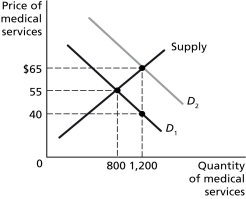 Figure 7-5 represents the market for medical services with and without insurance, and the effect of a third-party payer system on the demand for medical services.
-Refer to Figure 7-5. The efficient quantity of medical services is
Figure 7-5 represents the market for medical services with and without insurance, and the effect of a third-party payer system on the demand for medical services.
-Refer to Figure 7-5. The efficient quantity of medical services is (Multiple Choice)
4.9/5 (83)
(83) Figure 7-4 Figure 7-4 represents the market for medical services with and without insurance, and the effect of a third-party payer system on the demand for medical services.
-Refer to Figure 7-4. With insurance and a third-party payer system, what price do doctors receive for medical services?
Figure 7-4 represents the market for medical services with and without insurance, and the effect of a third-party payer system on the demand for medical services.
-Refer to Figure 7-4. With insurance and a third-party payer system, what price do doctors receive for medical services? (Multiple Choice)
4.8/5 (82)
(82) The situation in which one party to a transaction takes advantage of knowing more than the other party to the transaction is known as asymmetric information.
(True/False)
4.8/5 (78)
(78) How might a company that offers to handle all paperwork involved with a health insurance claim for a flat fee face the problem of adverse selection?
(Essay)
4.8/5 (86)
(86) Of the following high-income countries, which has the highest mortality ratio for cancer?
(Multiple Choice)
4.8/5 (82)
(82) Of the following, the rapid rise in health care costs in the United States can be attributed to
(Multiple Choice)
4.9/5 (71)
(71) 
Filters
- Essay(0)
- Multiple Choice(0)
- Short Answer(0)
- True False(0)
- Matching(0)