



 Chat with AI
Exam 7: The Economics of Health Care

Exam 1: Economics: Foundations and Models444 Questions
Exam 2: Trade-Offs, Comparative Advantage, and the Market System498 Questions
Exam 3: Where Prices Come From: the Interaction of Demand and Supply475 Questions
Exam 4: Economic Efficiency, Government Price Setting, and Taxes419 Questions
Exam 5: Externalities, Environmental Policy, and Public Goods266 Questions
Exam 6: Elasticity: the Responsiveness of Demand and Supply295 Questions
Exam 7: The Economics of Health Care334 Questions
Exam 8: Firms, the Stock Market, and Corporate Governance278 Questions
Exam 9: Comparative Advantage and the Gains From International Trade379 Questions
Exam 10: Consumer Choice and Behavioral Economics302 Questions
Exam 11: Technology, Production, and Costs330 Questions
Exam 12: Firms in Perfectly Competitive Markets298 Questions
Exam 13: Monopolistic Competition: the Competitive Model in a More Realistic Setting276 Questions
Exam 14: Oligopoly: Firms in Less Competitive Markets262 Questions
Exam 15: Monopoly and Antitrust Policy271 Questions
Exam 16: Pricing Strategy263 Questions
Exam 17: The Markets for Labor and Other Factors of Production286 Questions
Exam 18: Public Choice, Taxes, and the Distribution of Income258 Questions
Exam 19: GDP: Measuring Total Production and Income266 Questions
Exam 20: Unemployment and Inflation292 Questions
Exam 21: Economic Growth, the Financial System, and Business Cycles257 Questions
Exam 22: Long-Run Economic Growth: Sources and Policies268 Questions
Exam 23: Aggregate Expenditure and Output in the Short Run306 Questions
Exam 24: Aggregate Demand and Aggregate Supply Analysis284 Questions
Exam 25: Money, Banks, and the Federal Reserve System280 Questions
Exam 26: Monetary Policy277 Questions
Exam 27: Fiscal Policy303 Questions
Exam 28: Inflation, Unemployment, and Federal Reserve Policy257 Questions
Exam 29: Macroeconomics in an Open Economy278 Questions
Exam 30: The International Financial System262 Questions
Select questions type


Doctors have ________ incentive to control their costs when consumers ________ for a visit to the doctor's office.
(Multiple Choice)
4.9/5  (87)
(87) Figure 7-4  Figure 7-4 represents the market for medical services with and without insurance, and the effect of a third-party payer system on the demand for medical services.
-Refer to Figure 7-4. With insurance and a third-party payer system, the equilibrium quantity of medical services is
Figure 7-4 represents the market for medical services with and without insurance, and the effect of a third-party payer system on the demand for medical services.
-Refer to Figure 7-4. With insurance and a third-party payer system, the equilibrium quantity of medical services is (Multiple Choice)
4.7/5 (79)
(79) In 2011, ________ of the uninsured were younger than age 34.
(Multiple Choice)
4.8/5 (80)
(80) Figure 7-1 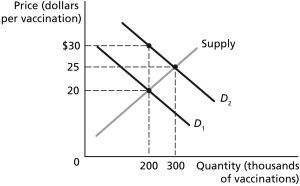 Figure 7-1 represents the market for vaccinations. Vaccinations are considered a benefit to society, and the figure shows both the marginal private benefit and the marginal social benefit from vaccinations.
-Refer to Figure 7-1. The market equilibrium price is
Figure 7-1 represents the market for vaccinations. Vaccinations are considered a benefit to society, and the figure shows both the marginal private benefit and the marginal social benefit from vaccinations.
-Refer to Figure 7-1. The market equilibrium price is (Multiple Choice)
4.9/5 (77)
(77) In the United States in 2012, a majority of people received health care through
(Multiple Choice)
4.7/5 (83)
(83) College education tends to result in a negative externality because the recipient does not receive the full benefit of the education.
(True/False)
4.8/5 (86)
(86) Since 1960, out-of-pocket spending on health care has increased sharply as a fraction of all health care spending.
(True/False)
4.8/5 (78)
(78) Figure 7-2  Figure 7-2 represents the market for vaccinations. Vaccinations are considered a benefit to society, and the figure shows both the marginal private benefit and the marginal social benefit from vaccinations.
-One effect of adverse selection in a market is that the equilibrium quantity of the product may be smaller than it would have been if there were no information problems.
Figure 7-2 represents the market for vaccinations. Vaccinations are considered a benefit to society, and the figure shows both the marginal private benefit and the marginal social benefit from vaccinations.
-One effect of adverse selection in a market is that the equilibrium quantity of the product may be smaller than it would have been if there were no information problems. (True/False)
4.8/5 (70)
(70) The Patient Protection and Affordable Care Act (ACA) is scheduled ________, at which point more than 30 million additional individuals are expected to have health care coverage.
(Multiple Choice)
4.7/5 (78)
(78) For many small firms, providing health insurance for their workers
(Multiple Choice)
4.8/5 (68)
(68) Health care is generally considered a normal good. Briefly explain what you would expect to see happen to spending on health care over time, with health care being considered as a normal good.
(Essay)
4.8/5 (86)
(86) Some economists have proposed making the tax treatment of employer-provided health insurance the same as the tax treatment of individually purchased health insurance and out-of-pocket health care spending. Such changes would make it more likely that
(Multiple Choice)
4.7/5 (75)
(75) Figure 7-1 Figure 7-1 represents the market for vaccinations. Vaccinations are considered a benefit to society, and the figure shows both the marginal private benefit and the marginal social benefit from vaccinations.
-Refer to Figure 7-1. At the market equilibrium,
Figure 7-1 represents the market for vaccinations. Vaccinations are considered a benefit to society, and the figure shows both the marginal private benefit and the marginal social benefit from vaccinations.
-Refer to Figure 7-1. At the market equilibrium, (Multiple Choice)
5.0/5 (77)
(77) Of the following high-income countries, which has the highest male life expectancy at age 65?
(Multiple Choice)
4.8/5 (71)
(71) In most circumstances, employees pay taxes on the value of health insurance their employers provide them.
(True/False)
4.8/5 (65)
(65) Health insurance typically pays for most preventive care procedures in all of the following countries except
(Multiple Choice)
4.8/5 (83)
(83) Which of the following factors help to explain the sustained increases in health care spending in the United States, and which do not?
a. the additional paperwork, duplication, and waste generated in the U.S. health care system compared to systems in other countries
b. the increasing costs of malpractice insurance and malpractice lawsuit settlements
c. the number of uninsured patients receiving hospital treatment that could have been preformed at a lower cost in doctors' offices
d. the slow growth in labor productivity in health care compared to that in the economy as a whole
e. the aging population
f. increases in the cost of providing health care
(Essay)
4.8/5 (83)
(83) Which of the following is a part of the "employer mandate" provision of the Patient Protection and Affordable Care Act (ACA)?
(Multiple Choice)
4.9/5 (81)
(81) Typically, the higher the level of income per person in a country, the higher the level of spending per person on health care. This relationship between income and spending indicates that health care is
(Multiple Choice)
4.8/5 (86)
(86) 
Filters
- Essay(0)
- Multiple Choice(0)
- Short Answer(0)
- True False(0)
- Matching(0)