



 Chat with AI
Exam 7: The Economics of Health Care

Exam 1: Economics: Foundations and Models444 Questions
Exam 2: Trade-Offs, Comparative Advantage, and the Market System498 Questions
Exam 3: Where Prices Come From: the Interaction of Demand and Supply475 Questions
Exam 4: Economic Efficiency, Government Price Setting, and Taxes419 Questions
Exam 5: Externalities, Environmental Policy, and Public Goods266 Questions
Exam 6: Elasticity: the Responsiveness of Demand and Supply295 Questions
Exam 7: The Economics of Health Care334 Questions
Exam 8: Firms, the Stock Market, and Corporate Governance278 Questions
Exam 9: Comparative Advantage and the Gains From International Trade379 Questions
Exam 10: Consumer Choice and Behavioral Economics302 Questions
Exam 11: Technology, Production, and Costs330 Questions
Exam 12: Firms in Perfectly Competitive Markets298 Questions
Exam 13: Monopolistic Competition: the Competitive Model in a More Realistic Setting276 Questions
Exam 14: Oligopoly: Firms in Less Competitive Markets262 Questions
Exam 15: Monopoly and Antitrust Policy271 Questions
Exam 16: Pricing Strategy263 Questions
Exam 17: The Markets for Labor and Other Factors of Production286 Questions
Exam 18: Public Choice, Taxes, and the Distribution of Income258 Questions
Exam 19: GDP: Measuring Total Production and Income266 Questions
Exam 20: Unemployment and Inflation292 Questions
Exam 21: Economic Growth, the Financial System, and Business Cycles257 Questions
Exam 22: Long-Run Economic Growth: Sources and Policies268 Questions
Exam 23: Aggregate Expenditure and Output in the Short Run306 Questions
Exam 24: Aggregate Demand and Aggregate Supply Analysis284 Questions
Exam 25: Money, Banks, and the Federal Reserve System280 Questions
Exam 26: Monetary Policy277 Questions
Exam 27: Fiscal Policy303 Questions
Exam 28: Inflation, Unemployment, and Federal Reserve Policy257 Questions
Exam 29: Macroeconomics in an Open Economy278 Questions
Exam 30: The International Financial System262 Questions
Select questions type


Figure 7-4  Figure 7-4 represents the market for medical services with and without insurance, and the effect of a third-party payer system on the demand for medical services.
-Refer to Figure 7-4. The efficient price of medical services is
Figure 7-4 represents the market for medical services with and without insurance, and the effect of a third-party payer system on the demand for medical services.
-Refer to Figure 7-4. The efficient price of medical services is (Multiple Choice)
4.9/5  (82)
(82) Economists John Cogan, Glenn Hubbard, and Daniel Kessler have estimated that ________ the tax preference for employer-provided health insurance would reduce spending by people enrolled in these programs by 33 percent.
(Multiple Choice)
4.7/5 (72)
(72) A majority of people in the United States do not have private health insurance.
(True/False)
4.7/5 (74)
(74) If a state requires all drivers to buy health insurance, the problem of adverse selection is eliminated.
(True/False)
4.8/5 (80)
(80) Which of the following Nobel laureates became known for the study of asymmetric information?
(Multiple Choice)
4.9/5 (66)
(66) The Congressional Budget Office estimates that the payments to settle malpractice lawsuits and the premiums doctors pay for malpractice insurance account for ________ of health care costs in the United States.
(Multiple Choice)
4.8/5 (85)
(85) What is an externality? Explain how someone receiving a meningitis vaccination is an example of an externality in the market for health care.
(Essay)
4.8/5 (79)
(79) Figure 7-5 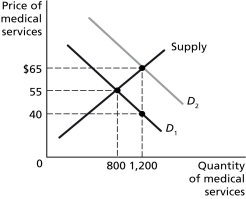 Figure 7-5 represents the market for medical services with and without insurance, and the effect of a third-party payer system on the demand for medical services.
-Refer to Figure 7-5. If consumers paid the full price of medical services, the equilibrium quantity would be
Figure 7-5 represents the market for medical services with and without insurance, and the effect of a third-party payer system on the demand for medical services.
-Refer to Figure 7-5. If consumers paid the full price of medical services, the equilibrium quantity would be (Multiple Choice)
4.8/5 (86)
(86) About ________ of pharmaceutical patents are issued to U.S. firms.
(Multiple Choice)
4.8/5 (73)
(73) Briefly describe the most important differences between the market for health care and the market for other goods and services.
(Essay)
4.9/5 (83)
(83) Most employees ________ pay taxes on the value of health insurance provided by employers, and most people ________ get a tax break when buying individual health insurance policies.
(Multiple Choice)
4.8/5 (70)
(70) A doctor pursuing his own interests rather than the interests of his patients is an example of the principal-agent problem.
(True/False)
4.9/5 (88)
(88) Figure 7-4 Figure 7-4 represents the market for medical services with and without insurance, and the effect of a third-party payer system on the demand for medical services.
-In addition to covering the costs of unpredictable events, health insurance typically covers many planned expenses, such as routine checkups, annual physicals, and the cost of vaccinations. Because of this, health insurance
Figure 7-4 represents the market for medical services with and without insurance, and the effect of a third-party payer system on the demand for medical services.
-In addition to covering the costs of unpredictable events, health insurance typically covers many planned expenses, such as routine checkups, annual physicals, and the cost of vaccinations. Because of this, health insurance (Multiple Choice)
4.9/5 (76)
(76) In the United States in 2011, over 50 percent of people without health insurance were below the age of 34.
(True/False)
4.7/5 (81)
(81) Because of asymmetric information, most used cars that are offered for sale will be sold for prices that are greater than their true value. Because of this fact, the used car market falls victim to
(Multiple Choice)
4.8/5 (87)
(87) In a market with positive externalities, the market equilibrium price will be less than the efficient equilibrium price.
(True/False)
5.0/5 (97)
(97) About ________ of research on new medicines is carried out in the United States.
(Multiple Choice)
4.7/5 (77)
(77) Figure 7-2  Figure 7-2 represents the market for vaccinations. Vaccinations are considered a benefit to society, and the figure shows both the marginal private benefit and the marginal social benefit from vaccinations.
-Refer to Figure 7-2. The market equilibrium price is
Figure 7-2 represents the market for vaccinations. Vaccinations are considered a benefit to society, and the figure shows both the marginal private benefit and the marginal social benefit from vaccinations.
-Refer to Figure 7-2. The market equilibrium price is (Multiple Choice)
4.8/5 (71)
(71) Better health allows people to work harder, which raises a country's total income. This indicates that in effect, better health
(Multiple Choice)
4.7/5 (76)
(76) The largest government-run health care system in the world, with 1.7 million employees, is in
(Multiple Choice)
4.8/5 (79)
(79) 
Filters
- Essay(0)
- Multiple Choice(0)
- Short Answer(0)
- True False(0)
- Matching(0)