



 Chat with AI
Exam 24: Multistate Corporate Taxation

Exam 1: An Introduction to Taxation and Understanding the Federal Tax Law159 Questions
Exam 2: Working With the Tax Law85 Questions
Exam 3: Computing the Tax150 Questions
Exam 4: Gross Income: Concepts and Inclusions125 Questions
Exam 5: Gross Income: Exclusions116 Questions
Exam 6: Deductions and Losses: in General153 Questions
Exam 7: Deductions and Losses: Certain Business Expenses and Losses97 Questions
Exam 8: Depreciation, Cost Recovery, Amortization, and Depletion116 Questions
Exam 9: Deductions: Employee and Self-Employed-Related Expenses166 Questions
Exam 10: Deductions and Losses: Certain Itemized Deductions106 Questions
Exam 11: Investor Losses103 Questions
Exam 12: Tax Credits and Payments109 Questions
Exam 13: Property Transactions: Determination of Gain or Loss, Basis Considerations, and Nontaxable Exchanges-Part 1200 Questions
Exam 13: Property Transactions: Determination of Gain or Loss, Basis Considerations, and Nontaxable Exchanges-Part 292 Questions
Exam 14: Property Transactions: Capital Gains and Losses, 1231, Recapture Provisions144 Questions
Exam 15: Alternative Minimum Tax125 Questions
Exam 16: Accounting Periods and Methods87 Questions
Exam 17: Corporations: Introduction and Operating Rules109 Questions
Exam 18: Corporations: Organization and Capital Structure93 Questions
Exam 19: Corporations: Distributions Not in Complete Liquidation145 Questions
Exam 20: Corporations: Distributions in Complete Liquidation and an Overview of Reorganizations70 Questions
Exam 21: Partnerships159 Questions
Exam 22: S: Corporations159 Questions
Exam 23: Exempt Entities151 Questions
Exam 24: Multistate Corporate Taxation145 Questions
Exam 25: Taxation of International Transactions148 Questions
Exam 26: Tax Practice and Ethics147 Questions
Exam 28: Income Taxation of Trusts and Estates145 Questions
Select questions type


General Corporation is taxable in a number of states. This year, General made a $100,000 sale from its A headquarters to a State B office of an agency of the U.S. government. General has not established nexus with B. State A does not apply a throwback rule. In which state(s) will the sale be included in the sales factor numerator?
(Multiple Choice)
4.9/5  (80)
(80) Helene Corporation owns manufacturing facilities in States A, B, and C. A uses a three-factor apportionment formula under which the sales, property and payroll factors are equally weighted.B uses a three-factor apportionment formula under which sales are double-weighted.C employs a single-factor apportionment factor, based solely on sales.
Helene's operations generated $1,000,000 of apportionable income, and its sales and payroll activity and average property owned in each of the three states is as follows.
 Helene's apportionable income assigned to A is:
 (Multiple Choice)
4.9/5 (81)
(81) Identify some state/local income tax issues facing pass-through entities such as S corporations, partnerships, and LLCs.
(Essay)
4.8/5 (78)
(78) Milt Corporation owns and operates two facilities that manufacture paper products.One of the facilities is located in State D, and the other is located in State
E.E does not distinguish between business and nonbusiness property.D apportions business income.Milt's activities within the two states are outlined below.
 Both D and E utilize a three-factor apportionment formula, under which sales, property, and payroll are equally weighted.Determine the amount of Milt's income that is subject to income tax by each state.
E.Milt generated $1,200,000 of taxable income, comprised of $1,000,000 of income from its manufacturing facilities and a $200,000 gain from the sale of nonbusiness property located in
Both D and E utilize a three-factor apportionment formula, under which sales, property, and payroll are equally weighted.Determine the amount of Milt's income that is subject to income tax by each state.
E.Milt generated $1,200,000 of taxable income, comprised of $1,000,000 of income from its manufacturing facilities and a $200,000 gain from the sale of nonbusiness property located in (Essay)
4.8/5 (75)
(75) Apportionment is a means by which a corporation's _________________________ income is divided among the states in which it conducts business.
(Short Answer)
4.8/5 (79)
(79) Usually a business chooses a location where it will build a new plant based chiefly on tax considerations.
(True/False)
4.8/5 (86)
(86) Parent and Junior form a non-unitary group of corporations.Parent is located in a state with an effective tax rate of 3%, while Junior's effective tax rate is 9%.Acting in concert to reduce overall tax liabilities, the group should:
(Multiple Choice)
4.8/5 (75)
(75) In most states, a limited liability company (LLC) is subject to the state income tax:
(Multiple Choice)
4.7/5 (87)
(87) In some states, an S corporation must withhold Federal income tax for its shareholders who ____________________ (are/are not) state residents.
(Short Answer)
4.9/5 (75)
(75) Discuss how a multistate business divides up its corporate taxable income among the states in which it operates. Hint: use the terms allocation and apportionment in your comments.
(Essay)
4.9/5 (89)
(89) Kim Corporation, a calendar year taxpayer, has manufacturing facilities in States A and
B.A summary of Kim's property holdings follows.
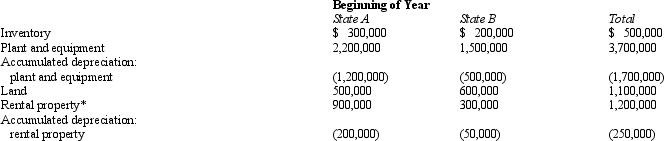
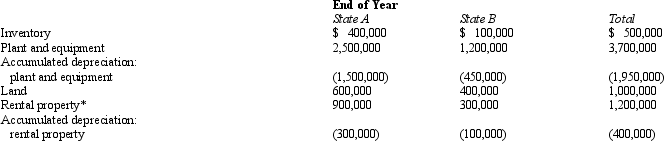 *Unrelated to Kim's regular business and operations.
Determine Kim's property factors for the two states. A's statutes provide that the average historical cost of business property is to be included in the property factor.B's statutes provide that the property factor is based on the average depreciated basis of in-state business property.
*Unrelated to Kim's regular business and operations.
Determine Kim's property factors for the two states. A's statutes provide that the average historical cost of business property is to be included in the property factor.B's statutes provide that the property factor is based on the average depreciated basis of in-state business property. (Essay)
4.9/5 (88)
(88) Under Public Law 86-272, a state is prohibited from taxing a business if the only connection with the state is the _____________________ of orders for sales of tangible personal property that are sent outside the state for approval or rejection and, if approved, are filled and shipped by the business from a point outside of the state.
(Short Answer)
5.0/5 (86)
(86) Although apportionment formulas vary among jurisdictions, most states use the same three factors in the formula.The factors are ____________________, ____________________, and ____________________.
or
or
(Essay)
4.7/5 (67)
(67) Leased property, when included in the property factor, usually is valued at ____________________ times its annual rental, even though the taxpayer does not own the asset.
or
(Short Answer)
4.7/5 (77)
(77) An ad valorem property tax is based on the asset's current ____________________.
(Short Answer)
4.7/5 (88)
(88) Typically exempt from the sales/use tax base is the purchase of lumber by a do-it-yourself homeowner, when she builds a deck onto her patio.
(True/False)
4.8/5 (84)
(84) Simpkin Corporation owns manufacturing facilities in States A, B, and C. A uses a three-factor apportionment formula under which the sales, property and payroll factors are equally weighted.B uses a three-factor apportionment formula under which sales are double-weighted.C employs a single-factor apportionment factor, based solely on sales.
Simpkin's operations generated $1,000,000 of apportionable income, and its sales and payroll activity and average property owned in each of the three states is as follows.
 Simpkin's apportionable income assigned to B is:
 (Multiple Choice)
4.8/5 (81)
(81) Node Corporation is subject to tax only in State X.Node generated the following income and deductions.State income taxes are not deductible for X income tax purposes.


(Essay)
4.9/5 (70)
(70) Most states waive the collection of sales tax on medical equipment.
(True/False)
4.9/5 (74)
(74) 
Filters
- Essay(0)
- Multiple Choice(0)
- Short Answer(0)
- True False(0)
- Matching(0)