



 Chat with AI
Exam 16: Multistate Corporate Taxation

Exam 1: Understanding and Working With the Federal Tax Law74 Questions
Exam 2: Corporations: Introduction and Operating Rules113 Questions
Exam 3: Corporations: Special Situations109 Questions
Exam 4: Corporations: Organization and Capital Structure92 Questions
Exam 5: Corporations: Earnings Profits and Dividend Distributions130 Questions
Exam 6: Corporations: Redemptions and Liquidations115 Questions
Exam 7: Corporations: Reorganizations140 Questions
Exam 8: Consolidated Tax Returns175 Questions
Exam 9: Taxation of International Transactions177 Questions
Exam 10: Partnerships: Formation, Operation, and Basis135 Questions
Exam 11: Partnerships: Distributions, Transfer of Interests, and Terminations144 Questions
Exam 12: S: Corporations158 Questions
Exam 13: Comparative Forms of Doing Business170 Questions
Exam 14: Taxes on the Financial Statements87 Questions
Exam 15: Exempt Entities185 Questions
Exam 16: Multistate Corporate Taxation187 Questions
Exam 17: Tax Practice and Ethics174 Questions
Exam 18: The Federal Gift and Estate Taxes222 Questions
Exam 19: Family Tax Planning188 Questions
Exam 20: Income Taxation of Trusts and Estates183 Questions
Select questions type


Milt Corporation owns and operates two facilities that manufacture paper products. One of the facilities is located in State D, and the other is located in State E. Milt generated $1,200,000 of taxable income, comprised of $1,000,000 of income from its manufacturing facilities and a $200,000 gain from the sale of nonbusiness property located in E. E does not distinguish between business and nonbusiness property. D apportions business income. Milt's activities within the two states are outlined below.
 Both D and E utilize a three-factor apportionment formula, under which sales, property, and payroll are equally weighted. Determine the amount of Milt's income that is subject to income tax by each state.
 (Essay)
4.8/5  (81)
(81) All of the U.S. states have adopted a tax based on the net taxable income of corporations.
(True/False)
4.8/5 (80)
(80) Valdez Corporation, a calendar-year taxpayer, owns property in States M and O. Both M and O require that the average value of assets be included in the property factor. M requires that the property be valued at its historical cost, and O requires that the property be included in the property factor at its net depreciated book value.
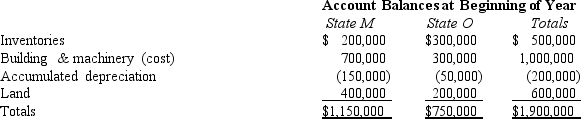
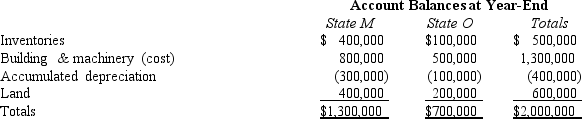 Valdez's O property factor is:

Valdez's O property factor is:
(Short Answer)
4.9/5 (86)
(86) The property factor includes business assets that the taxpayer owns, but also those merely used under a lease agreement.
(True/False)
4.8/5 (79)
(79) In conducting multistate tax planning, the taxpayer should:
(Multiple Choice)
4.9/5 (82)
(82) In computing the property factor, property owned by the corporation typically is valued at its
, but without adjusting for depreciation.
(Short Answer)
4.9/5 (75)
(75) In international taxation, we discuss income sourcing rules and the permanent establishment doctrine. In multistate taxation, an analogous term might be the "ultimate destination concept." Define this term, and identify at least two of the most important exceptions to the general rule.
(Essay)
4.9/5 (94)
(94) Although apportionment formulas vary among jurisdictions, most states use the same three factors in the formula. The factors are ____________________, ____________________, and ____________________.
(Essay)
4.9/5 (84)
(84) Parent Corporation owns all of the stock of Junior Corporation, a Delaware passive investment company. Parent operates strictly in nonunitary State B, which levies a 9% income tax. This year, Junior earned $200,000 of portfolio interest income and paid a $150,000 dividend to Parent. In which state(s) will the interest income create an income tax liability?
(Multiple Choice)
4.9/5 (93)
(93) A typical U.S. state piggybacks its collections of the corporate income tax, by letting the Federal government collect and remit the corresponding tax to the state.
(True/False)
4.9/5 (75)
(75) An assembly worker earns a $50,000 salary and receives a fringe benefit package worth $15,000. The payroll factor assigns $65,000 for this employee.
(True/False)
5.0/5 (76)
(76) Anders, a local business, wants your help in making a decision about a large capital investment. To assist your client, list several tax and non-tax implications of the decision.
(Essay)
4.8/5 (76)
(76) Typically, corporate income taxes constitute about 20 percent of a state's annual tax collections.
(True/False)
5.0/5 (68)
(68) In determining taxable income for state income tax purposes, interest income from Federal bonds typically constitutes a(n) modification.
(Short Answer)
4.9/5 (79)
(79) The tax usually is applied at the city or county level, as its main source of revenue.
(Short Answer)
4.8/5 (88)
(88) Flint Corporation is subject to a corporate income tax only in State X. The starting point in computing X taxable income is Federal taxable income. Flint's Federal taxable income is $750,000, which includes a $50,000 deduction for state income taxes. During the year, Flint received $10,000 interest on Federal obligations. X tax law does not allow a deduction for state income tax payments. Flint's taxable income for X purposes is:
(Multiple Choice)
4.8/5 (75)
(75) If a gift card is unused after a specified period of time, the state can collect the amount of the card proceeds from the seller, as ____________________ property.
(Short Answer)
4.9/5 (76)
(76) Helene Corporation owns manufacturing facilities in States A, B, and C. A uses a three-factor apportionment formula under which the sales, property and payroll factors are equally weighted. B uses a three-factor apportionment formula under which sales are double-weighted. C employs a single-factor apportionment factor, based solely on sales. Helene's operations generated $1,000,000 of apportionable income, and its sales and payroll activity and average property owned in each of the three states is as follows.
 Helene's apportionable income assigned to A is:
 (Multiple Choice)
4.8/5 (81)
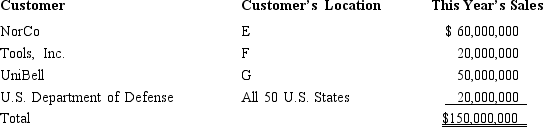
(81) Mercy Corporation, headquartered in State F, sells wireless computer devices, including keyboards and bar code readers. Mercy's degree of operations is sufficient to establish nexus only in States E and F. Determine its sales factor in those states.
State E applies a throwback rule to sales, while State F does not. State G has not adopted an income tax to date. Mercy reported the following sales for the year. All of the goods were shipped from Mercy's F manufacturing facilities.
(Essay)
4.9/5 (88)
(88) Match each of the following events, considered independently, to its likely effect on WillCo's various apportionment factors. WillCo is based in Q and has customers in Q, R, and S. To this point, WillCo has not established nexus with S. More than one choice may be correct.
a. No change in apportionment factors
b. Q apportionment factor increases
c. Q apportionment factor decreases
d. R apportionment factor increases
e. R apportionment factor decreases
f. S apportionment factor increases
g. S apportionment factor decreases
-WillCo completes the construction of production facilities in S.
(Short Answer)
4.7/5 (79)
(79) 
Filters
- Essay(0)
- Multiple Choice(0)
- Short Answer(0)
- True False(0)
- Matching(0)